
Pulp Fiction, 1928 · page 142 of 148
Argosy All-Story Weekly, April 28, 1928 — page 142: what you’re looking at
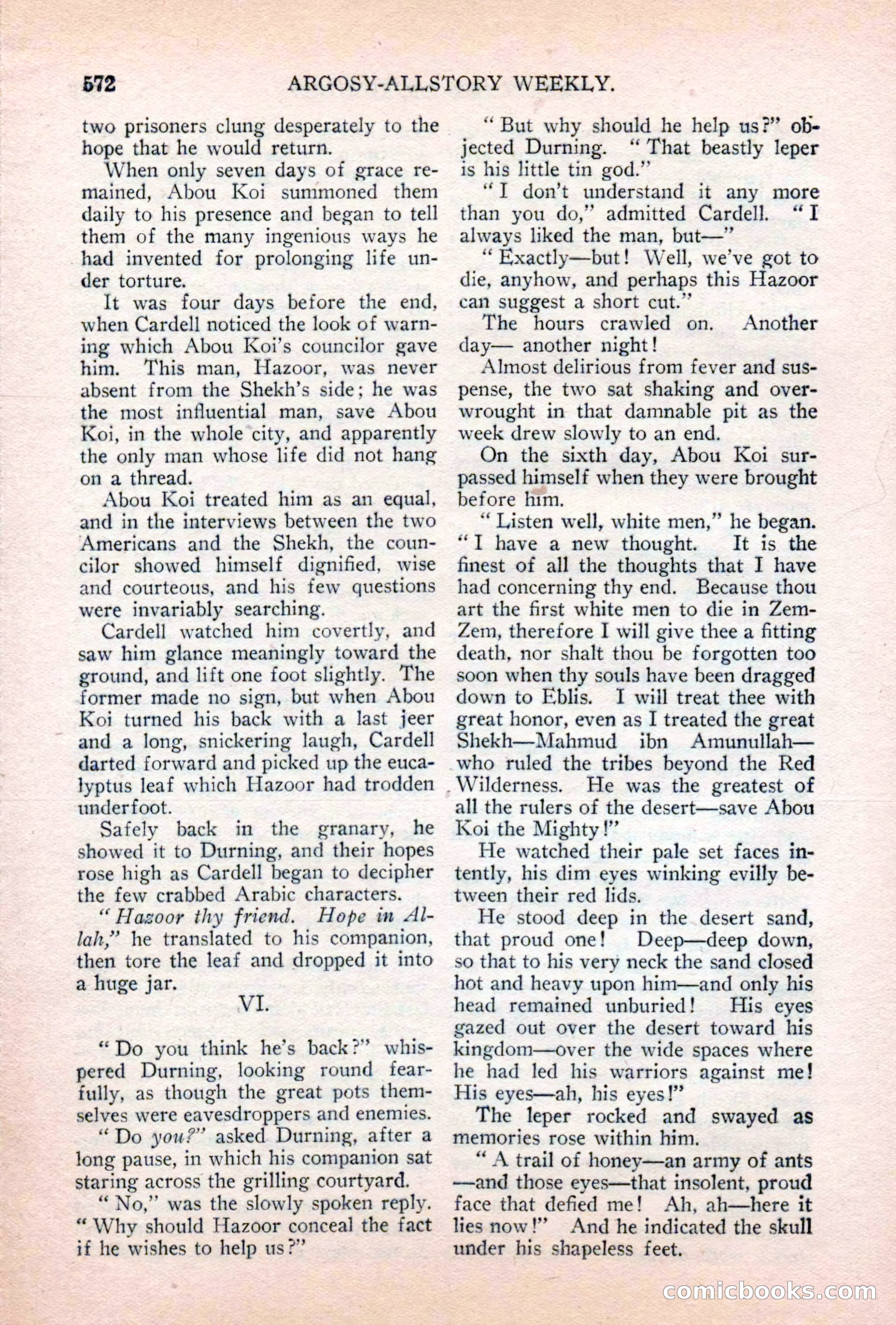
A restored page from Pulp Fiction, 1928. Page through the whole issue in the reader above.
📄 Transcribed text from this page (OCR, searchable)
Machine-transcribed from the original scan — historical spelling and the odd misread are preserved.
572 two prisoners clung desperately to the hope that he would return. When only seven days of grace re- mained, Abou Koi summoned them daily to his presence and began to tell them of the many ingenious ways he had invented for prolonging life un- der torture. It was four days before the end, when Cardell noticed the look of warn- ing which Abou Koi’s councilor gave him. ‘This man, Hazoor, was never absent from the Shekh’s side; he was the most influential man, save Abou Koi, in the whole city, and apparently the only man whose life did not hang on a thread. Abou Koi treated him as an equal, and in the interviews between the two Americans and the Shekh, the coun- cilor showed himself dignified, wise and courteous, and his few questions were invariably searching. Cardell watched him covertly, and saw him glance meaningly toward the ground, and lift one foot slightly. The former made no sign, but when Abou Koi turned his back with a last jeer and a long, snickering laugh, Cardell darted forward and picked up the euca- lyptus leaf which Hazoor had trodden underfoot. Safely back in the granary, he showed it to Durning, and their hopes rose high as Cardell began to decipher the few crabbed Arabic characters. “ Hazoor thy friend. Hope in Al- lah,’ he translated to his companion, then tore the leaf and dropped it into a huge jar. VI. “Do you think he’s back?” whis- pered Durning, looking round fear- fully, as though the great pots them- selves were eavesdroppers and enemies. “Do you?” asked Durning, after a long pause, in which his companion sat staring across the grilling courtyard. “No,” was the slowly spoken reply. “ Why should Hazoor conceal the fact if he wishes to help us?” _ Wilderness. ARGOSY-ALLSTORY WEEKLY. “But why should he help us?” ob- jected Durning. ‘ That beastly leper is his little tin god.” “J don’t understand it any more than you do,” admitted Cardell. “I always liked the man, but—’” ‘““Exactly—but! Well, we’ve got to die, anyhow, and perhaps this Hazoor can suggest a short cut.” The hours crawled on. day— another night! Almost delirious from fever and sus- pense, the two sat shaking and over- wrought in that damnable pit as the week drew slowly to an end. On the sixth day, Abou Koi sur- passed himself when they were brought before him. “Listen well, white men,” he began. “IT have a new thought. It is the finest of all the thoughts that I have had concerning thy end. Because thou art the first white men to die in Zem- Zem, therefore I will give thee a fitting death, nor shalt thou be forgotten too soon when thy souls have been dragged down to Eblis. I wiil treat thee with great honor, even as I treated the great Shekh—Mahmud ibn Amunullah— who ruled the tribes beyond the Red He was the greatest of all the rulers of the desert—save Abou Koi the Mighty!’ He watched their pale set faces in- tently, his dim eyes winking evilly be- tween their red lids. He stood deep in the desert sand, that proud one! Deep—deep down, so that to his very neck the sand closed hot and heavy upon him—and only his head remained unburied! His eyes gazed out over the desert toward his kingdom—over the wide spaces where he had led his warriors against me! His eyes—ah, his eyes!” The leper rocked and swayed as memories rose within him. “A trail of honey—an army of ants —and those eyes—that insolent, proud face that defied me! Ah, ah—here it lies now!” And he indicated the skull under his shapeless feet. Another COPMICOOOKS (C©@)