
Pulp Fiction, 1928 · page 15 of 148
Argosy All-Story Weekly, April 28, 1928 — page 15: what you’re looking at
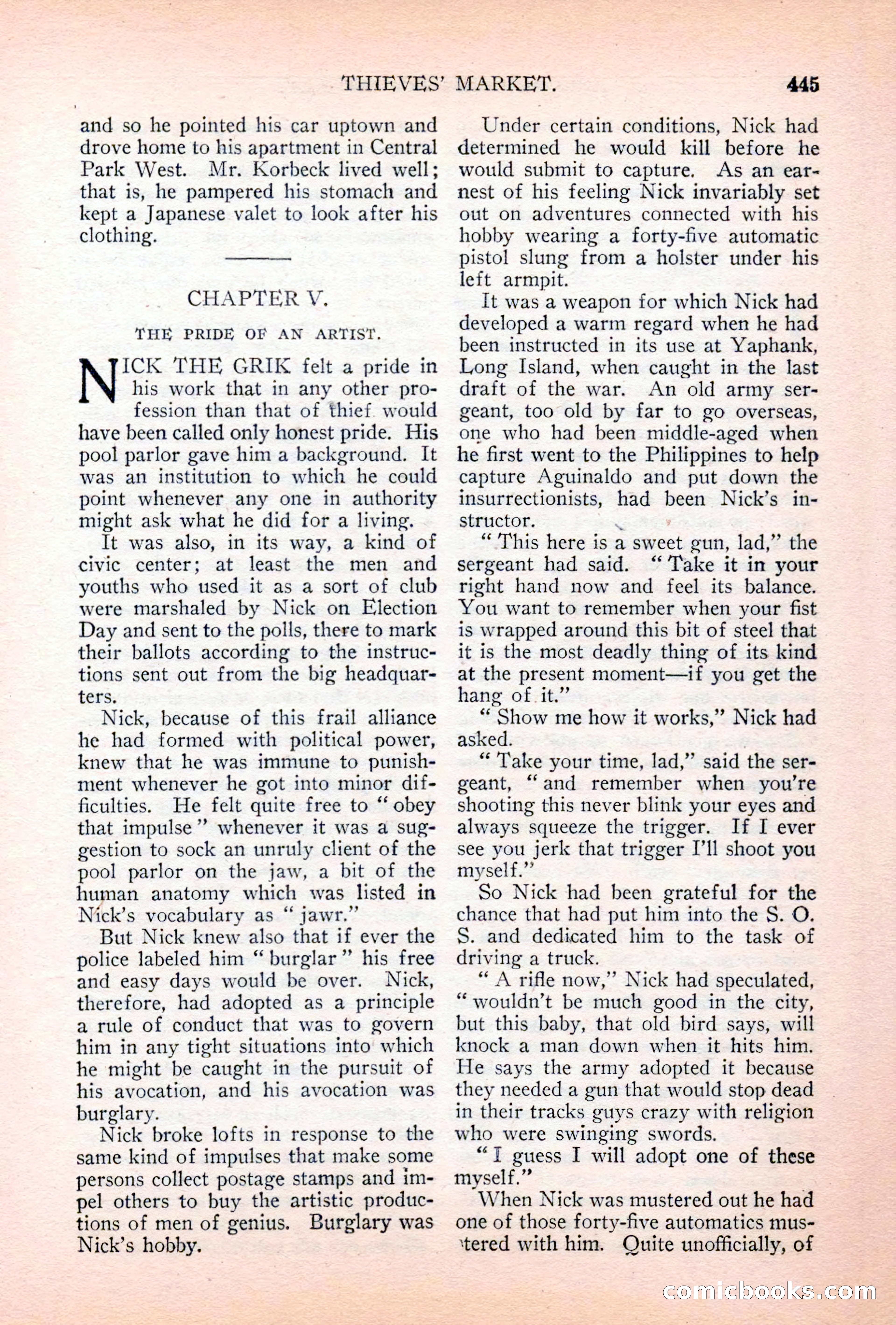
A restored page from Pulp Fiction, 1928. Page through the whole issue in the reader above.
📄 Transcribed text from this page (OCR, searchable)
Machine-transcribed from the original scan — historical spelling and the odd misread are preserved.
THIEVES’ MARKET. and so he pointed his car uptown and drove home to his apartment in Central Park West. Mr. Korbeck lived well; that is, he pampered his stomach and kept a Japanese valet to look after his clothing. THE PRIDE OF AN ARTIST. ICK THE GRIK felt a pride in his work that in any other pro- fession than that of thief. would have been called only honest pride. His pool parlor gave him a background. It was an institution to which he could point whenever any one in authority might ask what he did for a living. It was also, in its way, a kind of civic center; at least the men and youths who used it as a sort of club were marshaled by Nick on Election Day and sent to the polls, there to mark their ballots according to the instruc- tions sent out from the big headquar- ters. Nick, because of this frail alliance he had formed with political power, knew that he was immune to punish- ment whenever he got into minor dif- ficulties. He felt quite free to “‘ obey that impulse’ whenever it was a sug- gestion to sock an unruly client of the pool parlor on the jaw, a bit of the human anatomy which was listed in Nick’s vocabulary as “ jawr.”’ But Nick knew also that if ever the police labeled him “burglar” his free and easy days would be over. Nick, therefore, had adopted as a principle a rule of conduct that was to govern him in any tight situations into which he might be caught in the pursuit of his avocation, and his avocation was burglary. Nick broke lofts in response to the same kind of impulses that make some persons collect postage stamps and im- pel others to buy the artistic produc- tions of men of genius. Burglary was Nick’s hobby. 445 Under certain conditions, Nick had determined he would kill before he would submit to capture. As an ear- nest of his feeling Nick invariably set out on adventures connected with his hobby wearing a forty-five automatic pistol slung from a holster under his left armpit. It was a weapon for which Nick had developed a warm regard when he had been instructed in its use at Yaphank, Long Island, when caught in the last draft of the war. An old army ser- geant, too old by far to go overseas, one who had been middle-aged when he first went to the Philippines to help capture Aguinaldo and put down the insurrectionists, had been Nick’s in- structor. < ; “This here is a sweet gun, lad,’ the sergeant had said. “ Take it in your right hand now and feel its balance. You want to remember when your fist is wrapped around this bit of steel that it is the most deadly thing of its kind at the present moment—if you get the hang of. it.” *“* Show me how it works,” Nick had asked. “Take your time, lad,’ said the ser- geant, “and remember when you're shooting this never blink your eyes and always squeeze the trigger. If I ever see you jerk that trigger P’ll shoot you myself.” So Nick had been grateful for the chance that had put him into the S. O. S. and dedicated him to the task of driving a truck. “ A rifle now,” Nick had speculated, “wouldn’t be much good in the city, but this baby, that old bird says, will knock a man down when it hits him. He says the army adopted it because they needed a gun that would stop dead in their tracks guys crazy with religion who were swinging swords. “J guess I will adopt one of these myself.” When Nick was mustered out he had one of those forty-five automatics mus- ‘tered with him. Quite unofficially, of CORMICLOOKS (E@)