
Pulp Fiction, 1928 · page 17 of 148
Argosy All-Story Weekly, April 28, 1928 — page 17: what you’re looking at
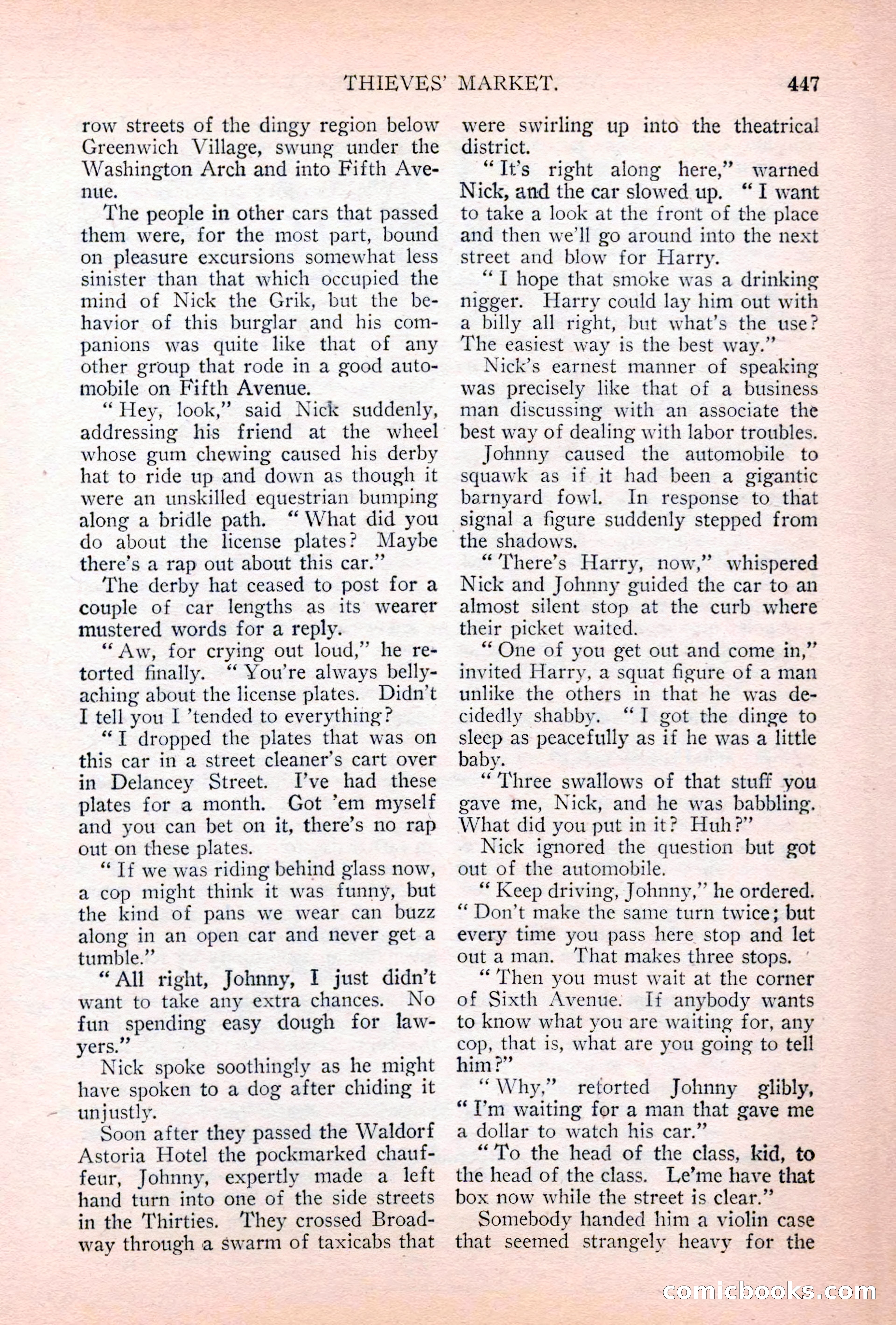
A restored page from Pulp Fiction, 1928. Page through the whole issue in the reader above.
📄 Transcribed text from this page (OCR, searchable)
Machine-transcribed from the original scan — historical spelling and the odd misread are preserved.
THIEVES’ row streets of the dingy region below Greenwich Village, swung under the Washington Arch and into Fifth Ave- nue. The people in other cars that passed them were, for the most part, bound on pleasure excursions somewhat less sinister than that which occupied the mind of Nick the Grik, but the be- havior of this burglar and his com- panions was quite like that of any other group that rode in a good auto- mobile on Fifth Avenue. “Hey, look,” said Nick suddenly, addressing his friend at the wheel whose gum chewing caused his derby hat to ride up and down as though it were an unskilled equestrian bumping along a bridle path. “ What did you do about the license plates? Maybe there’s a rap out about this car.” The derby hat ceased to post for a couple of car lengths as its wearer mustered words for a reply. “ Aw, for crying out loud,” he re- torted finally. “ You’re always belly- aching about the license plates. Didn't I tell you I ’tended to everything? “I dropped the plates that was on this car in a street cleaner’s cart over in Delancey Street. I’ve had these plates for a month. Got ’em myself and you can bet on it, there’s no rap out on these plates. “Tf we was riding behind glass now, a cop might think it was funny, but the kind of pans we wear can buzz along in an open car and never get a tumble.” “All right, Johnny, I just didn’t want to take any extra chances. No fun spending easy dough for law- yers.”’ : Nick spoke soothingly as he might have spoken to a dog after chiding it unjustly. Soon after they passed the Waldorf Astoria Hotel the pockmarked chauf- feur, Johnny, expertly made a left hand turn into one of the side streets in the Thirties. ‘They crossed Broad- way through a swarm of taxicabs that MARKET. 447 were swirling up into the theatrical district. “It's right along here,” warned Nick, and the car slowed up. “I want to take a look at the front of the place and then we'll go around into the next street and blow for Harry. “T hope that smoke was a drinking nigger. Harry could lay him out with a billy all right, but what’s the use? The easiest way is the best way.” Nick’s earnest manner of speaking was precisely like that of a business man discussing with an associate the best way of dealing with labor troubles. Johnny caused the automobile to squawk as if it had been a gigantic barnyard fowl. In response to that signal a figure suddenly stepped from the shadows. “There’s Harry, now,” whispered Nick and Johnny guided the car to an almost silent stop at the curb where their picket waited. “One of you get out and come in,” invited Harry, a squat figure of a man unlike the others in that he was de- cidedly shabby. “I got the dinge to sleep as peacefully as if he was a little baby. “Three swallows of that stuff you gave me, Nick, and he was babbling. What did you put in it? Huhe” Nick ignored the question but got out of the automobile. “ Keep driving, Johnny,” he ordered. “ Don’t make the same turn twice; but every time you pass here stop and let out aman. ‘That makes three stops. ° “Then you must wait at the corner of Sixth Avenue. If anybody wants to know what you are waiting for, any cop, that is, what are you going to tell him?” “Why,” retorted Johnny glibly, “Tm waiting for a man that gave me a dollar to watch his car.” “To the head of the class, kid, to the head of the class. Le’me have that box now while the street is clear.” Somebody handed him a violin case that seemed strangely heavy for the b COPMICLOOOKS G (E@)