
Pulp Fiction, 1928 · page 47 of 148
Argosy All-Story Weekly, April 28, 1928 — page 47: what you’re looking at
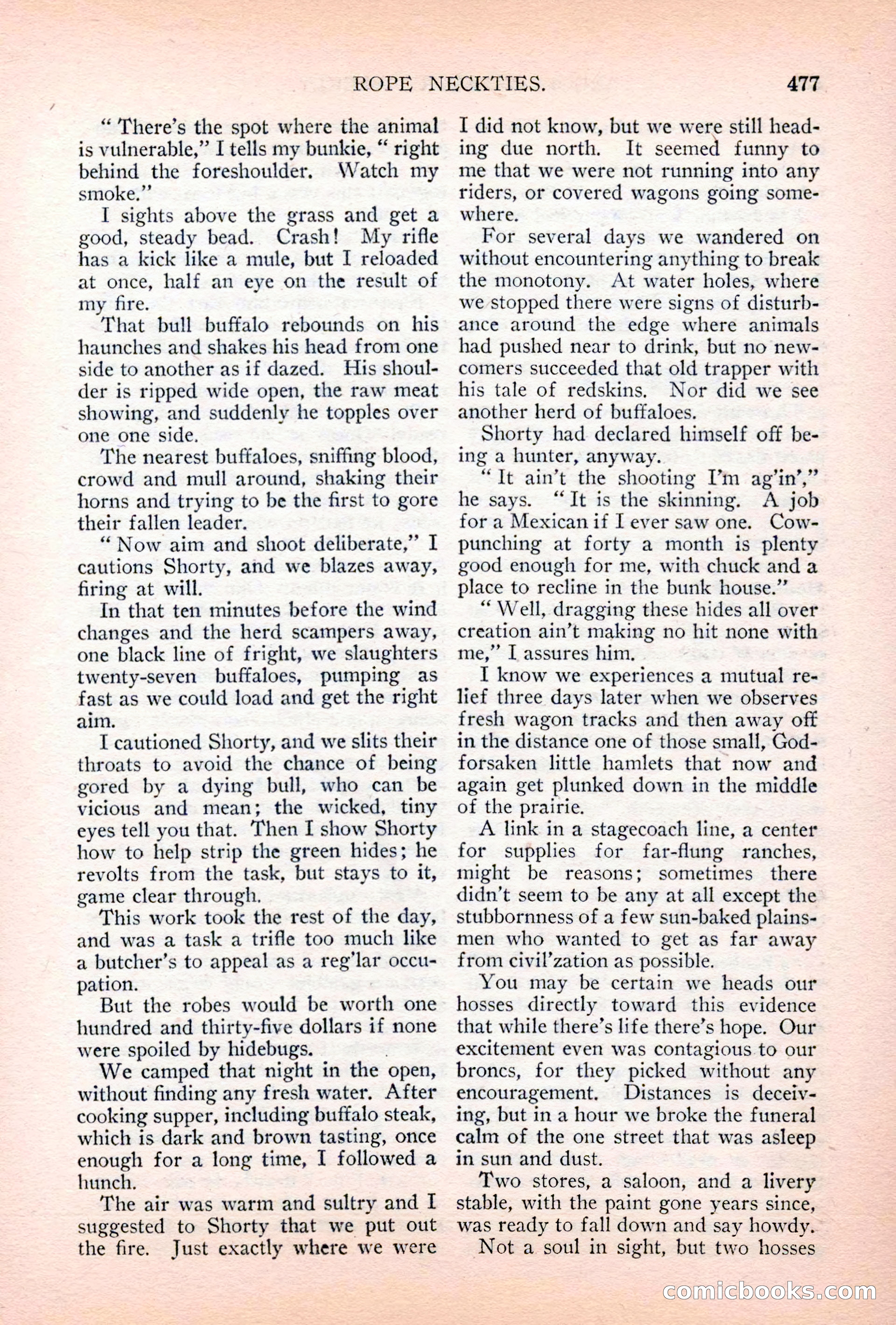
A restored page from Pulp Fiction, 1928. Page through the whole issue in the reader above.
📄 Transcribed text from this page (OCR, searchable)
Machine-transcribed from the original scan — historical spelling and the odd misread are preserved.
ROPE NECKTIES. “ There’s the spot where the animal is vulnerable,” I tells my bunkie, “ right behind the foreshoulder. Watch my smoke,” I sights above the grass and get a good, steady bead. Crash! My rifle has a kick like a mule, but I reloaded at once, half an eye on the result of my fire. That bull buffalo rebounds on his haunches and shakes his head from one side to another as if dazed. His shoul- der is ripped wide open, the raw meat showing, and suddenly he topples over one one side. The nearest buffaloes, sniffing blood, crowd and mull around, shaking their horns and trying to be the first to gore their fallen leader. “ Now aim and shoot deliberate,” I cautions Shorty, and we blazes away, firing at will. In that ten minutes before the wind changes and the herd scampers away, one black line of fright, we slaughters twenty-seven buffaloes, pumping as fast as we could load and get the right aim. I cautioned Shorty, and we slits their throats to avoid the chance of being gored by a dying bull, who can be vicious and mean; the wicked, tiny eyes tell you that. Then I show Shorty how to help strip the green hides; he revolts from the task, but stays to it, game clear through. This work took the rest of the day, and was a task a trifle too much like a butcher’s to appeal as a reg’lar occu- pation. But the robes would be worth one hundred and thirty-five dollars if none were spoiled by hidebugs. 7 We camped that night in the open, without finding any fresh water. After cooking supper, including buffalo steak, which is dark and brown tasting, once enough for a long time, I followed a hunch. The air was warm and sultry and I suggested to Shorty that we put out the fire. Just exactly where we were ATT I did not know, but we were still head- ing due north. It seemed funny to me that we were not running into any riders, or covered wagons going some- where. For several days we wandered on without encountering anything to break the monotony. At water holes, where we stopped there were signs of disturb- ance around the edge where animals had pushed near to drink, but no new- comers succeeded that old trapper with his tale of redskins. Nor did we see another herd of buffaloes. Shorty had declared himself off be- ing a hunter, anyway. “Tt ain’t the shooting ’m ag’in’,” he says. “It is the skinning. A job fora Mexicanif Lever saw one. Cow- punching at forty a month is plenty good enough for me, with chuck and a place to recline in the bunk house.” “Well, dragging these hides all over creation ain’t making no hit none with me,” I assures him, I know we experiences a mutual re- lief three days later when we observes fresh wagon tracks and then away off in the distance one of those small, God- forsaken little hamlets that now and again get plunked down in the middle of the prairie. A link in a stagecoach line, a center for supplies for far-flung ranches, might be reasons; sometimes there didn’t seem to be any at all except the stubbornness of a few sun-baked plains- men who wanted to get as far away from civil’zation as possible. You may be certain we heads our hosses directly toward this evidence that while there’s life there’s hope. Our excitement even was contagious to our broncs, for they picked without any encouragement. Distances is deceiv- ing, but in a hour we broke the funeral calm of the one street that was asleep in sun and dust. Two stores, a saloon, and a livery stable, with the paint gone years since, was ready to fall down and say howdy. Not a soul in sight, but two hosses COPMICLOOOKS (C@