
Pulp Fiction, 1928 · page 56 of 148
Argosy All-Story Weekly, April 28, 1928 — page 56: what you’re looking at
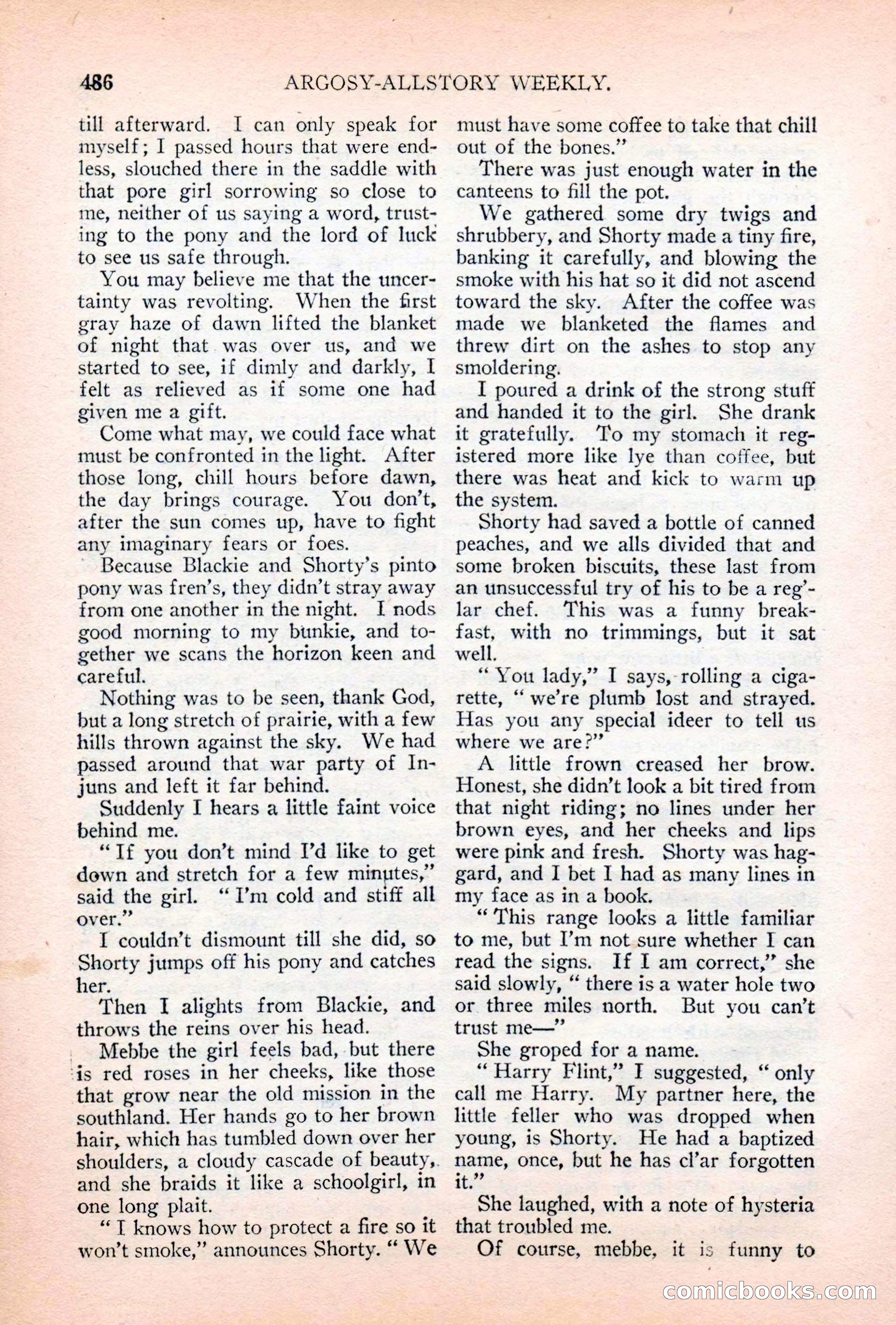
A restored page from Pulp Fiction, 1928. Page through the whole issue in the reader above.
📄 Transcribed text from this page (OCR, searchable)
Machine-transcribed from the original scan — historical spelling and the odd misread are preserved.
486 till afterward. I can only speak for myself; I passed hours that were end- less, slouched there in the saddle with that pore girl sorrowing so close to me, neither of us saying a word, trust- ing to the pony and the lord of luck to see us safe through. You may believe me that the uncer- tainty was revolting. When the first gray haze of dawn lifted the blanket of night that was over us, and we started to see, if dimly and darkly, I felt as relieved as if some one had given me a gift. Come what may, we could face what must be confronted in the light. After those long, chill hours before dawn, the day brings courage. You don’t, after the sun comes up, have to fight any imaginary fears or foes. Because Blackie and Shorty’s pinto pony was fren’s, they didn’t stray away from one another in the night. I nods good morning to my bunkie, and to- gether we scans the horizon keen and careful. Nothing was to be seen, thank God, but a long stretch of prairie, with a few hills thrown against the sky. We had passed around that war party of In- juns and left it far behind. Suddenly I hears a little faint voice behind me. “Tf you don’t mind I’d like to get dewn and stretch for a few minutes,” said the girl. ‘“ I’m cold and stiff all over.” I couldn’t dismount till she did, so Shorty jumps off his pony and catches her. Then I alights from Blackie, and throws the reins over his head. _ Mebbe the girl feels bad, but there is red roses in her cheeks, like those that grow near the old mission in the southland. Her hands go to her brown hair, which has tumbled down over her shoulders, a cloudy cascade of beauty,. and she braids it like a schoolgirl, in one long plait. “T knows how to protect a fire so it won’t smoke,” announces Shorty. “ We ARGOSY-ALLSTORY WEEKLY. must have some coffee to take that chill out of the bones.” There was just enough water in the canteens to fill the pot. We gathered some dry twigs and shrubbery, and Shorty made a tiny fire, banking it carefully, and blowing the smoke with his hat so it did not ascend toward the sky. After the coffee was made we blanketed the flames and threw dirt on the ashes to stop any smoldering. I poured a drink of the strong stuff and handed it to the girl. She drank it gratefully. To my stomach it reg- istered more like lye than coffee, but there was heat and kick to warm up the system. Shorty had saved a bottle of canned peaches, and we alls divided that and some broken biscuits, these last from an unsuccessful try of his to be a reg’- lar chef. This was a funny break- fast, with no trimmings, but it sat well. “You lady,” I says, rolling a ciga- rette, “we're plumb lost and strayed. Has you any special ideer to tell us where we are?” A little frown creased her brow. Honest, she didn’t look a bit tired from that night riding; no lines under her brown eyes, and her cheeks and lips were pink and fresh. Shorty was hag- gard, and I bet I had as many lines in my face as in a book. “This range looks a little familiar to me, but I’m not sure whether I can read the signs. If I am correct,” she said slowly, “ there is a water hole two or three miles north. But you can’t trust me—” She groped for a name. “Harry Flint,” I suggested, “ only call me Harry. My partner here, the little feller who was dropped when young, is Shorty. He had a baptized name, once, but he has cl’ar forgotten it.’ She laughed, with a note of hysteria that troubled me. Of course, mebbe, it is funny to (EO) OOOKS ANIC (E@