
Pulp Fiction, 1928 · page 7 of 148
Argosy All-Story Weekly, April 28, 1928 — page 7: what you’re looking at
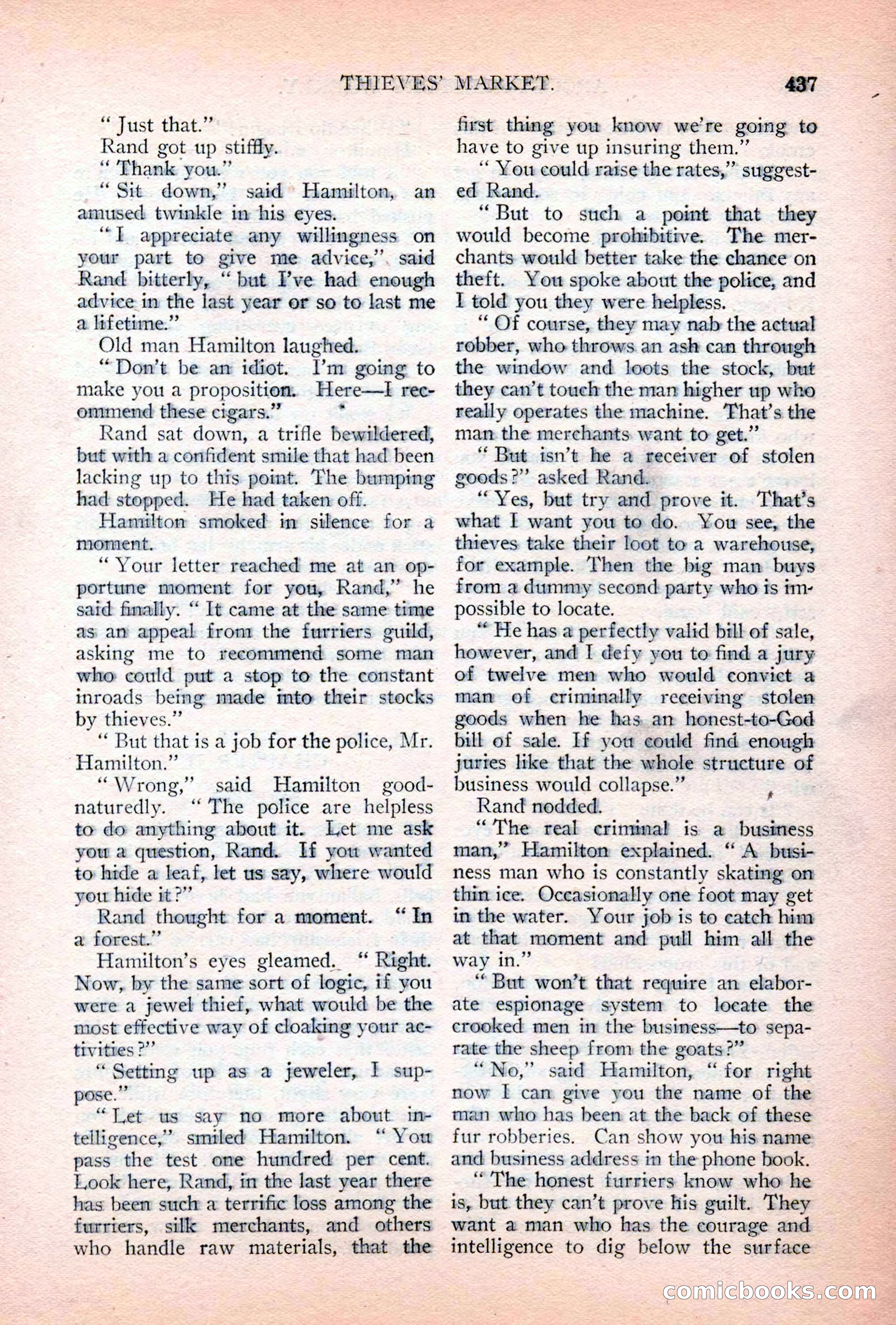
A restored page from Pulp Fiction, 1928. Page through the whole issue in the reader above.
📄 Transcribed text from this page (OCR, searchable)
Machine-transcribed from the original scan — historical spelling and the odd misread are preserved.
THIEVES’ MARKET. “Just that.” Rand got up stiffly. “Thank you.” “Sit down,’ said Hamilton, amused twinkle im his eyes. ‘I appreciate any willingness on your part to give me advice,’’. said Rand bitterly, “but Pve had enough advice in the last year or so to last me a lefetime.”’ Old man Hamilton laughed. “Don’t be an idiot. I’m going to make you a propositiom. Here—I rec- ommend these cigars.” is Rand sat down, a trifle bewildered, but with a confident smile that had been lacking up to this pomt. The bumping had stopped. He had taken off. Hanulton smoked im silence for a moment. “Your letter reached me at an op- portune moment for you, Rand,” he said finally. “ It came at the same time asi am appeal fron: the furriers guild, asking me to recommend some man who could put a stop to the constant inroads being made mto their stocks by thieves.” ‘“ But that is a job for the police, Mr. Hamilton.” “Wrong,” said Hamilton good- naturedly. ‘‘ The police are helpless to do anything about it. Let me ask you a question, Rand. If you wanted to hide a leaf, let us say, where would you hide it?” Rand thought for a moment. “In a forest.”’ Hamilton’s eyes gleamed. “ Right. Now, by the same sort of logic, if you were a jewel thief, what would be the most effective way of cloaking your ac- tivities ?”’ “ Setting up as a jeweler, I sup- pose.” “Let us say no more about in- telligence,” smiled Hamilton. “ You pass the test ome hundred per cent. Look here, Rand, in the last year there has beem such a terrific loss among the furriers, silk merchants, and others who handle raw materials, that the an 437 first thing you know we're going to have to give up insuring them.” ‘ You could raise the rates,” suggest- ed Rand. “But to such a point that they would become prohibitive. The mer- chants would better take the chance on theft. You spoke about the police, and I told you they were helpless. “ Of course, they may nab the actual robber, who throws. an ash can through the window and loots the stock, but they can’t touch the man higher up who really operates the machine. ‘That’s the man the merchants. want to get.” But isn’t he a receiver of stolen goods?” asked Rand. “Yes, but try and prove it. That's what I want you to do. You see, the thieves take their loot to a warehouse, for example. Then the big man buys from a dummy second party who is im- possible to locate. “He has a perfectly valid bill of sale, however, and | defy you to find a jury of twelve mem who would convict a mam of criminally receiving stolen goods when he has, an honest-to-God bill of sale. [If you could find enough jurtes like that the whole structure of business would collapse.” Rand nodded. “The real criminal is a business man,” Hamilton explained. “ A busi- ness man who is constantly skating on thin ice. Occasionally one foot may get in the water. Your job is to catch him at that moment and pull him all the Way in.” “But won’t that require an elabor- ate espionage system: to locate the crooked men in the business—to sepa- rate the sheep from the goats?” “No,” satd Hamilton, “for right now [ can give you the name of the man who has been at the back of these fur robberies. Can show you his name and busimess address in the phone book. “The honest furrters know who he is, but they can’t prove his guilt. They want a man who has the courage and intelligence to dig below the surface = DOOKS COM com)