
Pulp Fiction, 1928 · page 78 of 148
Argosy All-Story Weekly, April 28, 1928 — page 78: what you’re looking at
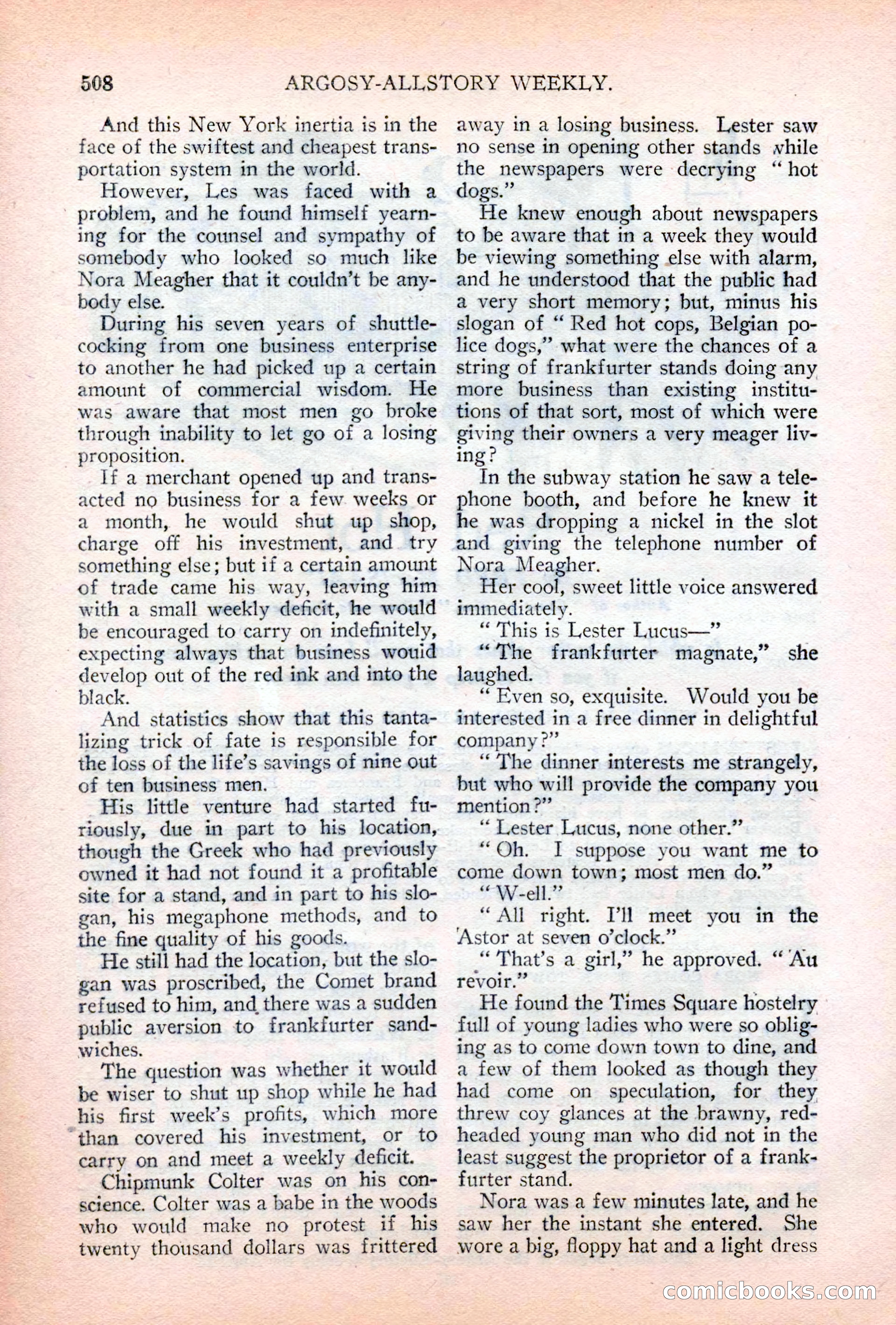
A restored page from Pulp Fiction, 1928. Page through the whole issue in the reader above.
📄 Transcribed text from this page (OCR, searchable)
Machine-transcribed from the original scan — historical spelling and the odd misread are preserved.
008 And this New York inertia is in the face of the swiftest and cheapest trans- portation system in the world. However, Les was faced with a problem, and he found himself yearn- ing for the counsel and sympathy of somebody who looked so much like Nora Meagher that it couldn’t be any- body else. During his seven years of shuttle- cocking from one business enterprise to another he had picked up a certain amount of commercial wisdom. He was aware that most men go broke through inability to let go of a losing proposition. If a merchant opened up and trans- acted no business for a few weeks or a month, he would shut up shop, charge off his investment, and. try something else; but if a certain amount of trade came his way, leaving him with a small weekly deficit, he would be encouraged to carry on indefinitely, expecting always that business wouid develop out of the red ink and into the black. And statistics show that this tanta- lizing trick of fate is responsible for the loss of the life’s savings of nine out of ten business men. His little venture had started fu- riously, due in part to his location, though the Greek who had previously owned it had not found it a profitable site for a stand, and in part to his slo- gan, his megaphone methods, and to the fine quality of his goods. He still had the location, but the slo- gan was proscribed, the Comet brand refused to him, and there was a sudden public aversion to frankfurter sand- wiches. The question was whether it would be wiser to shut up shop while he had his first week’s profits, which more “than covered his investment, or to carry on and meet a weekly deficit. Chipmunk Colter was on his con- science. Colter was a babe in the woods who would make no protest if his twenty thousand dollars was frittered ARGOSY-ALLSTORY WEEKLY. away in a losing business. Lester saw no sense in opening other stands while the newspapers were decrying “ hot dogs.” He knew enough about newspapers to be aware that in a week they would be viewing something else with alarm, and he understood that the public had a very short memory; but, minus his slogan of “ Red hot cops, Belgian po- lice dogs,” what were the chances of a string of frankfurter stands doing any more business than existing institu- tions of that sort, most of which were giving their owners a very meager liv- ing? In the subway station he saw a tele- phone booth, and before he knew it he was dropping a nickel in the slot and giving the telephone number of Nora Meagher. Her cool, sweet little voice answered immediately. “ This is Lester Lucus—” “The frankfurter magnate,” she laughed. “Even so, exquisite. Would you be interested in a free dinner in delightful company ?” ‘The dinner interests me strangely, but who will provide the company you mention?” ; “ Lester Lucus, none other.” “Oh. J suppose you want me to come down town; most men do.” “W-ell.” “All right. Dll meet you in the ‘Astor at seven o’clock.” “’That’s a girl,” he approved. “Au revoir.” | He found the Times Square hostelry full of young ladies who were so oblig- ing as to come down town to dine, and a few of them looked as though they had come on speculation, for they threw coy glances at the brawny, red- headed young man who did not in the least suggest the proprietor of a frank- furter stand. Nora was a few minutes late, and he saw her the instant she entered. She wore a big, floppy hat and a light dress eGo VOOKS mie (C@