
Pulp Fiction, 1928 · page 83 of 148
Argosy All-Story Weekly, April 28, 1928 — page 83: what you’re looking at
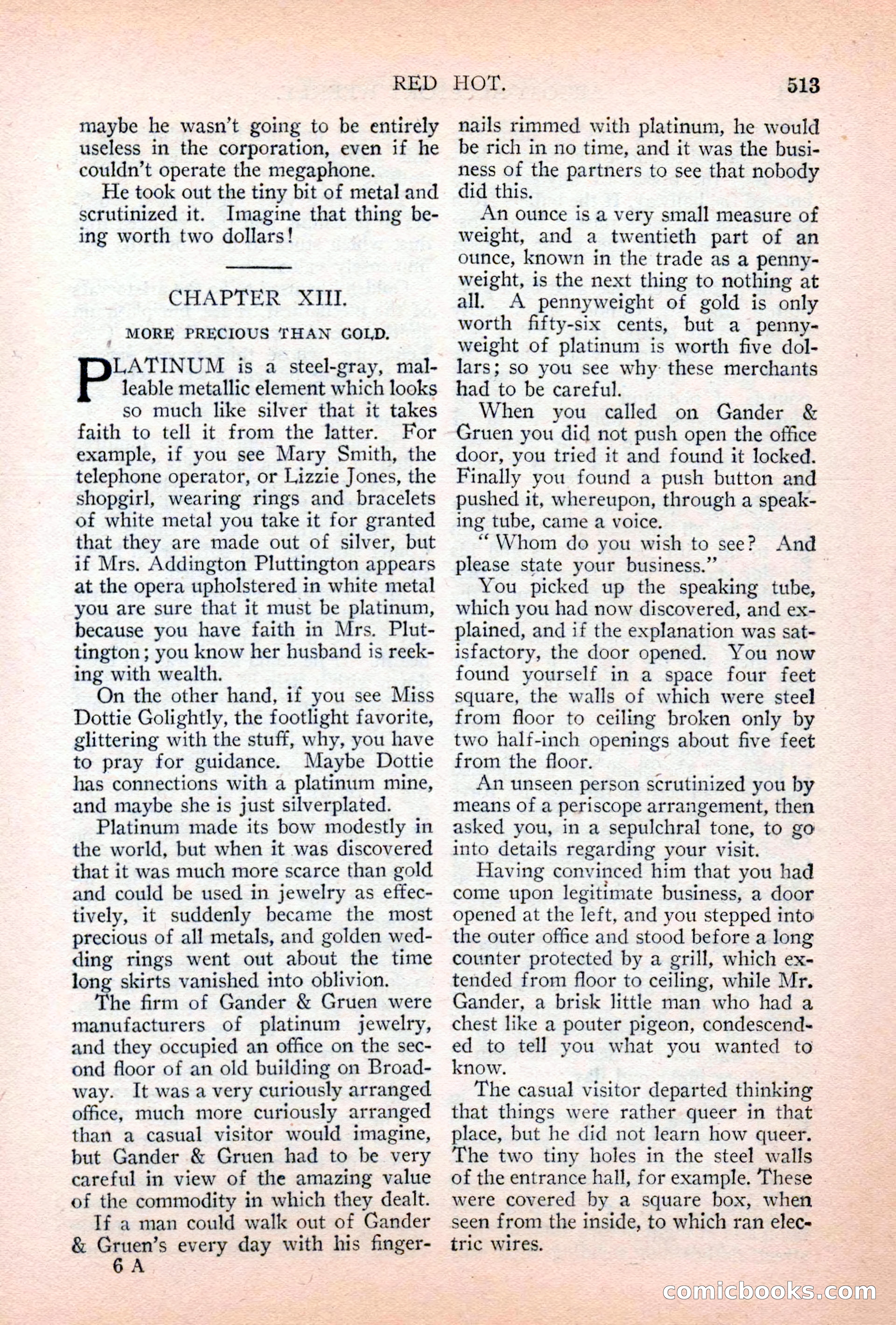
A restored page from Pulp Fiction, 1928. Page through the whole issue in the reader above.
📄 Transcribed text from this page (OCR, searchable)
Machine-transcribed from the original scan — historical spelling and the odd misread are preserved.
RED maybe he wasn’t going to be entirely useless in the corporation, even if he couldn’t operate the megaphone. He took out the tiny bit of metal and scrutinized it. Imagine that thing be- ing worth two dollars! CHAPTER XIII. _ MORE PRECIOUS THAN GOLD. LATINUM is a steel-gray, mal- leable metallic element which looks so much like silver that it takes faith to tell it from the latter. For example, if you see Mary Smith, the telephone operator, or Lizzie Jones, the shopgirl, wearing rings and bracelets of white metal you take it for granted that they are made out of silver, but if Mrs. Addington Pluttington appears at the opera upholstered in white metal you are sure that it must be platinum, because you have faith in Mrs. Plut- tington ; you know her husband 1s reek- ing with wealth. On the other hand, if you see Miss Dottie Golightly, the footlight favorite, glittering with the stuff, why, you have to pray for guidance. Maybe Dottie has connections with a platinum mine, and maybe she is just silverplated. Platinum made its bow modestly in the world, but when it was discovered that it was much more scarce than gold and could be used in jewelry as effec- tively, it suddenly became the most precious of all metals, and golden wed- ding rings went out about the time long skirts vanished into oblivion. he firm of Gander & Gruen were manufacturers of platinum jewelry, and they occupied an office on the sec- ond floor of an old building on Broad- way. It was a very curiously arranged office, much more curiously arranged than a casual visitor would imagine, but Gander & Gruen had to be very careful in view of the amazing value of the commodity in which they dealt. If a man could walk out of Gander & Gruen’s every day with his finger- 6A HOT, 513 nails rimmed with platinum, he would be rich in no time, and it was the busi- ness of the partners to see that nobody did this. An ounce is a very small measure of weight, and a twentieth part of an ounce, known in the trade as a penny- weight, is the next thing to nothing at all. A pennyweight of gold is only worth fifty-six cents, but a penny- weight of platinum is worth five dol- lars; so you see why these merchants had to be careful. When you called on Gander & Gruen you did not push open the office door, you tried it and found it locked. Finally you found a push button and pushed it, whereupon, through a speak- ing tube, came a voice. “Whom do you wish to see? And please state your business.” You picked up the speaking tube, which you had now discovered, and ex- plained, and if the explanation was sat- isfactory, the door opened. You now found yourself in a space four feet square, the walls of which were steel from floor to ceiling broken only by two half-inch openings about five feet from the floor. An unseen person scrutinized you by means of a periscope arrangement, then asked you, in a sepulchral tone, to go into details regarding your visit. Having convinced him that you had come upon legitimate business, a door opened at the left, and you stepped into the outer office and stood before a long counter protected by a grill, which ex- tended from floor to ceiling, while Mr. Gander, a brisk little man who had a chest like a pouter pigeon, condescend- ed to tell you what you wanted to know. The casual visitor departed thinking that things were rather queer in that place, but he did not learn how queer. The two tiny holes in the steel walls of the entrance hall, for example. These were covered by a square box, when seen from the inside, to which ran elec- tric wires. DOOKS COMEGE (E)