
Pulp Fiction, 1928 · page 99 of 148
Argosy All-Story Weekly, April 28, 1928 — page 99: what you’re looking at
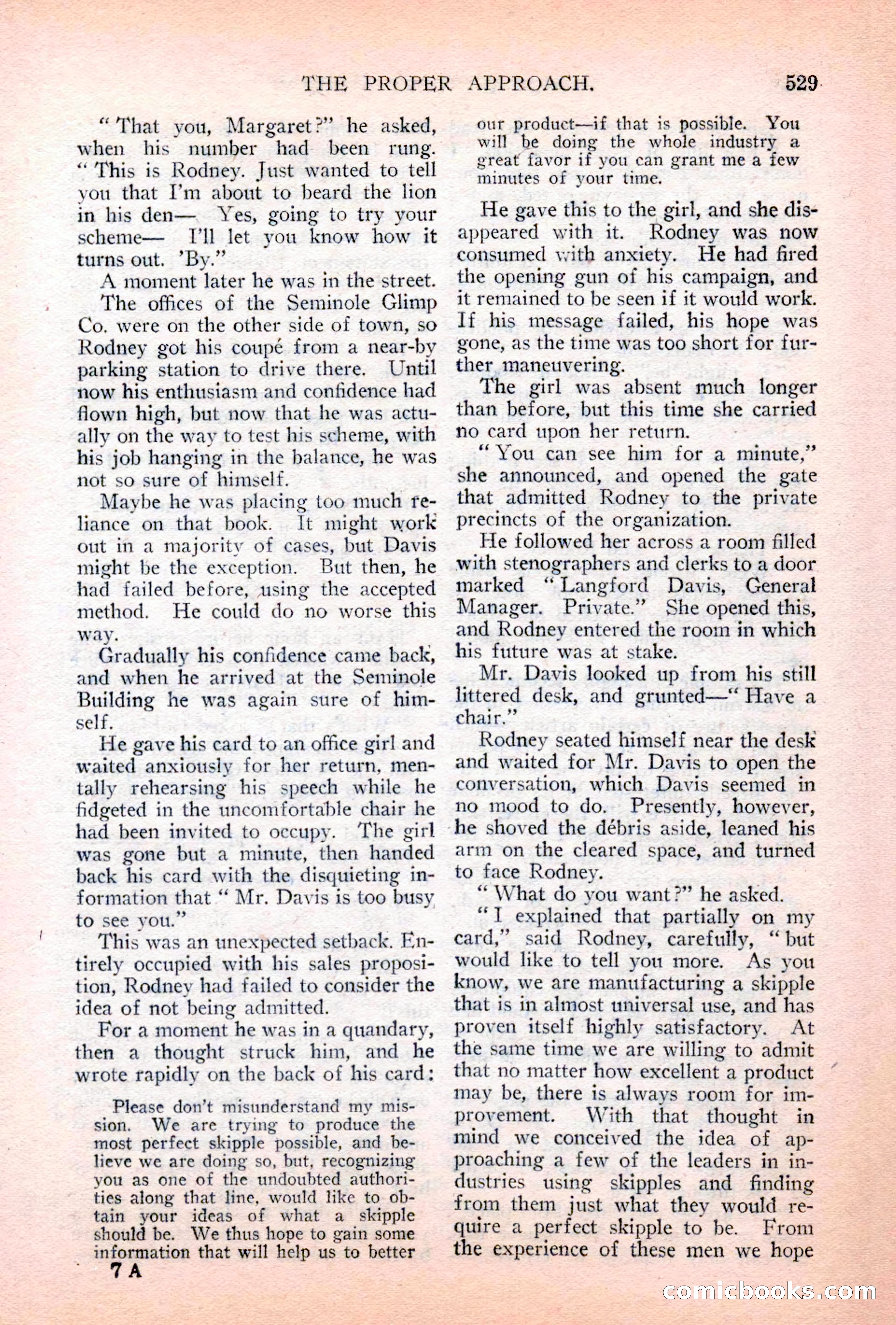
A restored page from Pulp Fiction, 1928. Page through the whole issue in the reader above.
📄 Transcribed text from this page (OCR, searchable)
Machine-transcribed from the original scan — historical spelling and the odd misread are preserved.
THE PROPER APPROACH, “That you, Margaret?” he asked, when his number had been rung. “This is Rodney. Just wanted to tell you that I’m about to beard the lion in his den— Yes, going to try your scheme— I'll let you know how it turns out. ’By.” A moment later he was in the street. The offices of the Seminole Glimp Co. were on the other side of town, so Rodney got his coupé from a near-by parking station to drive there. Until now his enthusiasm and confidence had flown high, but now that he was actu- ally on the way to test his scheme, with his job hanging in the balance, he was not so sure of himself. Maybe he was placing too much fe- liance on that book. It might work out in a majoritv of cases, but Davis might be the exception. But then, he had failed before, using the accepted method. He could do no worse this way. Gradually his confidence came back, and when he arrived at the Seminole Building he was again sure of him- self. He gave his card to an office girl and waited anxiously for her return, men- tally rehearsing his speech while he fidgeted in the uncomfortable chair he had been invited to occupy. The girl was gone but a minute, then handed back his card with the disquieting in- formation that “ Mr. Davis is too busy to see you.” This was an unexpected setback. En- tirely occupied with his sales proposi- tion, Rodney had failed to consider the idea of not being admitted. For a moment he was in a quandary, then a thought struck him, and he wrote rapidly on the back of his card: Please don’t misunderstand my mis- sion. We are trying to produce the most perfect skipple possible, and be- lieve we are doing so, but, recognizing you as one of the undoubted authori- ties along that line, would like to ob- tain your ideas of what a_ skipple should be. We thus hope to gain some ane that will help us to better our product—if that is possible. You will be doing the whole industry a great favor if you can grant me a few minutes of your time. He gave this to the girl, and she dis- appeared with it. Rodney was now consumed with anxiety. He had fired the opening gun of his campaign, and it remained to be seen if it would work. If his message failed, his hope was gone, as the time was too short for fur- ther maneuvering. The girl was absent much longer than before, but this time she carried no card upon her return. “You can see him for a minute,” she announced, and opened the gate that admitted Rodney to the private precincts of the organization. He followed her across a room filled with stenographers and clerks to a door marked “Langford Davis, General Manager. Private.” She opened this, and Rodney entered the room in which his future was at stake. Mr. Davis looked up from his still littered desk, and grunted—‘“ Have a chair.” Rodney seated himself near the desk and waited for Mr. Davis to open the conversation, which Davis seemed in no mood to do. Presently, however, he shoved the débris aside, leaned his arm on the cleared space, and turned to face Rodney. “ What do you want?” he asked. “I explained that partially on my card,’ said Rodney, carefully, “ but would like to tell you more. As you know, we are manufacturing a skipple that is in almost universal use, and has proven itself highly satisfactory. At the same time we are willing to admit that no matter how excellent a product may be, there is always room for im- provement. With that thought in mind we conceived the idea of ap- proaching a few of the leaders in in- dustries using skipples and finding from them just what they would re- quire a perfect skipple to be. From the experience of these men we hope COPNIC OOO KS 529. (So)