
Pulp Fiction, 1928 · page 107 of 156
Argosy All-Story Weekly, May 5, 1928 — page 107: what you’re looking at
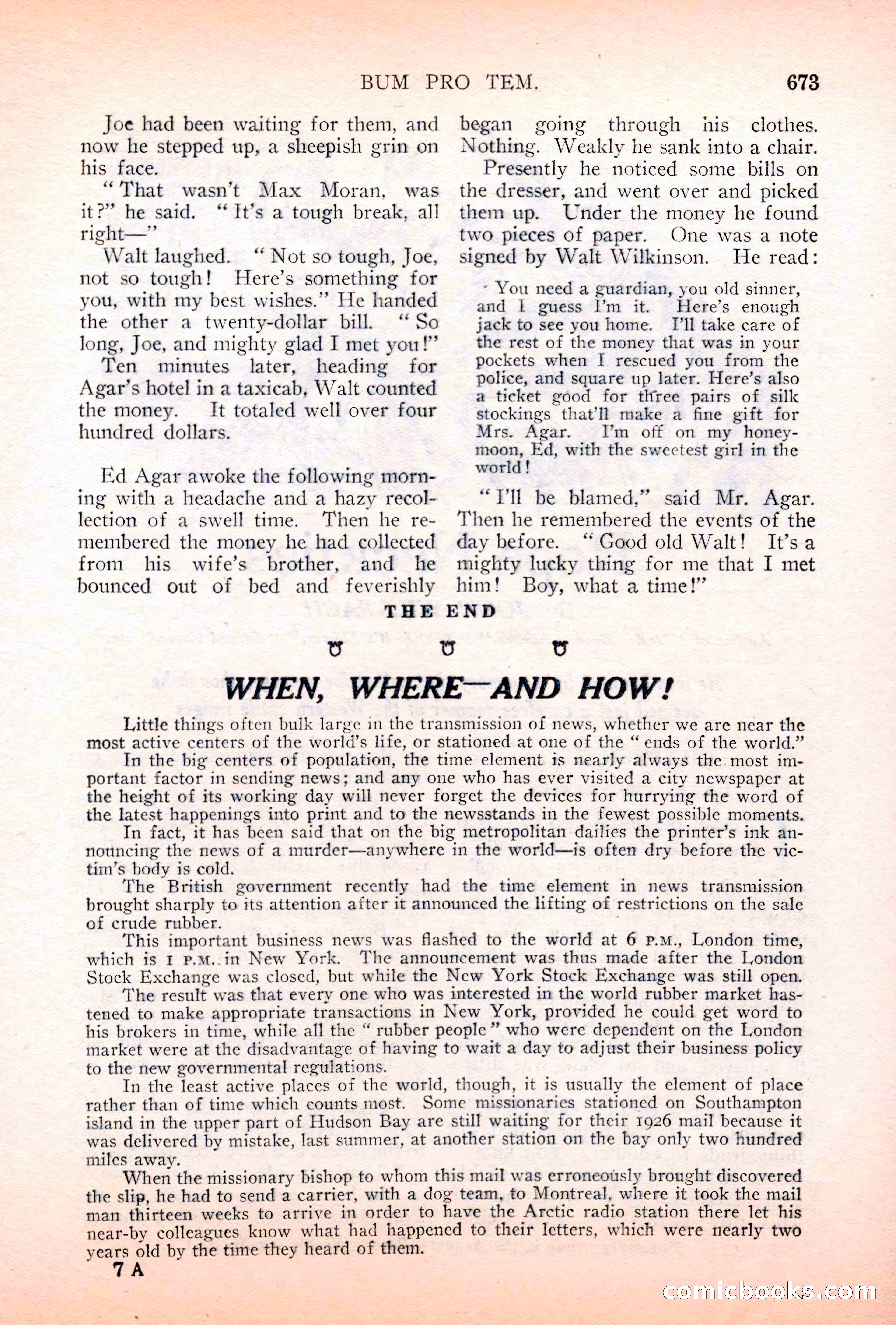
A restored page from Pulp Fiction, 1928. Page through the whole issue in the reader above.
📄 Transcribed text from this page (OCR, searchable)
Machine-transcribed from the original scan — historical spelling and the odd misread are preserved.
BUM PRO TEM. Joe had been waiting for them, and now he stepped up, a sheepish grin on his face. “That wasn’t Max Moran, was it?” he said. “It’s a tough break, all right—” Walt laughed. ‘‘ Not so tough, Joe, not so tough! MHere’s something for you, with my best wishes.’’ He handed the other a twenty-dollar bill. “So long, Joe, and mighty glad I met you!” Ten minutes later, heading for Agar’s hotel in a taxicab, Walt counted 673 began going through his clothes. Nothing. Weakly he sank into a chair. Presently he noticed some bills on the dresser, and went over and picked them up. Under the money he found two pieces of paper. One was a note signed by Walt Wilkinson. He read: - You need a guardian, you old sinner, and | guess I’m it. Here’s enough jack to see you home. [I'll take care of the rest of the money that was in your pockets when | rescued you from the police, and square up later. Here’s also a ticket good for three pairs of silk stockings that'll make a fine gift for Mrs. Agar. I’m off on my honey- moon, Ed, with the swectest girl in the world! the money. It totaled well over four hundred dollars. Eid Agar awoke the following morn- ing with a headache and a hazy recol- lection of a swell time. Then he re- membered the money he had collected day before. “Good old Walt! It’s a from his wife’s brother, and he mighty lucky thing for me that I met bounced out of bed and feverishly him! Boy, what a time!” THE END Lo] U Ls] WHEN, WHERE—AND HOW! Little things often bulk large in the transmission of news, whether we are near the most active centers of the world’s life, or stationed at one of the “ends of the world.” In the big centers of population, the time element is nearly always the most im- portant factor in sending news; and any one who has ever visited a city newspaper at the height of its working day will never forget the devices for hurrying the word of the latest happenings into print and to the newsstands in the fewest possible moments. In fact, it has been said that on the big metropolitan dailies the printer’s ink an- nouncing the news of a murder—anywhere in the world—is often dry before the vic- tim’s body is cold. The British government recently had the time element in news transmission brought sharply to its attention after it announced the lifting of restrictions on the sale of crude rubber. . This important business news was flashed to the world at 6 p.m., London time, which is 1 p.M..in New York. The announcement was thus made after the London Stock Exchange was closed, but while the New York Stock Exchange was still open. The result was that every one who was interested in the world rubber market has- tened to make appropriate transactions in New York, provided he could get word to his brokers in time, while all the “ rubber people ” who were dependent on the London market were at the disadvantage of having to wait a day to adjust their business policy to the new governmental regulations. In the least active places of the world, though, it is usually the element of place rather than of time which counts most. Some missionaries stationed on Southampton island in the upper part of Hudson Bay are still waiting for their 1926 mail because it was delivered by mistake, last summer, at another station on the bay only two hundred miles away. When the missionary bishop to whom this mail was erroneously brought discovered the slip, he had to send a carrier, with a dog team, to Montreal, where it took the mail man thirteen weeks to arrive in order to have the Arctic radio station there let his near-by colleagues know what had happened to their letters, which were nearly two years old by the time they heard of them. TA ECORMICLOO© “Tl be blamed,” said Mr. Agar. Then he remembered the events of the Ss (F@)