
Pulp Fiction, 1928 · page 19 of 156
Argosy All-Story Weekly, May 5, 1928 — page 19: what you’re looking at
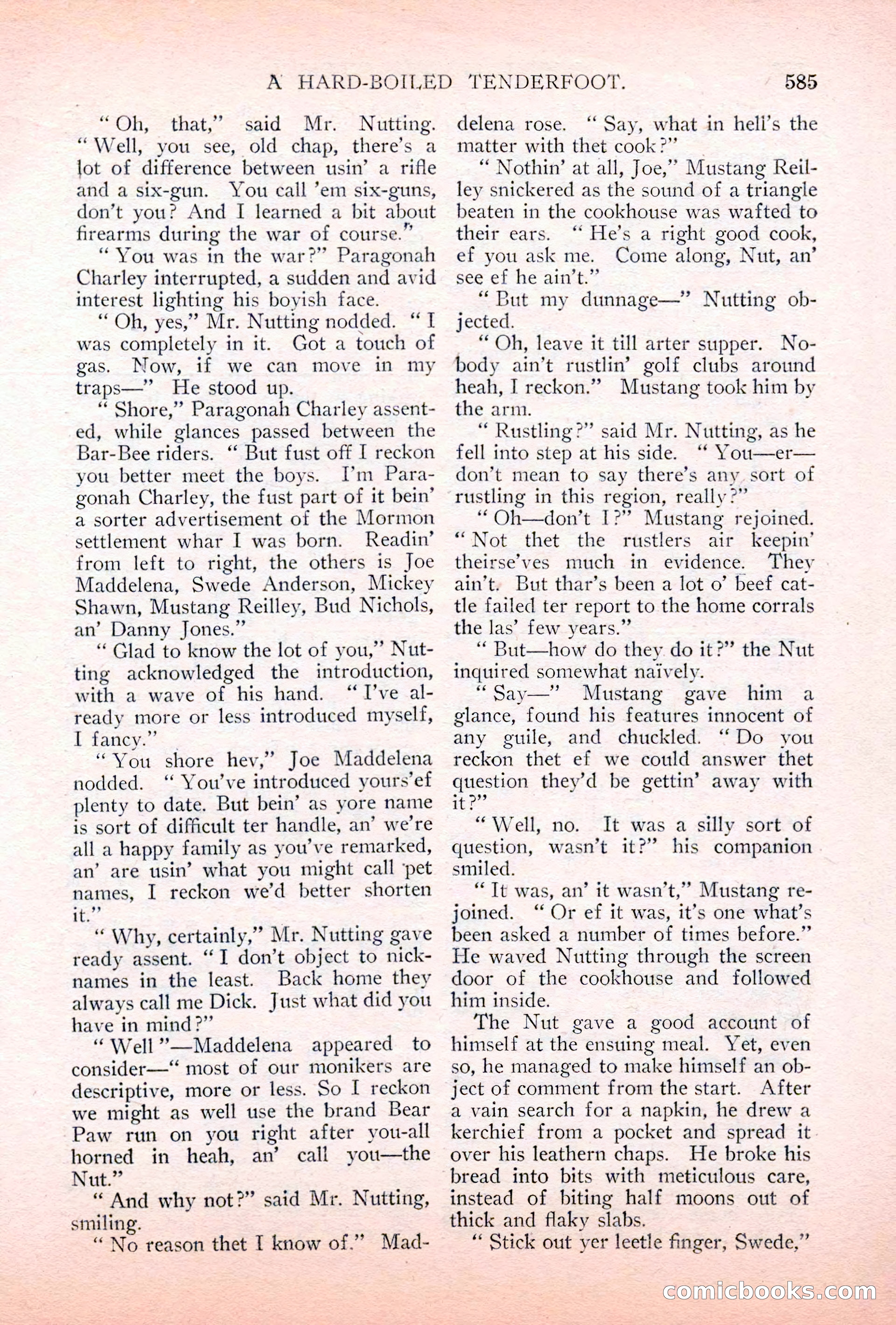
A restored page from Pulp Fiction, 1928. Page through the whole issue in the reader above.
📄 Transcribed text from this page (OCR, searchable)
Machine-transcribed from the original scan — historical spelling and the odd misread are preserved.
A HARD-BOILED TENDERFOOT. “Oh, that,’ said Mr. Nutting. “Well, you see, old chap, there’s a lot of difference between usin’ a rifle and a six-gun. You call ’em six-guns, don’t you? And [ learned a bit about firearms during the war of course.” “You was in the war?” Paragonah Charley interrupted, a sudden and avid interest lighting his boyish face. “Oh, yes,” Mr. Nutting nodded. “I was completely in it. Got a touch of gas. Now, if we can move in my traps He stood up. ‘‘ Shore,” Paragonah Charley assent- ed, while glances passed between the Bar-Bee riders. ‘‘ But fust off [ reckon you better meet the boys. I’m Para- gonah Charley, the fust part of it bein’ a sorter advertisement of the Mormon settlement whar I was born. Readin’ from left to right, the others is Joe Maddelena, Swede Anderson, Mickey Shawn, Mustang Reilley, Bud Nichols, an’ Danny Jones.” “Glad to know the lot of you,” Nut- ting acknowledged the introduction, with a wave of his hand. “I’ve al- ready more or less introduced myself, I fancy.” -. “You shore hev,” Joe Maddelena nodded. ‘“ You’ve introduced yours’ef plenty to date. But bein’ as yore name is sort of difficult ter handle, an’ we’re all a happy family as you’ve remarked, an’ are usin’ what you might call ‘pet names, I reckon we'd better shorten "a “ Why, certainly,” Mr. Nutting gave ready assent. “I don’t object to nick- names in the least. Back home they always call me Dick. Just what did you have in mind?” ‘Well ’—Maddelena appeared to consider—“ most of our monikers are descriptive, more or less. So I reckon we might as well use the brand Bear Paw run on you right after you-all horned in heah, an’ call you—the Nut.” “ And why not?” said Mr. Nutting, smiling. “No reason thet I know of.” Mad- 585 delena rose. ‘‘ Say, what in heli’s the matter with thet cook?” “ Nothin’ at all, Joe,’ Mustang Reil- ley snickered as the sound of a triangle beaten in the cookhouse was wafted to their ears. “ He’s a right good cook, ef you ask me. Come along, Nut, an’ see ef he ain't.” “But my dunnage—” Nutting ob- jected. “Oh, leave it till arter supper. No- body ain’t rustlin’ golf clubs around heah, I reckon.” Mustang took him by the arm. “ Rustling’?” said Mr. Nutting, as he fell into step at his side. “* You—er— don’t mean to say there’s any sort of rustling in this region, really?” “ Oh—don’t I?” Mustang rejoined. “Not thet the rustlers air keepin’ theirse’ves much in evidence. They ain’t. But thar’s been a lot o’ beef cat- tle failed ter report to the home corrals the las’ few years.” ‘“ But—how do they do it?” the Nut inquired somewhat naively. ‘“Say—” Mustang gave him a glance, found his features innocent of any guile, and chuckled. “Do you reckon thet ef we could answer thet question they’d be gettin’ away with ee “Well, no. It was a silly sort of question, wasn’t it?” his companion smiled. “Tt was, an’ it wasn’t,” Mustang re- joined. “ Or ef it was, it’s one what’s been asked a number of times before.” He waved Nutting through the screen door of the cookhouse and followed him inside. The Nut gave a good account of himself at the ensuing meal. Yet, even so, he managed to make himself an ob- ject of comment from the start. After a vain search for a napkin, he drew a kerchief from a pocket and spread it over his leathern chaps. He broke his bread into bits with meticulous care, instead of biting half moons out of thick and flaky slabs. ‘Stick out yer leetle finger, Swede,” EOPMIE OOOKS (E@)