
Pulp Fiction, 1928 · page 21 of 156
Argosy All-Story Weekly, May 5, 1928 — page 21: what you’re looking at
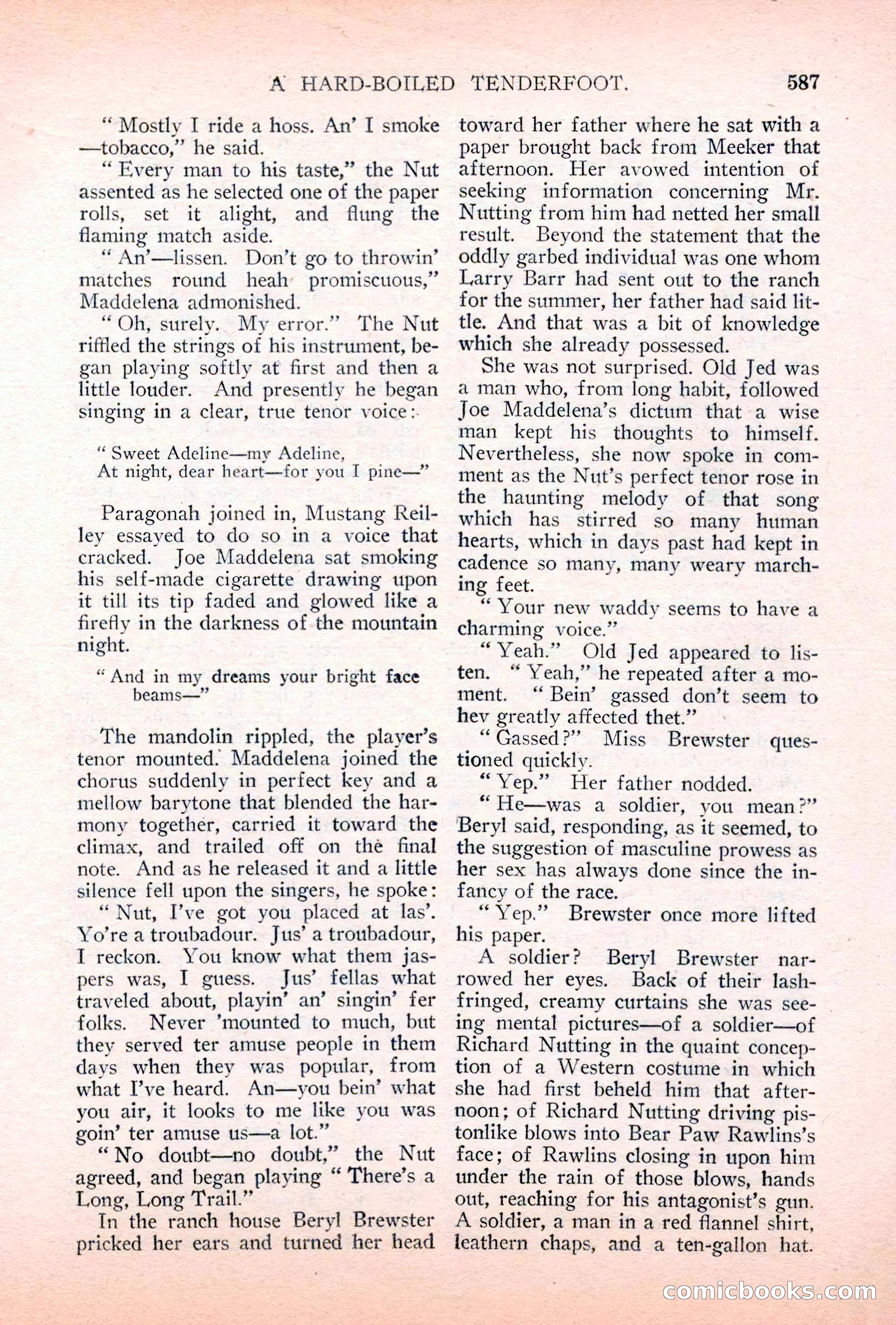
A restored page from Pulp Fiction, 1928. Page through the whole issue in the reader above.
📄 Transcribed text from this page (OCR, searchable)
Machine-transcribed from the original scan — historical spelling and the odd misread are preserved.
A HARD-BOILED TENDERFOOT. “Mostly I ride a hoss. An’ I smoke —tobacco,” he said. “Every man to his taste,” the Nut assented as he selected one of the paper rolls, set it alight, and flung the flaming match aside. “ An’—lissen. Don’t go to throwin’ matches round heah promiscuous,” Maddelena admonished. “Oh, surely.. My error.” The Nut riffled the strings of his instrument, be- gan playing softly at first and then a little louder. And presently he began singing in a clear, true tenor voice :. ‘ Sweet Adeline—my Adeline, At night, dear heart—for you I pine—” Paragonah joined in, Mustang Reil- ley essayed to do so in a voice that cracked. Joe Maddelena sat smoking his self-made cigarette drawing upon it till its tip faded and glowed like a firefly in the darkness of the mountain night. “And in my dreams your bright face beams—” The mandolin rippled, the player’s tenor mounted. Maddelena joined the chorus suddenly in perfect key and a mellow barytone that blended the har- mony together, carried it toward the climax, and trailed off on thé final note. And as he released it and a little silence fell upon the singers, he spoke: “Nut, I’ve got you placed at las’. Yo’re a troubadour. Jus’ a troubadour, I reckon. You know what them jas- pers was, I guess. Jus’ fellas what traveled about, playin’ an’ singin’ fer folks. Never ’mounted to much, but they served ter amuse people in them days when they was popular, from what I’ve heard. An—you bein’ what you air, it looks to me like you was goin’ ter amuse us—a lot.” “No doubt—no doubt,” the Nut agreed, and began playing “ There’s a Long, Long Trail.” In the ranch house Beryl Brewster pricked her ears and turned her head 587 toward her father where he sat with a paper brought back from Meeker that afternoon. Her avowed intention of seeking information concerning Mr. Nutting from him had netted her small result. Beyond the statement that the oddly garbed individual was one whom Larry Barr had sent out to the ranch for the summer, her father had said lit- tle. And that was a bit of knowledge which she already possessed. She was not surprised. Old Jed was a man who, from long habit, followed Joe Maddelena’s dictum that a wise man kept his thoughts to himself. Nevertheless, she now spoke in com- ment as the Nut’s perfect tenor rose in the haunting melody of that song which has stirred so many human hearts, which in days past had kept in cadence so many, many weary march- ing feet. “Your new waddy seems to have a charming voice.” “Yeah.” Old Jed appeared to lis- ten. “ Yeah,” he repeated after a mo- ment. ‘ Bein’ gassed don’t seem to hev greatly affected thet.” “Gassed?’”? Miss Brewster ques- tioned quickly. “Yep.” Her father nodded. “ He—was a soldier, you mean?” Beryl said, responding, as it seemed, to the suggestion of masculine prowess as her sex has always done since the in- fancy of the race. “Yep.” Brewster once more lifted his paper. A soldier? Beryl Brewster nar- rowed her eyes. Back of their lash- fringed, creamy curtains she was see- ing mental pictures—of a soldier—of Richard Nutting in the quaint concep- tion of a Western costume in which she had first beheld him that after- noon; of Richard Nutting driving pis- tonlike blows into Bear Paw Rawlins’s face; of Rawlins closing in upon him under the rain of those blows, hands out, reaching for his antagonist’s gun. A soldier, a man in a red flannel shirt, feathern chaps, and a ten-gallon hat. Go DOOKS AMUN (Glo)