
Pulp Fiction, 1928 · page 31 of 156
Argosy All-Story Weekly, May 5, 1928 — page 31: what you’re looking at
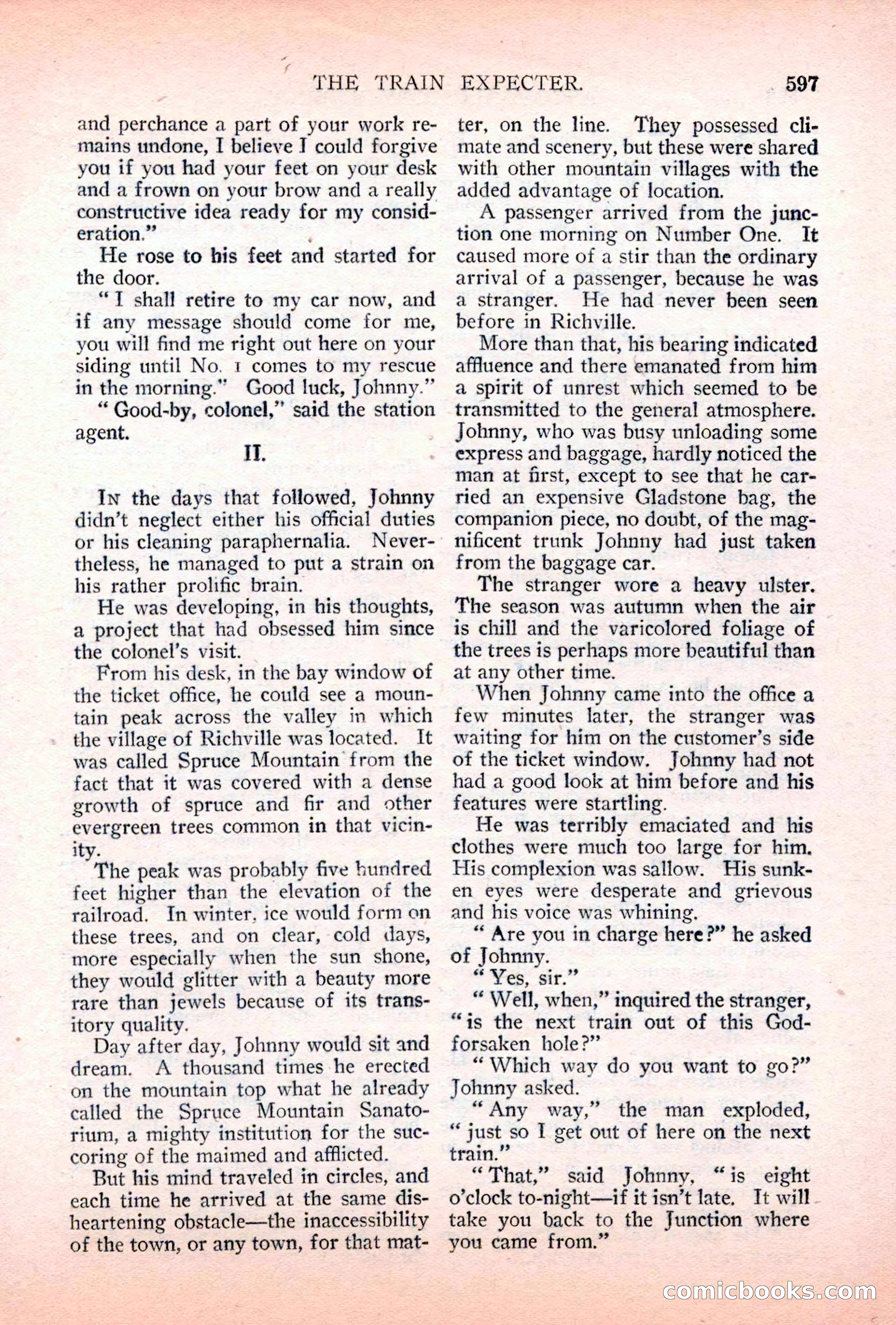
A restored page from Pulp Fiction, 1928. Page through the whole issue in the reader above.
📄 Transcribed text from this page (OCR, searchable)
Machine-transcribed from the original scan — historical spelling and the odd misread are preserved.
THE TRAIN and perchance a part of your work re- mains undone, I believe I could forgive you if you had your feet on your desk and a frown on your brow and a really constructive idea ready for my consid- eration.” ‘ He rose to his feet and started for the door. “T shall retire to my car now, and if any message should come for me, you will find me right out here on your siding until No. 1 comes to my rescue in the morning.” Good luck, Johnny.” “ Good-by, colonel,” said the station agent, IT. In the days that followed, Johnny didn’t neglect either his official duties or his cleaning paraphernalia. Never- theless, he managed to put a strain on his rather prolific brain. He was developing, in his thoughts, a project that had obsessed him since the colonel’s visit. From his desk, in the bay window of the ticket office, he could see a moun- tain peak across the valley in which the village of Richville was located. It was called Spruce Mountain from the fact that it was covered with a dense growth of spruce and fir and other evergreen trees common in that vicin- ity. The peak was probably five hundred feet higher than the elevation of the railroad. In winter. ice would form on these trees, and on clear, cold days, more especially when the sun shone, they would glitter with a beauty more rare than jewels because of its trans- itory quality. Day after day, Johnny would sit and dream. A thousand times he erected on the mountain top what he already called the Spruce Mountain Sanato- rium, a mighty institution for the suc- coring of the maimed and afflicted. But his mind traveled in circles, and each time he arrived at the same dis- heartening obstacle—the inaccessibility of the town, or any town, for that mat- EXPECTER. 597 ter, on the line. They possessed cli- mate and scenery, but these were shared with other mountain villages with the added advantage of location. A passenger arrived from the junc- tion one morning on Number One. It caused more of a stir than the ordinary arrival of a passenger, because he was a stranger. He had never been seen before in Richville. More than that, his bearing indicated affluence and there emanated from him a spirit of unrest which seemed to be transmitted to the general atmosphere. Johnny, who was busy unloading some express and baggage, hardly noticed the man at first, except to see that he car- ried an expensive Gladstone bag, the companion piece, no doubt, of the mag- nificent trunk Johnny had just taken from the baggage car. The stranger wore a heavy ulster. The season was autumn when the air is chill and the varicolored foliage of the trees is perhaps more beautiful than at any other time. When Johnny came into the office a few minutes later, the stranger was waiting for him on the customer’s side of the ticket window. Johnny had not had a good look at him before and his features were startling. He was terribly emaciated and his clothes were much too large for him. His complexion was sallow. His sunk- en eyes were desperate and grievous and his voice was whining, “ Are you in charge here?” he asked of Johnny. eT, ar “ Well, when,” inquired the stranger, “is the next train out of this God- forsaken hole?” “Which way do you want to go?” Johnny asked. “Any way,” the man _ exploded, * just so I get out of here on the next train.” “That,” said Johnny, “is eight o'clock to-night—if it isn’t late. It will take you back to the Junction where you came from.” (COLMMUCE DOOKS (E@)