
Pulp Fiction, 1928 · page 46 of 156
Argosy All-Story Weekly, May 5, 1928 — page 46: what you’re looking at
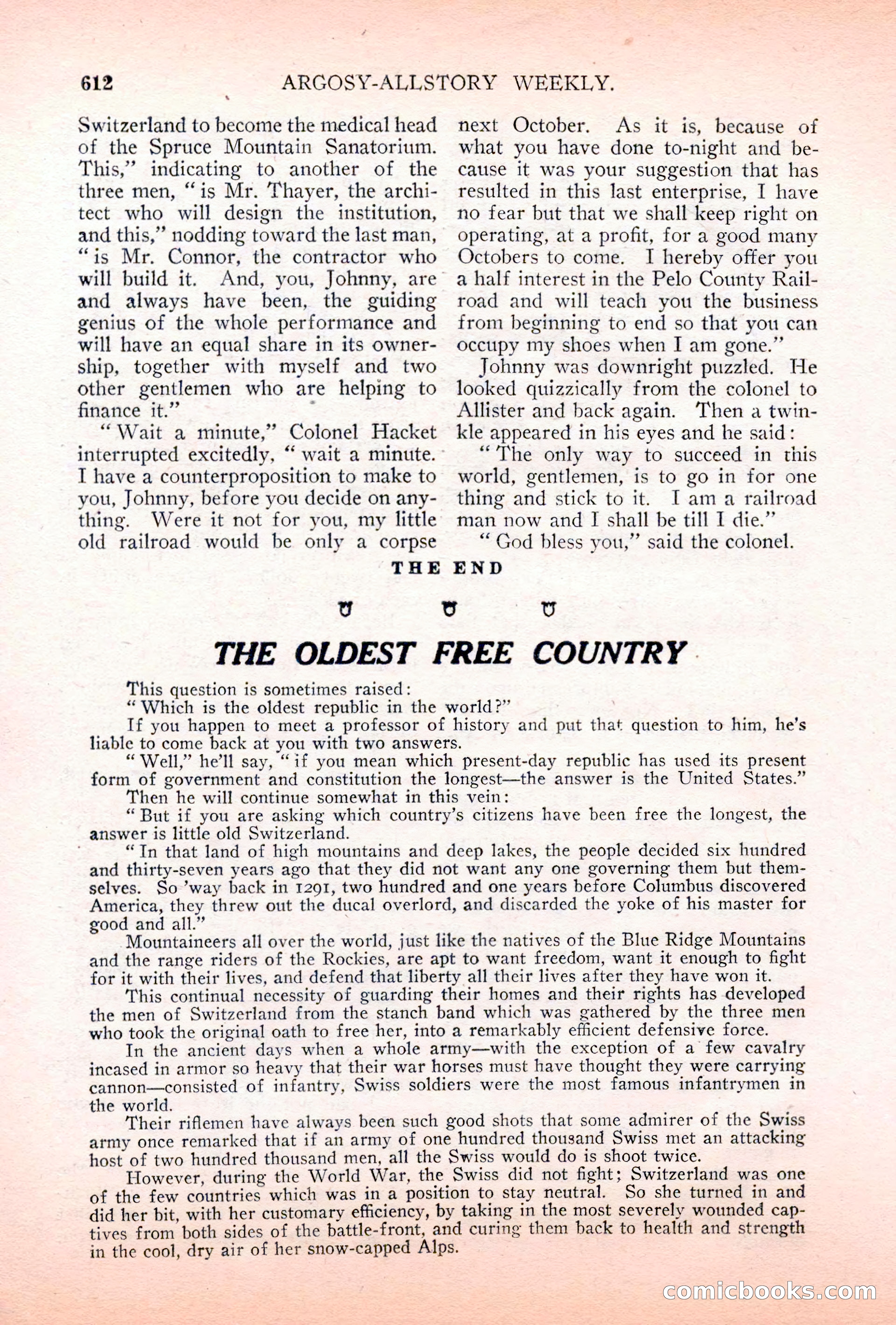
A restored page from Pulp Fiction, 1928. Page through the whole issue in the reader above.
📄 Transcribed text from this page (OCR, searchable)
Machine-transcribed from the original scan — historical spelling and the odd misread are preserved.
612 Switzerland to become the medical head of the Spruce Mountain Sanatorium. This,” indicating to another of the three men, “is Mr. Thayer, the archi- tect who will design the institution, and this,” nodding toward the last man, “is Mr. Connor, the contractor who will build it. And, you, Johnny, are and always have been, the guiding genius of the whole performance and will have an equal share in its owner- ship, together with myself and two other gentlemen who are helping to finance it.” “Wait a minute,” Colonel Hacket interrupted excitedly, “ wait a minute. I have a counterproposition to make to you, Johnny, before you decide on any- thing. Were it not for you, my little old railroad would be only a corpse THE Le Le} ARGOSY-ALLSTORY W EEKLY., next October. As it is, because of what you have done to-night and be- cause it was your suggestion that has resulted in this last enterprise, I have no fear but that we shall keep right on operating, at a profit, for a good many Octobers to come. I hereby offer you a half interest in the Pelo County Rail- road and will teach you the business from beginning to end so that you can occupy my shoes when I am gone.” Johnny was downright puzzled. He looked quizzically from the colonel to Allister and back again. Then a twin- kle appeared in his eyes and he said: “The only way to succeed in this world, gentlemen, is to go in for one thing and stick to it. [I ama railroad man now and J shall be till I die.” “God bless you,” said the colonel. END U THE OLDEST FREE COUNTRY | This question is sometimes raised: “Which is the oldest republic in the world?” If you happen to meet a professor of history and put that question to him, he’s liable to come back at you with two answers. “Well,” he’ll say, “if you mean which present-day republic has used its present form of government and constitution the longest—the answer is the United States.” Then he will continue somewhat in this vein: “But if you are asking which country’s citizens have been free the longest, the answer is little old Switzerland. “Tn that land of high mountains and deep lakes, the people decided six hundred and thirty-seven years ago that they did not want any one governing them but them- selves. So ’way back in 1291, two hundred and one years before Columbus discovered America, they threw out the ducal overlord, and discarded the yoke of his master for good and all.” | Mountaineers all over the world, just like the natives of the Blue Ridge Mountains and the range riders of the Rockies, are apt to want freedom, want it enough to fight for it with their lives, and defend that liberty all their lives after they have won it. This continual necessity of guarding their homes and their rights has developed the men of Switzerland from the stanch band which was gathered by the three men who took the original oath to free her, into a remarkably efficient defensive force. In the ancient days when a whole army—with the exception of a few cavalry incased in armor so heavy that their war horses must have thought they were carrying cannon—consisted of infantry, Swiss soldiers were the most famous infantrymen in the world. Their riflemen have always been such good shots that some admirer of the Swiss army once remarked that if an army of one hundred thousand Swiss met an attacking host of two hundred thousand men, all the Swiss would do is shoot twice. However, during the World War, the Swiss did not fight; Switzerland was one of the few countries which was in a position to stay neutral. So she turned in and did her bit, with her customary efficiency, by taking in the most severely wounded cap- tives from both sides of the battle-front, and curing them back to health and strength in the cool, dry air of her snow-capped Alps. COLNMUC DOOKS (E@)