
Pulp Fiction, 1928 · page 62 of 156
Argosy All-Story Weekly, May 5, 1928 — page 62: what you’re looking at
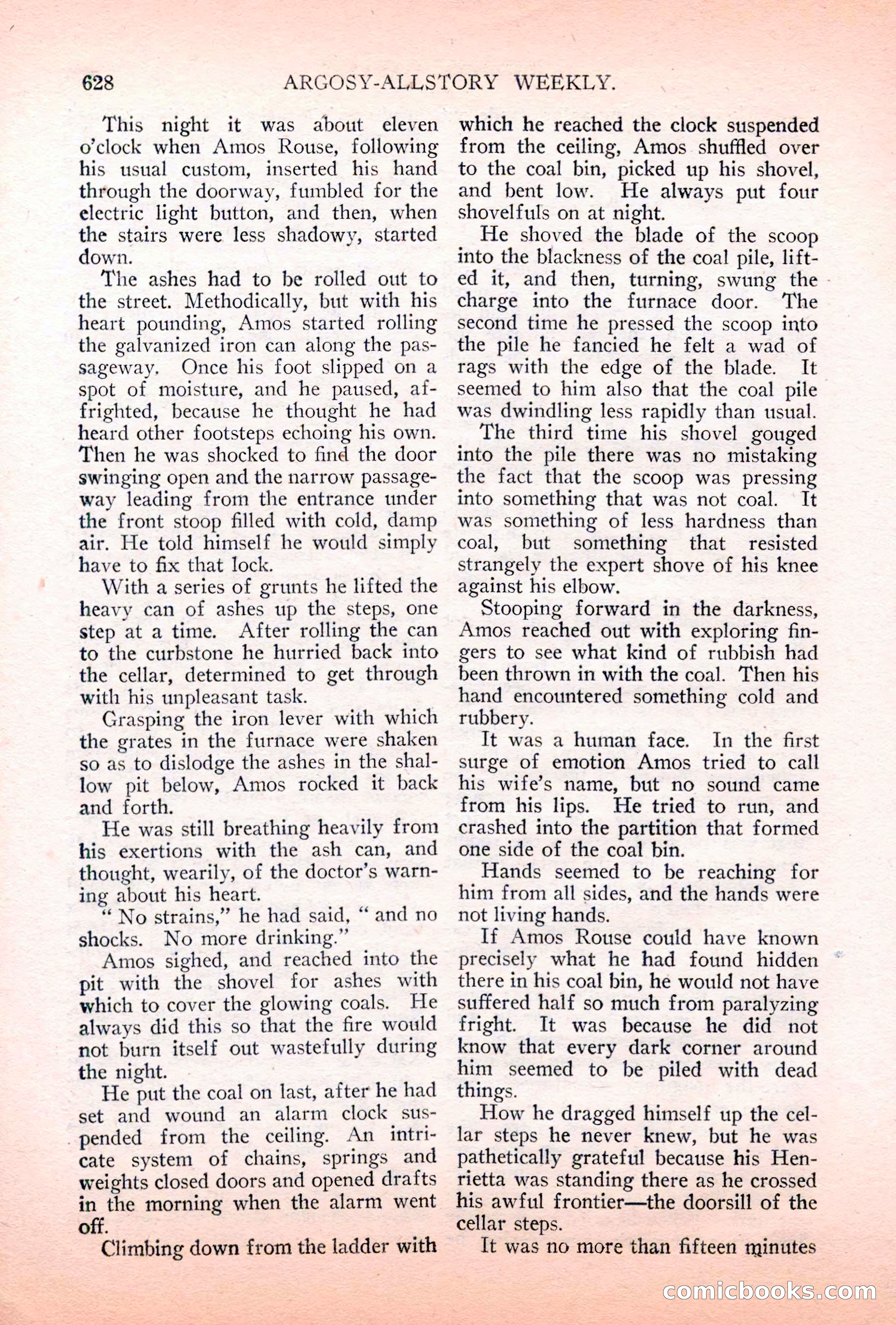
A restored page from Pulp Fiction, 1928. Page through the whole issue in the reader above.
📄 Transcribed text from this page (OCR, searchable)
Machine-transcribed from the original scan — historical spelling and the odd misread are preserved.
628 This night it was about eleven o'clock when Amos Rouse, following his usual custom, inserted his hand through the doorway, fumbled for the electric light button, and then, when the stairs were less shadowy, started down. The ashes had to be rolled out to the street. Methodically, but with his heart pounding, Amos started rolling the galvanized iron can along the pas- sageway. Once his foot slipped on a spot of moisture, and he paused, af- frighted, because he thought he had heard other footsteps echoing his own. Then he was shocked to find the door swinging open and the narrow passage- way leading from the entrance under the front stoop filled with cold, damp air. He told himself he would simply have to fix that lock. With a series of grunts he lifted the heavy can of ashes up the steps, one step at a time. After rolling the can to the curbstone he hurried back into the cellar, determined to get through with his unpleasant task. Grasping the iron lever with which the grates in the furnace were shaken so as to dislodge the ashes in the shal- low pit below, Amos rocked it back and forth. He was still breathing heavily from his exertions with the ash can, and thought, wearily, of the doctor’s warn- ing about his heart. “No strains,” he had said, “ and no shocks. No more drinking.” Amos sighed, and reached into the pit with the shovel for ashes with which to cover the glowing coals. He always did this so that the fire would not burn itself out wastefully during the night. He put the coal on last, after he had set and wound an alarm clock sus- pended from the ceiling. An intri- cate system of chains, springs and weights closed doors and opened drafts in the morning when the alarm went off. Climbing down from the ladder with ARGOSY-ALLSTORY WEEKLY. which he reached the clock suspended from the ceiling, Amos shuffled over to the coal bin, picked up his shovel, and bent low. He always put four shovelfuls on at night. He shoved the blade of the scoop into the blackness of the coal pile, lift- ed it, and then, turning, swung the - charge into the furnace door. ‘The second time he pressed the scoop into the pile he fancied he felt a wad of rags with the edge of the blade. It seemed to him also that the coal pile was dwindling less rapidly than usual. The third time his shovel gouged into the pile there was no mistaking the fact that the scoop was pressing into something that was not coal. It was something of less hardness than coal, but something that resisted strangely the expert shove of his knee against his elbow. Stooping forward in the darkness, Amos reached out with exploring fin- gers to see what kind of rubbish had been thrown in with the coal. Then his hand encountered something cold and rubbery. It was a human face. In the first surge of emotion Amos tried to call his wife’s name, but no sound came from his lips. He tried to run, and crashed into the partition that formed one side of the coal bin. Hands seemed to be reaching for him from all sides, and the hands were not living hands. If Amos Rouse could have known precisely what he had found hidden there in his coal bin, he would not have suffered half so much from paralyzing fright. It was because he did not know that every dark corner around him seemed to be piled with dead things. How he dragged himself up the cel- lar steps he never knew, but he was pathetically grateful because his Hen- rietta was standing there as he crossed his awful frontier—the doorsill of the cellar steps. It was no more than fifteen minutes (e(0) DOOKS AAG (F@)