
Pulp Fiction, 1928 · page 77 of 156
Argosy All-Story Weekly, May 5, 1928 — page 77: what you’re looking at
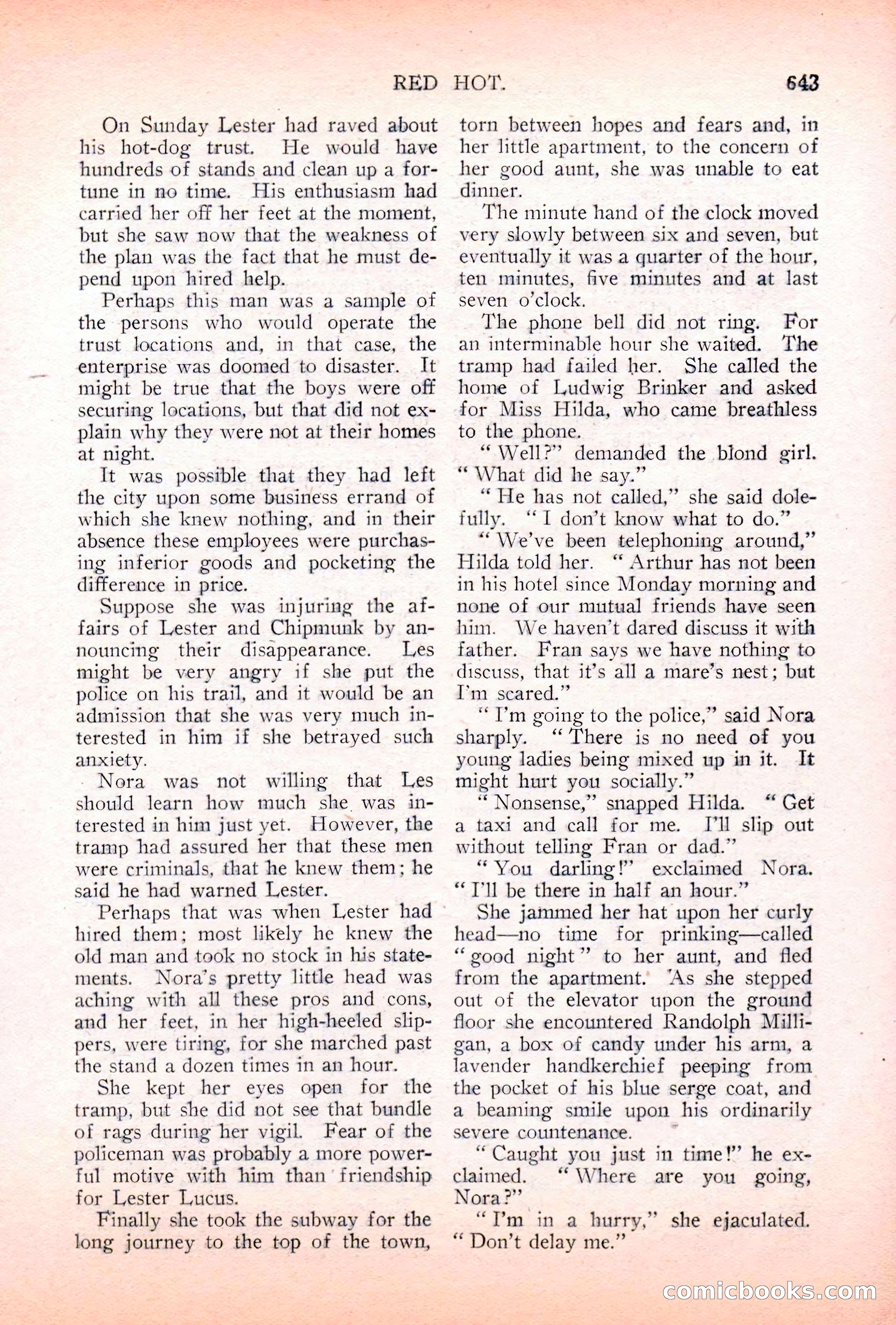
A restored page from Pulp Fiction, 1928. Page through the whole issue in the reader above.
📄 Transcribed text from this page (OCR, searchable)
Machine-transcribed from the original scan — historical spelling and the odd misread are preserved.
RED On Sunday Lester had raved about his hot-dog trust. He would have hundreds of stands and clean up a for- tune in no time. His enthusiasm had carried her off her feet at the moment, but she saw now that the weakness of the plan was the fact that he must de- pend upon hired help. Perhaps this man was a sample of the persons who would operate the trust locations and, in that case, the enterprise was doomed to disaster. It might be true that the boys were off securing locations, but that did not ex- plain why they were not at their homes at night. It was possible that they had left the city upon some business errand of which she knew nothing, and in their absence these employees were purchas- ing inferior goods and pocketing the difference in price. Suppose she was injuring the af- fairs of Lester and Chipmunk by an- nouncing their disappearance. Les might be very angry if she put the police on his trail, and it would be an admission that she was very much in- terested in him if she betrayed such anxiety. Nora was not willing that Les should learn how much she was in- terested in him just yet. However, the tramp had assured her that these men were criminals, that he knew them; he said he had warned Lester. Perhaps that was when Lester had hired them; most likely he knew the old man and took no stock in his state- ments. Nora’s pretty little head was aching with all these pros and cons, and her feet, in her high-heeled slip- pers, were tiring, for she marched past the stand a dozen times in an hour. She kept her eyes open for the tramp, but she did not see that bundle of rags during her vigil. Fear of the policeman was probably a more power- ful motive with him than’ friendship for Lester Lucus. Finally she took the subway for the long journey to the top of the town, 643 torn between hopes and fears and, in her little apartment, to the concern of her good aunt, she was unable to eat dinner. The minute hand of the clock moved very slowly between six and seven, but eventually it was a quarter of the hour, ten minutes, five minutes and at last seven o'clock. The phone bell did not ring. For an interminable hour she waited. The tramp had failed her. She called the home of Ludwig Brinker and asked for Miss Hilda, who came breathless to the phone. * Well?’ demanded the blond girl. “What did he say.” “He has not called,” she said dole- fully. “‘ I don’t know what to do.” “We've been telephoning around,” Hilda told her. “ Arthur has not been in his hotel since Monday morning and none of our mutual friends have seen him. We haven’t dared discuss it with father. Fran says we have nothing to discuss, that it’s all a mare’s nest; but I’m scared.” ‘“[’m going to the police,” said Nora sharply. “‘ There is no need of you young ladies being mixed up in it. It might hurt you socially.” “Nonsense,” snapped Hilda. “ Get a taxi and call for me. IJ'll slip out without telling Fran or dad.” “You darling!’ exclaimed Nora. “Tl be there in half an hour.” She jammed her hat upon her curly head—no time for prinking—called “good night” to her aunt, and fled from the apartment. ‘As she stepped out of the elevator upon the ground floor she encountered Randolph Milli- gan, a box of candy under his arm, a lavender handkerchief peeping from the pocket of his blue serge coat, and a beaming smile upon his ordinarily severe countenance. “Caught you just in time!” he ex- claimed. ‘“‘ Where are you going, Nora?” “T’m in a hurry,” she ejaculated. “Don’t delay me.” HOT. COLMUCE NOOLKS (F@