
Pulp Fiction, 1928 · page 82 of 156
Argosy All-Story Weekly, May 5, 1928 — page 82: what you’re looking at
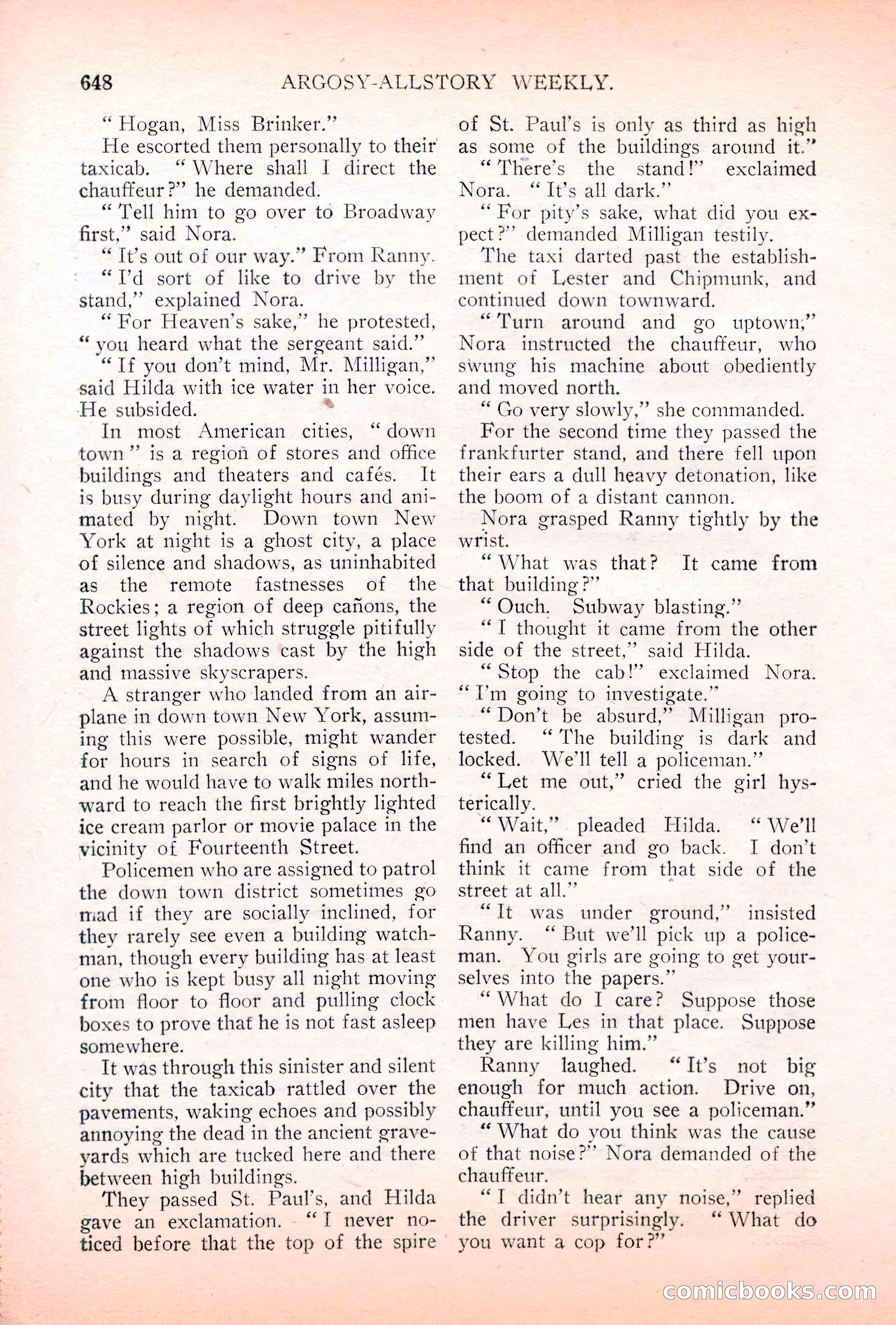
A restored page from Pulp Fiction, 1928. Page through the whole issue in the reader above.
📄 Transcribed text from this page (OCR, searchable)
Machine-transcribed from the original scan — historical spelling and the odd misread are preserved.
648 “Hogan, Miss Brinker.” He escorted them personally to their taxicab. ‘“ Where shall I direct the chauffeur?” he demanded. “Tell him to go over to Broadway first; said Nora. - “Tt’s out of our way.” From Ranny. “I'd _-sort of like to drive by the stand,’’ explained Nora. “For Heaven’s sake,” he protested, “vou heard what the sergeant said.” “Tf you don’t mind, Mr. Milligan,” said Hilda with ice water in her voice. He subsided. ” In most American cities, “ down town” is a region of stores and office buildings and theaters and cafés. It is busy during daylight hours and ani- mated by night. Down town New York at night is a ghost city, a place of silence and shadows, as uninhabited as the remote fastnesses of the Rockies; a region of deep cafions, the street lights of which struggle pitifully against the shadows cast by the high and massive skyscrapers. A stranger who landed from an air- plane in down town New York, assum- ing this were possible, might wander for hours in search of signs of life, and he would have to walk miles north- ward to reach the first brightly lighted ice cream parlor or movie palace in the vicinity of Fourteenth Street. Policemen who are assigned to patrol the down town district sometimes go niad if they are socially inclined, for they rarely see even a building watch- man, though every building has at least one who is kept busy all night moving from floor to floor and pulling clock boxes to prove that he is not fast asleep somewhere. It was through this sinister and silent city that the taxicab rattled over the pavements, waking echoes and possibly annoying the dead in the ancient grave- yards which are tucked here and there between high buildings. They passed St. Paul’s, and Hilda gave an exclamation. “I never no- ticed before that the top of the spire ARGOSY-ALLSTORY WEEKLY. of St. Paul’s is only as third as high as some of the buildings around it.” “There’s the stand!’ exclaimed Nota. Tt's-4H dark,”’ , “For pity’s sake, what did you ex- pect?’ demanded Mulligan testily. The taxi darted past the establish- ment of Lester and Chipmunk, and continued down townward. “Turn around and go uptown,” Nora instructed the chauffeur, who swung his machine about obediently and moved north. “Go very slowly,” she commanded. For the second time they passed the frankfurter stand, and there fell upon their ears a dull heavy detonation, like the boom of a distant cannon. Nora grasped Ranny tightly by the wrist. “What was that? that building?” “Ouch. Subway blasting.” “T thought it came from the other side of the street,” said Hilda. “Stop the cab!” exclaimed Nora. “Tm going to investigate.” “Don’t be absurd,” Milligan pro- tested. “The building is dark and locked. We'll tell a policeman.” “Let me out,” cried the girl hys- terically. “Wait,” . pleaded Hilda. “ We'll find an officer and go back. JI don’t think it came from that side of the street at all.” 3 “It was under ground,” insisted Ranny. “ But we'll pick up a police- man. You girls are going to get your- selves into the papers.”’ “What do I care? Suppose those men have Les in that place. Suppose they are killing him.” Ranny laughed. “It’s not big enough for much action. Drive on, chauffeur, until you see a policeman.” “What do you think was the cause of that noise?’” Nora demanded of the chauffeur. ““T didn’t hear any noise,” replied the driver surprisingly. ‘‘ What do you want a cop for?” It came from EOMMICLOOKS (C@