
Pulp Fiction, 1928 · page 98 of 156
Argosy All-Story Weekly, May 5, 1928 — page 98: what you’re looking at
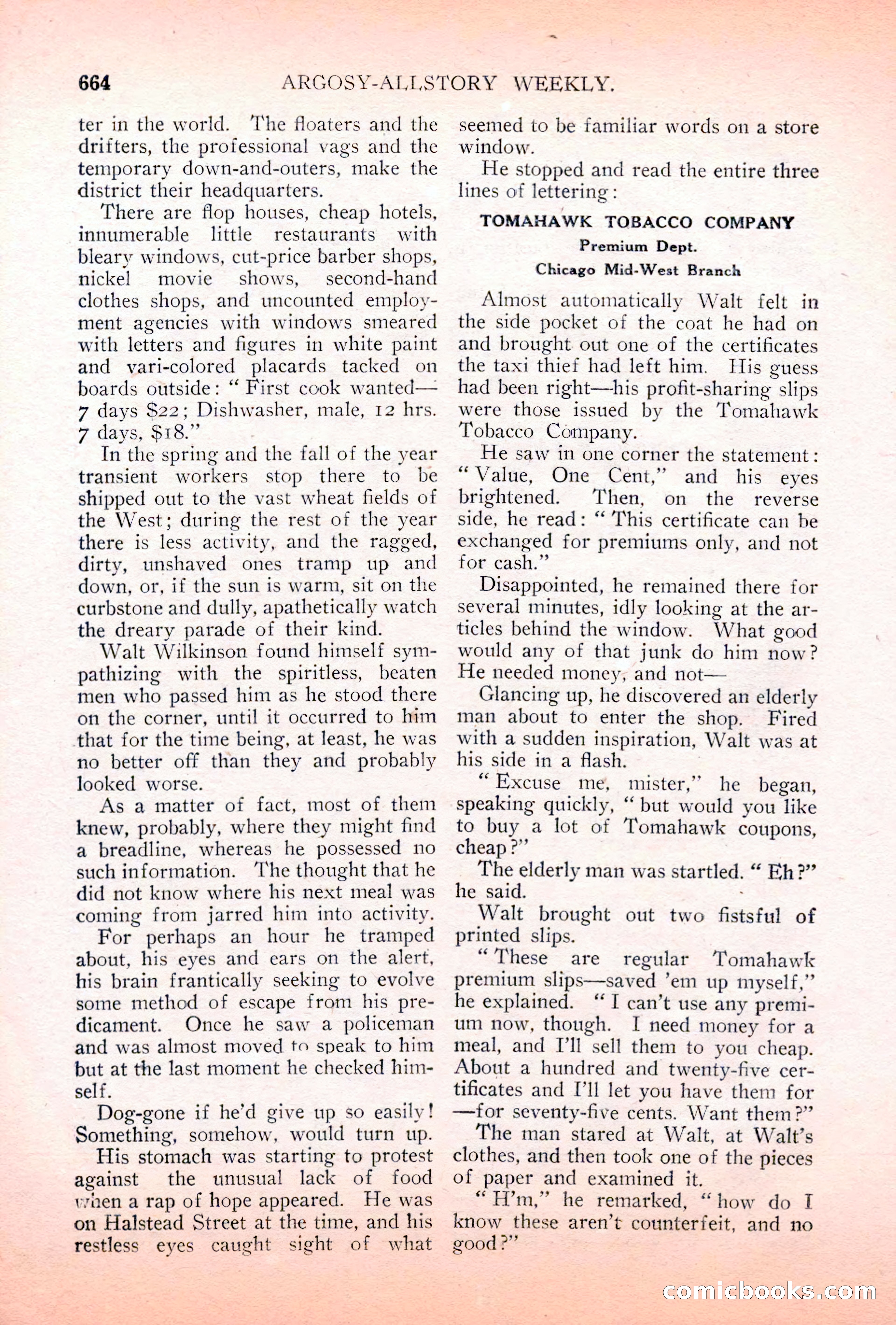
A restored page from Pulp Fiction, 1928. Page through the whole issue in the reader above.
📄 Transcribed text from this page (OCR, searchable)
Machine-transcribed from the original scan — historical spelling and the odd misread are preserved.
664 ter in the world. The floaters and the drifters, the professional vags and the temporary down-and-outers, make the district their headquarters. There are flop houses, cheap hotels, innumerable little restaurants with blearvy windows, cut-price barber shops, nickel movie shows, second-hand clothes shops, and uncounted employ- ment agencies with windows smeared with letters and figures in white paint and vari-colored placards tacked on boards outside: “ First cook wanted— 7 days $22; Dishwasher, male, 12 hrs. 7 days, $18.” In the spring and the fall of the year transient workers stop there to be shipped out to the vast wheat fields of the West; during the rest of the year there is less activity, and the ragged, dirty, unshaved ones tramp up and down, or, if the sun is warm, sit on the curbstone and dully, apathetically watch the dreary parade of their kind. Walt Wilkinson found himself sym- pathizing with the spiritless, beaten men who passed him as he stood there on the corner, until it occurred to him that for the time being, at least, he was no better off than they and probably looked worse. As a matter of fact, most of them knew, probably, where they might find a breadline, whereas he possessed no such information. The thought that he did not know where his next meal was coming from jarred him into activity. For perhaps an hour he tramped about, his eyes and ears on the alert, his brain frantically seeking to evolve some method of escape from his pre- dicament. Once he saw a policeman and was almost moved to speak to him but at the last moment he checked him- self. Dog-gone if he’d give up so easily! Something, somehow, would turn up. His stomach was starting to protest against the unusual lack of food vraen a rap of hope appeared. He was on Halstead Street at the time, and his restless eyes caught sight of what ARGOSY-ALLSTORY WEEKLY. seemed to be familiar words on a store window. He stopped and read the entire three lines of lettering: TOMAHAWK TOBACCO COMPANY Premium Dept. Chicago Mid-West Branch Almost automatically Walt felt in the side pocket of the coat he had on and brought out one of the certificates the taxi thief had left him. His guess had been right—his profit-sharing slips were those issued by the ’omahawk Tobacco Company. He saw in one corner the statement: “Value, One Cent,” and his eyes brightened. Then, on the reverse side, he read: “‘ This certificate can be exchanged for premiums only, and not for cash.” Disappointed, he remained there for several minutes, idly looking at the ar- ticles behind the window. What good would any of that junk do him now? He needed money, and not— Glancing up, he discovered an elderly man about to enter the shop. Fired with a sudden inspiration, Walt was at his side in a flash. “Excuse me, mister,” he began, speaking quickly, “ but would you like to buy a lot of Tomahawk coupons, cheap ?”’ The elderly man was startled. “ Eh?” he said. Walt brought out two fistsful of printed slips. “These are regular ‘Tomahawk premium slips—saved ’em up myself,” he explained. ‘I can’t use any premi- um now, though. I need money for a meal, and I'll sell them to you cheap. About a hundred and twenty-five cer- tificates and [ll let you have them for —for seventy-five cents. Want them?” The man stared at Walt, at Walt’s clothes, and then took one of the pieces of paper and examined it. “'H’m,” he remarked, “how do I know these aren’t counterfeit, and no good ?” EOPMICE OO KS (@) (E@)