
Pulp Fiction, 1928 · page 113 of 150
Argosy All-Story Weekly, July 7, 1928 — page 113: what you’re looking at
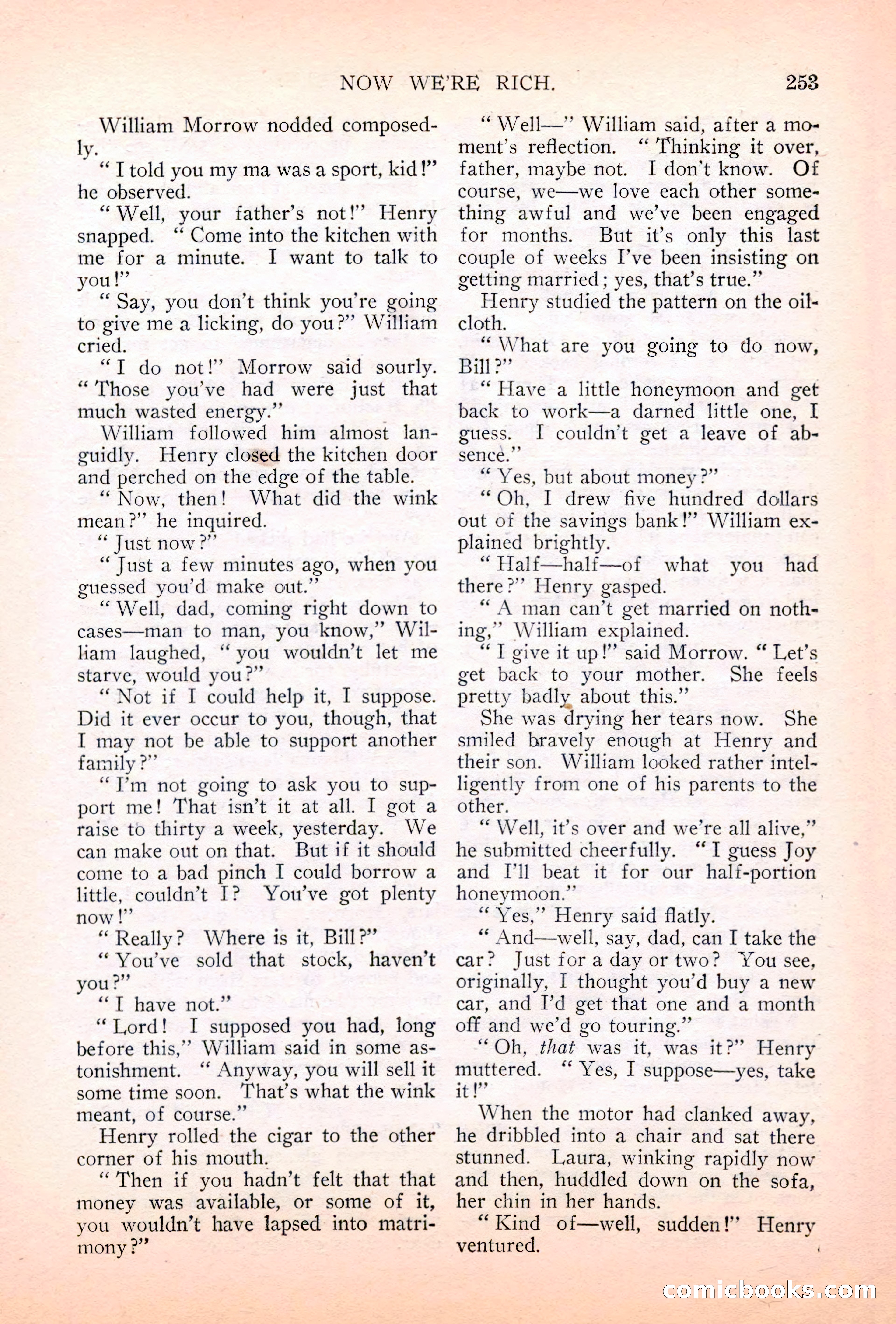
A restored page from Pulp Fiction, 1928. Page through the whole issue in the reader above.
📄 Transcribed text from this page (OCR, searchable)
Machine-transcribed from the original scan — historical spelling and the odd misread are preserved.
NOW WE/’RE RICH. William Morrow nodded composed- ly. MC I told you my ma was a sport, kid!” he observed. “Well, your father’s not!’ Henry snapped. “ Come into the kitchen with me for a minute. I want to talk to you!” “ Say, you don’t think you’re going to give me a licking, do you?” William cried. “T do not!’ Morrow said sourly. “Those you've had were just that much wasted energy.” : William followed him almost lan- guidly. Henry closed the kitchen door and perched on the edge of the table. “Now, then! What did the wink mean?” he inquired. “ Just now?” “Just a few minutes ago, when you guessed you’d make out.” “Well, dad, coming right down to cases—man to man, you know,” Wil- liam laughed, “ you wouldn’t let me starve, would you?” “Not if I could help it, I suppose. Did it ever occur to you, though, that I may not be able to support another family ?” “Tm not going to ask you to sup- port me! That isn’t it at all. I got a raise to thirty a week, yesterday. We can make out on that. But if it should come to a bad pinch I could borrow a little, couldn’t I? You've got plenty now !”’ “Really? Where is it, Bill?” “VYou’ve sold that stock, haven’t you?” “T have not.” “Tord! I supposed you had, long before this,’ William said in some as- tonishment. “‘ Anyway, you will sell it some time soon. That’s what the wink meant, of course.” Henry rolled the cigar to the other corner of his mouth. “Then if you hadn’t felt that that money was available, or some of it, you wouldn’t have lapsed into matri- mony ?” 253 “ Well—’ William said, after a mo- ment’s reflection. ‘ Thinking it over, father, maybe not. I don’t know. Of course, we—we love each other some- thing awful and we’ve been engaged for months. But it’s only this last couple of weeks I’ve been insisting on getting married; yes, that’s true.” Henry studied the pattern on the oil- cloth. “What are you going to do now, Bill ?” “Have a little honeymoon and get back to work—a darned little one, I guess. I couldn’t get a leave of ab- sence.” “Yes, but about money ?” “Oh, I drew five hundred dollars out of the savings bank!’ William ex- plained brightly. “ Half—half—of what you had there?’ Henry gasped. “A man can’t get married on noth- ing,” William explained. “T give it up!” said Morrow. “ Let’s get back to your mother. She feels pretty badly about this.” She was drying her tears now. She smiled bravely enough at Henry and their son. Wiaulliam looked rather intel- ligently from one of his parents to the other. “Well, it’s over and we're all alive,” he submitted cheerfully. “TI guess Joy and [ll beat it for our half-portion honeymoon.” “Yes,” Henry said flatly. ** And—well, say, dad, can I take the car? Just fora day ortwo? You see, originally, I thought you’d buy a new car, and I’d get that one and a month off and we'd go touring.” “Oh, that was tt, was<itr’ Henry muttered. “‘ Yes, I suppose—yes, take it !”’ When the motor had clanked away, he dribbled into a chair and sat there stunned. Laura, winking rapidly now and then, huddled down on the sofa, her chin in her hands. “Kind of—well, sudden!’ Henry ventured. COMMICEOOOKS (E@)