
Pulp Fiction, 1928 · page 126 of 150
Argosy All-Story Weekly, July 7, 1928 — page 126: what you’re looking at
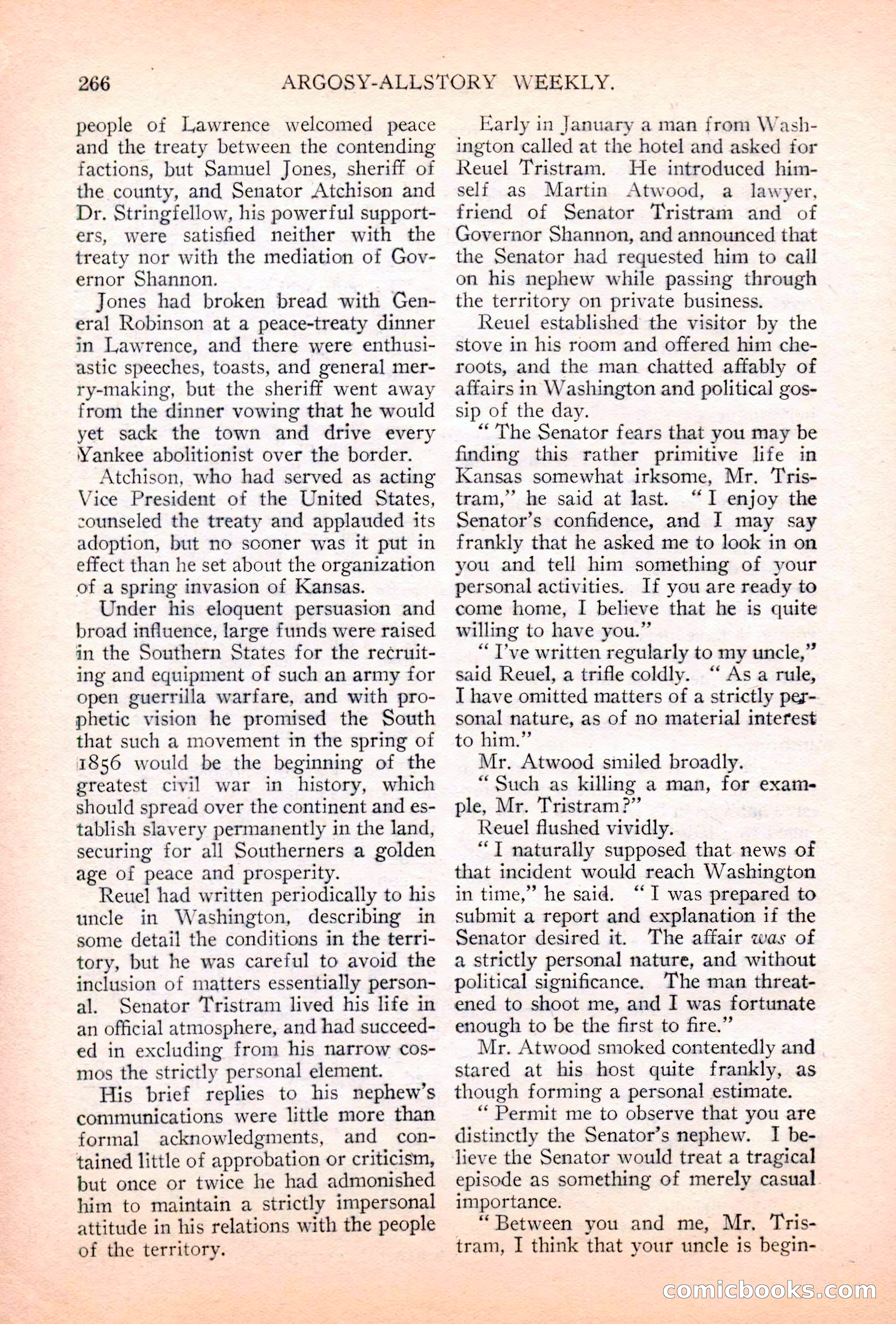
A restored page from Pulp Fiction, 1928. Page through the whole issue in the reader above.
📄 Transcribed text from this page (OCR, searchable)
Machine-transcribed from the original scan — historical spelling and the odd misread are preserved.
266 people of Lawrence welcomed peace and the treaty between the contending factions, but Samuel Jones, sheriff of the county, and Senator Atchison and Dr. Stringfellow, his powerful support- ers, were Satisfied neither with the treaty nor with the mediation of Gov- ernor Shannon. Jones had broken bread with Gen- eral Robinson at a peace-treaty dinner in Lawrence, and there were enthusi- astic speeches, toasts, and general mer- ry-making, but the sheriff went away from the dinner vowing that he would yet sack the town and drive every Yankee abolitionist over the border. Atchison, who had served as acting Vice President of the United States, counseled the treaty and applauded its adoption, but no sooner was it put in effect than he set about the organization of a spring invasion of Kansas. Under his eloquent persuasion and broad influence, large funds were raised in the Southern States for the recruit- ing and equipment of such an army for open guerrilla warfare, and with pro- phetic vision he promised the South that such a movement in the spring of 1856 would be the beginning of the greatest civil war in history, which should spread over the continent and es- tablish slavery permanently in the land, securing for all Southerners a golden age of peace and prosperity. Reuel had written periodically to his uncle in Washington, describing in some detail the conditions in the terri- tory, but he was careful to avoid the inclusion of matters essentially person- al. Senator Tristram lived his life in an official atmosphere, and had succeed- ed in excluding from his narrow cos- mos the strictly personal element. His brief replies to his nephew’s communications were little more than formal acknowledgments, and con- tained little of approbation or criticism, but once or twice he had admonished him to maintain a strictly impersonal attitude in his relations with the people of the territory. ARGOSY-ALLSTORY WEEKLY. Early in January a man from Wash- ington called at the hotel and asked for Reuel Tristram. He introduced him- self as Martin Atwood, a lawyer, friend of Senator Tristram and of Governor Shannon, and announced that the Senator had requested him to call on his nephew while passing through the territory on private business. Reuel established the visitor by the stove in his room and offered him che- roots, and the man chatted affably of affairs in Washington and political gos- sip of the day. “ The Senator fears that you may be finding this rather primitive life in Kansas somewhat irksome, Mr. Tris- tram,” he said at last. “I enjoy the Senator’s confidence, and I may say frankly that he asked me to look in on you and tell him something of your personal activities. If you are ready to come home, I believe that he is quite willing to have you.” “ T’ve written regularly to my uncle,” said Reuel, a trifle coldly. “ Asa rule, I have omitted matters of a strictly pey- sonal nature, as of no material interest to him.” Mr. Atwood smiled broadly. “ Such as killing a man, for exam- ple, Mr. Tristram?” Reuel flushed vividly. “TI naturally supposed that news of that incident would reach Washington in time,” he said. “I was prepared to submit a report and explanation if the Senator desired it. The affair was of a strictly personal nature, and without political significance. The man threat- ened to shoot me, and I was fortunate enough to be the first to fire.” Mr. Atwood smoked contentedly and stared at his host quite frankly, as though forming a personal estimate. “Permit me to observe that you are distinctly the Senator’s nephew. I be- lieve the Senator would treat a tragical episode as something of merely casual importance. “Between you and me, Mr, Tris- tram, I think that your uncle is begin- Go 0)(0Y(0) mie <S (C@