
Pulp Fiction, 1928 · page 134 of 150
Argosy All-Story Weekly, July 7, 1928 — page 134: what you’re looking at
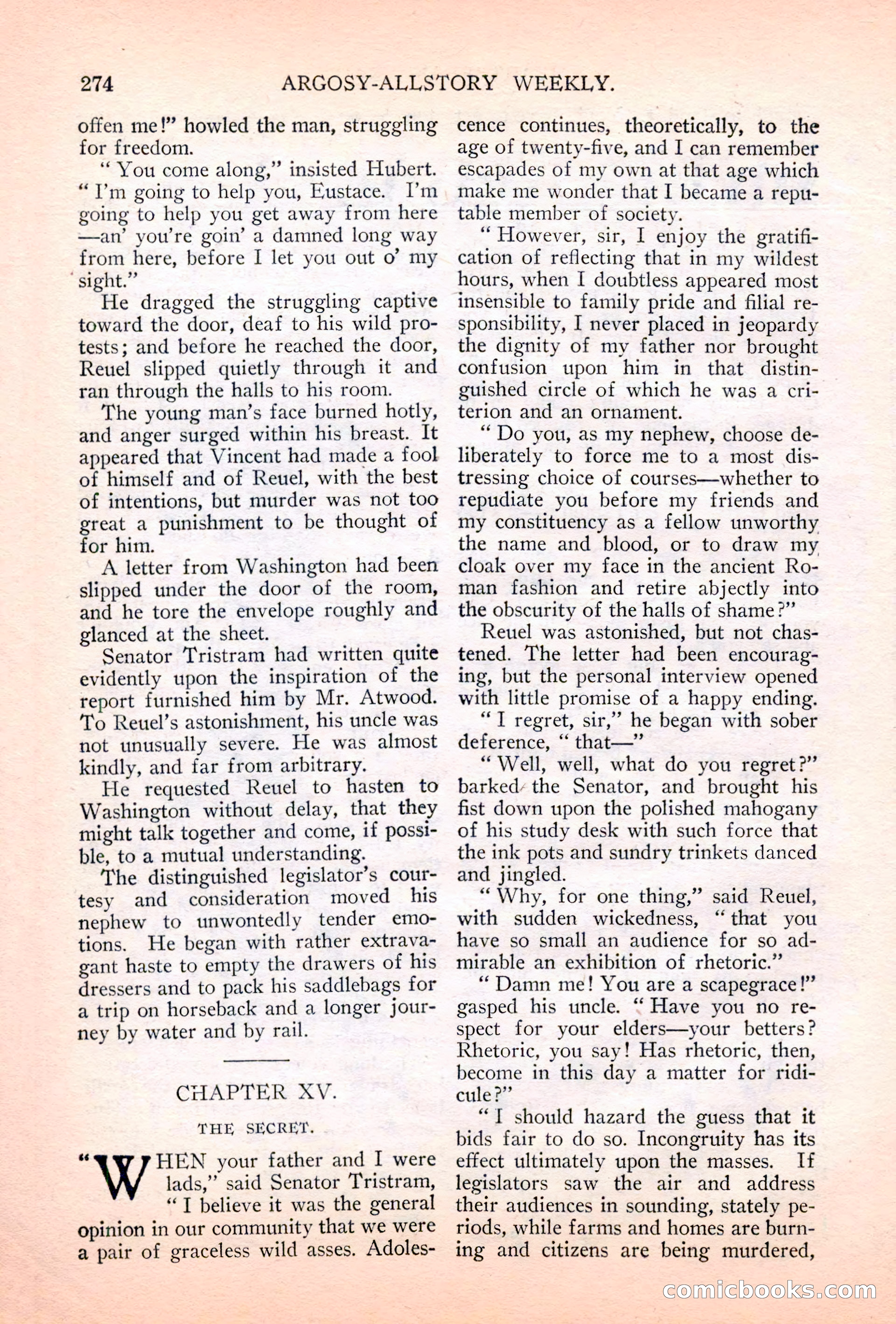
A restored page from Pulp Fiction, 1928. Page through the whole issue in the reader above.
📄 Transcribed text from this page (OCR, searchable)
Machine-transcribed from the original scan — historical spelling and the odd misread are preserved.
274 offen me!” howled the man, struggling for freedom. ‘You come along,” insisted Hubert. “I’m going to help you, Eustace. I’m going to help you get away from here an’ you’re goin’ a damned long way from here, before I let you out o’ my sight.” He dragged the struggling captive toward the door, deaf to his wild pro- tests; and before he reached the door, Reuel slipped quietly through it and ran through the halls to his room. The young man’s face burned hotly, and anger surged within his breast. It appeared that Vincent had made a fool of himself and of Reuel, with the best of intentions, but murder was not too great a punishment to be thought of for him. A letter from Washington had been slipped under the door of the room, and he tore the envelope roughly and glanced at the sheet. Senator Tristram had written quite evidently upon the inspiration of the report furnished him by Mr. Atwood. To Reuel’s astonishment, his uncle was not unusually severe. He was almost kindly, and far from arbitrary. He requested Reuel to hasten to Washington without delay, that they might talk together and come, if possi- ble, to a mutual understanding. The distinguished legislator’s cour- tesy and consideration moved his nephew to unwontedly tender emo- tions. He began with rather extrava- gant haste to empty the drawers of his dressers and to pack his saddlebags for a trip on horseback and a longer jour- ney by water and by rail. CHAPTER XV. THE SECRET. *: HEN your father and I were lads,” said Senator Tristram, “T believe it was the general opinion in our community that we were a pair of graceless wild asses. Adoles- ARGOSY-ALLSTORY WEEKLY. cence continues, theoretically, to the age of twenty-five, and I can remember escapades of my own at that age which make me wonder that I became a repu- table member of society. ‘ However, sir, I enjoy the gratifi- cation of reflecting that in my wildest hours, when I doubtless appeared most insensible to family pride and filial re- sponsibility, I never placed in jeopardy the dignity of my father nor brought confusion upon him in that distin- guished circle of which he was a cri- terion and an ornament. “Do you, as my nephew, choose de- liberately to force me to a most dis- tressing choice of courses—whether to repudiate you before my friends and my constituency as a fellow unworthy the name and blood, or to draw my cloak over my face in the ancient Ro- man fashion and retire abjectly into the obscurity of the halls of shame?” Reuel was astonished, but not chas- tened. The letter had been encourag- ing, but the personal interview opened with little promise of a happy ending. “JT regret, sir,” he began with sober deference, “ that—” “Well, well, what do you regret?” barked the Senator, and brought his fist down upon the polished mahogany of his study desk with such force that the ink pots and sundry trinkets danced and jingled. “Why, for one thing,” said Reuel, with sudden wickedness, “that you have so small an audience for so ad- mirable an exhibition of rhetoric.” “Damn me! You are a scapegrace!”’ gasped his uncle. “ Have you no re- spect for your elders—your betters? Rhetoric, you say! Has rhetoric, then, become in this day a matter for ridi- cule?” “T should hazard the guess that it bids fair to do so. Incongruity has its effect ultimately upon the masses. If legislators saw the air and address their audiences in sounding, stately pe- riods, while farms and homes are burn- ing and citizens are being murdered, Gomichbooks (C@