
Pulp Fiction, 1928 · page 140 of 150
Argosy All-Story Weekly, July 7, 1928 — page 140: what you’re looking at
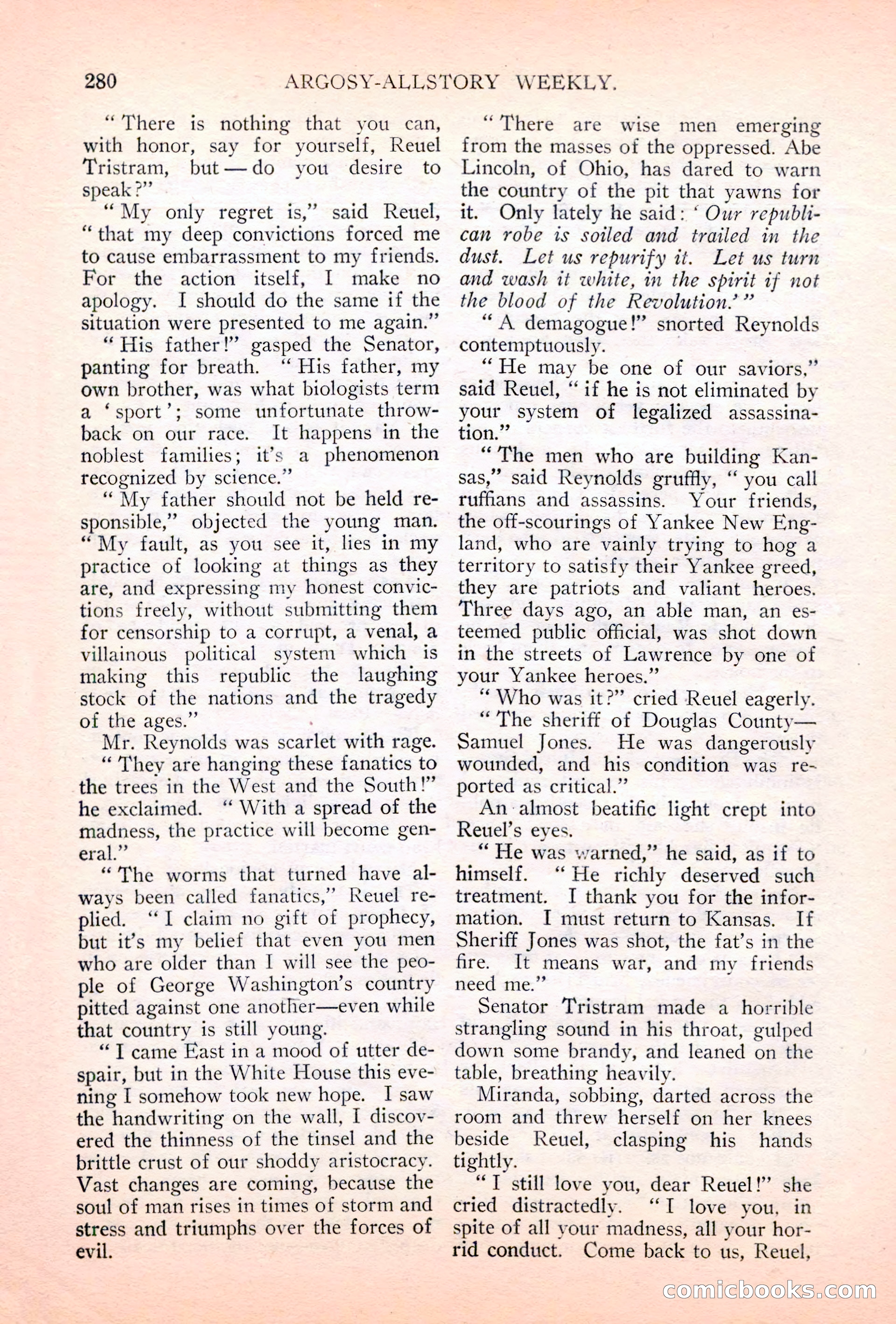
A restored page from Pulp Fiction, 1928. Page through the whole issue in the reader above.
📄 Transcribed text from this page (OCR, searchable)
Machine-transcribed from the original scan — historical spelling and the odd misread are preserved.
280 “There is nothing that you can, with honor, say for yourself, Reuel Tristram, but—do you desire to speak ?”’ “My only regret is,” said Reuel, “that my deep convictions forced me to cause embarrassment to my friends. For the action itself, I make no apology. I should do the same if the situation were presented to me again.” “His father!” gasped the Senator, panting for breath. ‘“‘ His father, my own brother, was what biologists term a ‘sport’; some unfortunate throw- back on our race. It happens in the noblest families; it’s a phenomenon recognized by science.” ‘““My father should not be held re- sponsible,” objected the young man. “My fault, as you see it, lies in my practice of looking at things as they are, and expressing my honest convic- tions freely, without submitting them for censorship to a corrupt, a venal, a villainous political system which is making this republic the laughing stock of the nations and the tragedy of the ages.” Mr. Reynolds was scarlet with rage. “They are hanging these fanatics to the trees in the West and the South!” he exclaimed. ‘‘ With a spread of the madness, the practice will become gen- eral.” “The worms that turned have al- ways been called fanatics,” Reuel re- plied. “I claim no gift of prophecy, but it’s my belief that even you men who are older than I will see the peo- ple of George Washington’s country pitted against one another—even while that country is still young. “T came East in a mood of utter de- spair, but in the White House this eve- ning I somehow took new hope. I saw the handwriting on the wall, I discov- ered the thinness of the tinsel and the brittle crust of our shoddy aristocracy. Vast changes are coming, because the soul of man rises in times of storm and stress and triumphs over the forces of evil. ARGOSY-ALLSTORY WEEKLY. “There are wise men emerging from the masses of the oppressed. Abe Lincoln, of Ohio, has dared to warn the country of the pit that yawns for it. Only lately he said: ‘ Our republi- can robe is soiled and trailed in the dust. Let us repurify it. Let us turn and wash it white, in the spirit if not the blood of the Revolution, ”’ “A demagogue!” snorted Reynolds contemptuously. “He may be one of our saviors,” said Reuel, “ if he is not eliminated by your system of legalized assassina- tion.” “The men who are building Kan- sas,” said Reynolds gruffly, “ you call ruffans and assassins. Your friends, the off-scourings of Yankee New Eng- land, who are vainly trying to hog a territory to satisfy their Yankee greed, they are patriots and valiant heroes. Three days ago, an able man, an es- teemed public official, was shot down in the streets of Lawrence by one of your Yankee heroes.” “Who was it?” cried Reuel eagerly. “The sheriff of Douglas County— Samuel Jones. He was dangerously wounded, and his condition was re- ported as critical.” An almost beatific light crept into Reuel’s eyes. “He was warned,” he said, as if to himself. “ He richly deserved such treatment. I thank you for the infor- mation. I must return to Kansas. If Sheriff Jones was shot, the fat’s in the fire. It means war, and my friends need me.” Senator Tristram made a horrible strangling sound in his throat, gulped down some brandy, and leaned on the table, breathing heavily. Miranda, sobbing, darted across the room and threw herself on her knees beside Reuel, clasping his hands tightly. “T still love you, dear Reuel!’’ she cried distractedly. “I love you, in spite of all your madness, all your hor- rid conduct. Come back to us, Reuel, COPNICGLOOOKS (C@