
Pulp Fiction, 1928 · page 17 of 150
Argosy All-Story Weekly, July 7, 1928 — page 17: what you’re looking at
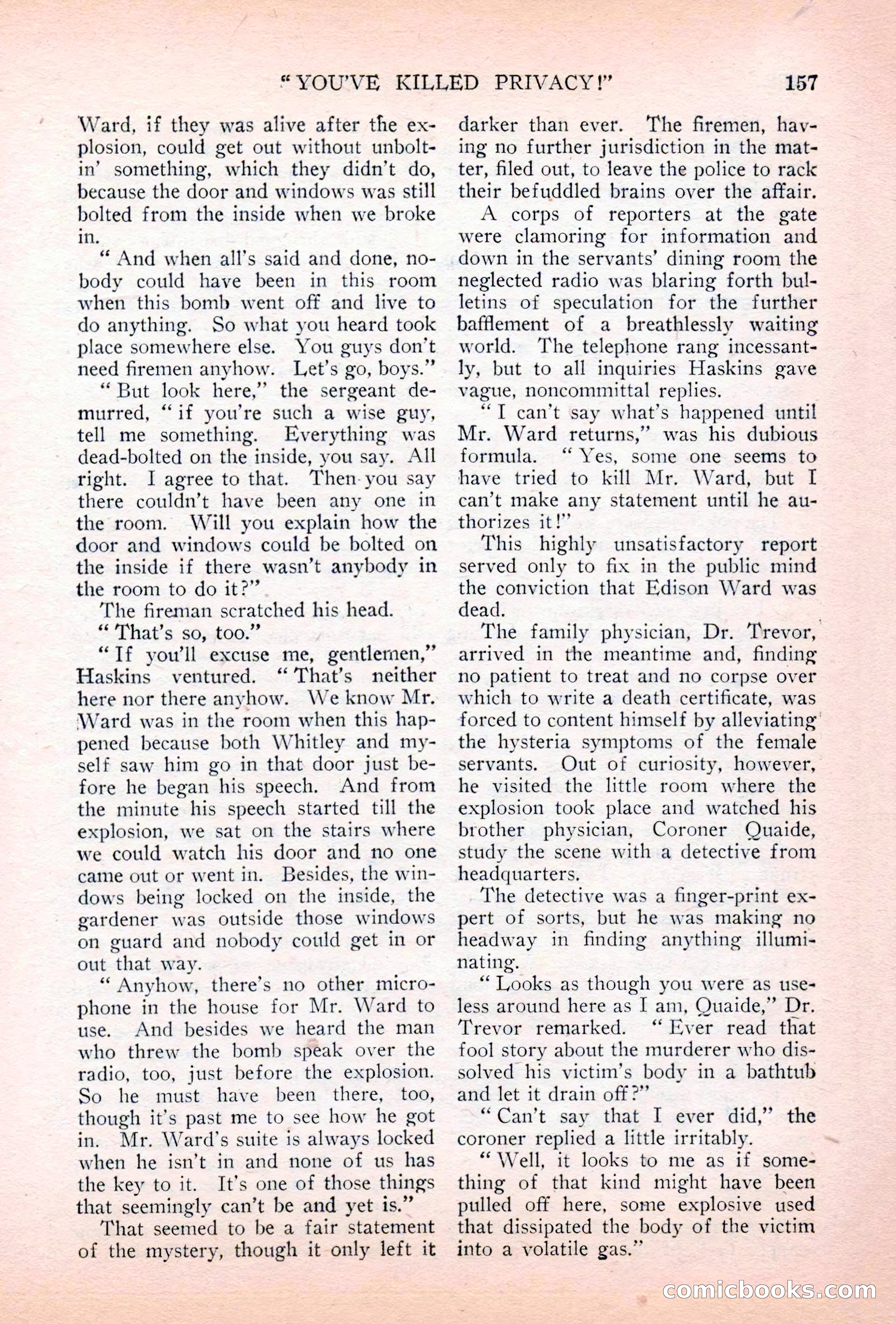
A restored page from Pulp Fiction, 1928. Page through the whole issue in the reader above.
📄 Transcribed text from this page (OCR, searchable)
Machine-transcribed from the original scan — historical spelling and the odd misread are preserved.
“YOU'VE KILLED PRIVACY!” Ward, if they was alive after the ex- plosion, could get out without unbolt- in’ something, which they didn’t do, because the door and windows was still bolted from the inside when we broke in. “And when all’s said and done, no- body could have been in this room when this bomb went off and live to do anything. So what you heard took place somewhere else. You guys don’t need firemen anyhow. Let’s go, boys.” “But look here,” the sergeant de- murred, “if you're such a wise guy, tell me something. Everything was dead-bolted on the inside, you say. All right. I agree to that. Then-you say there couldn’t have been any one in the room. Will you explain how the door and windows could be bolted on the inside if there wasn’t anybody in the room to do it?” The fireman scratched his head. * That’s so, too.” “Tf you'll excuse me, gentlemen,” Haskins ventured. ‘ That’s neither here nor there anyhow. We know Mr. Ward was in the room when this hap- pened because both Whitley and my- self saw him go in that door just be- fore he began his speech. And from the minute his speech started till the explosion, we sat on the stairs where we could watch his door and no one came out or went in. Besides, the win- dows being locked on the inside, the gardener was outside those windows on guard and nobody could get in or out that way. ““ Anyhow, there’s no other micro- phone in the house for Mr. Ward to use. And besides we heard the man who threw the bomb speak over the radio, too, just before the explosion. So he must have been there, too, though it’s past me to see how he got in. Mr. Ward’s suite is always locked when he isn’t in and none of us has the key to it. It’s one of those things that seemingly can’t be and yet is.” That seemed to be a fair statement of the mystery, though it only left it 157 darker than ever. The firemen, hav- ing no further jurisdiction in the mat- ter, filed out, to leave the police to rack their befuddled brains over the affair. A corps of reporters at the gate were clamoring for information and down in the servants’ dining room the neglected radio was blaring forth bul- letins of speculation for the further bafflement of a breathlessly waiting world. The telephone rang incessant- ly, but to all inquiries Haskins gave vague, noncommittal replies. “T can’t say what’s happened until Mr. Ward returns,” was his dubious formula. ‘“ Yes, some one seems to have tried to kill Mr. Ward, but I can’t make any statement until he au- thorizes it!” This highly unsatisfactory report served only to fix in the public mind the conviction that Edison Ward was dead. The family physician, Dr. Trevor, arrived in the meantime and, finding no patient to treat and no corpse over which to write a death certificate, was forced to content himself by alleviating’ the hysteria symptoms of the female servants. Out of curiosity, however, he visited the litthe room where the explosion took place and watched his brother physician, Coroner Quaide, study the scene with a detective from headquarters. The detective was a finger-print ex- pert of sorts, but he was making no headway in finding anything illumi- nating. “Looks as though you were as use- less around here as I am, Quaide,” Dr. Trevor remarked. “ Ever read that fool story about the murderer who dis- solved his victim’s body in a bathtub and let it drain off?” “Can’t say that I ever did,” the coroner replied a little irritably. * Well, it looks to me as if some- thing of that kind might have been pulled off here, some explosive used that dissipated the body of the victim into a volatile gas.” COPMICLOOOKS (E@)