
Pulp Fiction, 1928 · page 72 of 150
Argosy All-Story Weekly, July 7, 1928 — page 72: what you’re looking at
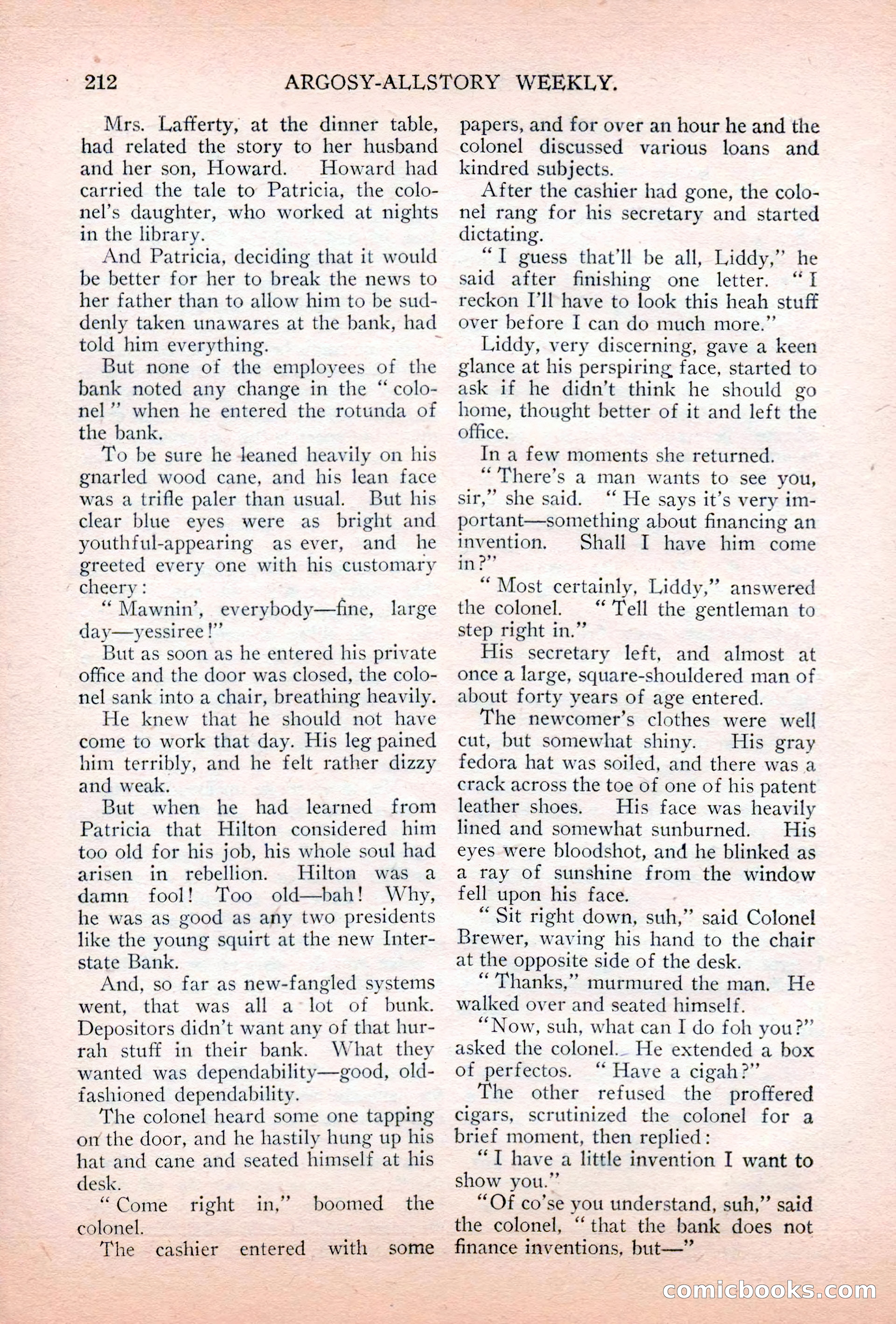
A restored page from Pulp Fiction, 1928. Page through the whole issue in the reader above.
📄 Transcribed text from this page (OCR, searchable)
Machine-transcribed from the original scan — historical spelling and the odd misread are preserved.
212 Mrs. Lafferty, at the dinner table, had related the story to her husband and her son, Howard. Howard had carried the tale to Patricia, the colo- nel’s daughter, who worked at nights in the library. And Patricia, deciding that it would be better for her to break the news to her father than to allow him to be sud- denly taken unawares at the bank, had told him everything. But none of the employees of the bank noted any change in the “ colo- nel’’ when he entered the rotunda of the bank, To be sure he Jeaned heavily on his gnarled wood cane, and his lean face was a trifle paler than usual. But his clear blue eyes were as bright and youthful-appearing as ever, and he greeted every one with his customary cheery: “ Mawnin’, everybody—fine, large day—yessiree !” But as soon as he entered his private office and the door was closed, the colo- nel sank into a chair, breathing heavily. He knew that he should not have come to work that day. His leg pained him terribly, and he felt rather dizzy and weak. But when he had learned from Patricia that Hilton considered him too old for his job, his whole soul had arisen in rebellion. Hilton was a damn fool! Too old—bah! Why, he was as good as any two presidents like the young squirt at the new Inter- state Bank. And, so far as new-fangled systems went, that was all a lot of bunk. Depositors didn’t want any of that hur- rah stuff in their bank. What they wanted was dependability—good, old- fashioned dependability. The colonel heard some one tapping on the door, and he hastily hung up his hat and cane and seated himself at his desk. “Come right in,’ boomed the colonel. The cashier entered with some ARGOSY-ALLSTORY WEEKLY. papers, and for over an hour he and the colonel discussed various loans and kindred subjects. After the cashier had gone, the colo- nel rang for his secretary and started dictating. “I guess that'll be all, Liddy,” he said after finishing one letter. “I reckon I'll have to look this heah stuff over before I can do much more.” Liddy, very discerning, gave a keen glance at his perspiring face, started to ask if he didn’t think he should go home, thought better of it and left the office. In a few moments she returned. “There’s a man wants to see you, sir,” she said. “ He says it’s very im- portant—something about financing an invention, Shall I have him come in?” “Most certainly, Liddy,” answered the colonel. “Tell the gentleman to step right in.” His secretary left, and almost at once a large, square-shouldered man of about forty years of age entered. The newcomer’s clothes were well cut, but somewhat shiny. His gray fedora hat was soiled, and there was a crack across the toe of one of his patent leather shoes. His face was heavily lined and somewhat sunburned. His eyes were bloodshot, and he blinked as a ray of sunshine from the window fell upon his face. “Sit right down, suh,” said Colonel Brewer, waving his hand to the chair at the opposite side of the desk. “Thanks,” murmured the man. He walked over and seated himself. “Now, suh, what can I do foh you?” asked the colonel... He extended a box of perfectos. “ Have a cigah?” The other refused the proffered cigars, scrutinized the colonel for a brief moment, then replied: “TI have a little invention I want to show you.” “Of co’se you understand, suh,”’ said the colonel, “that the bank does not finance inventions, but—” Gomichbooks (E@)