
Pulp Fiction, 1928 · page 81 of 150
Argosy All-Story Weekly, July 7, 1928 — page 81: what you’re looking at
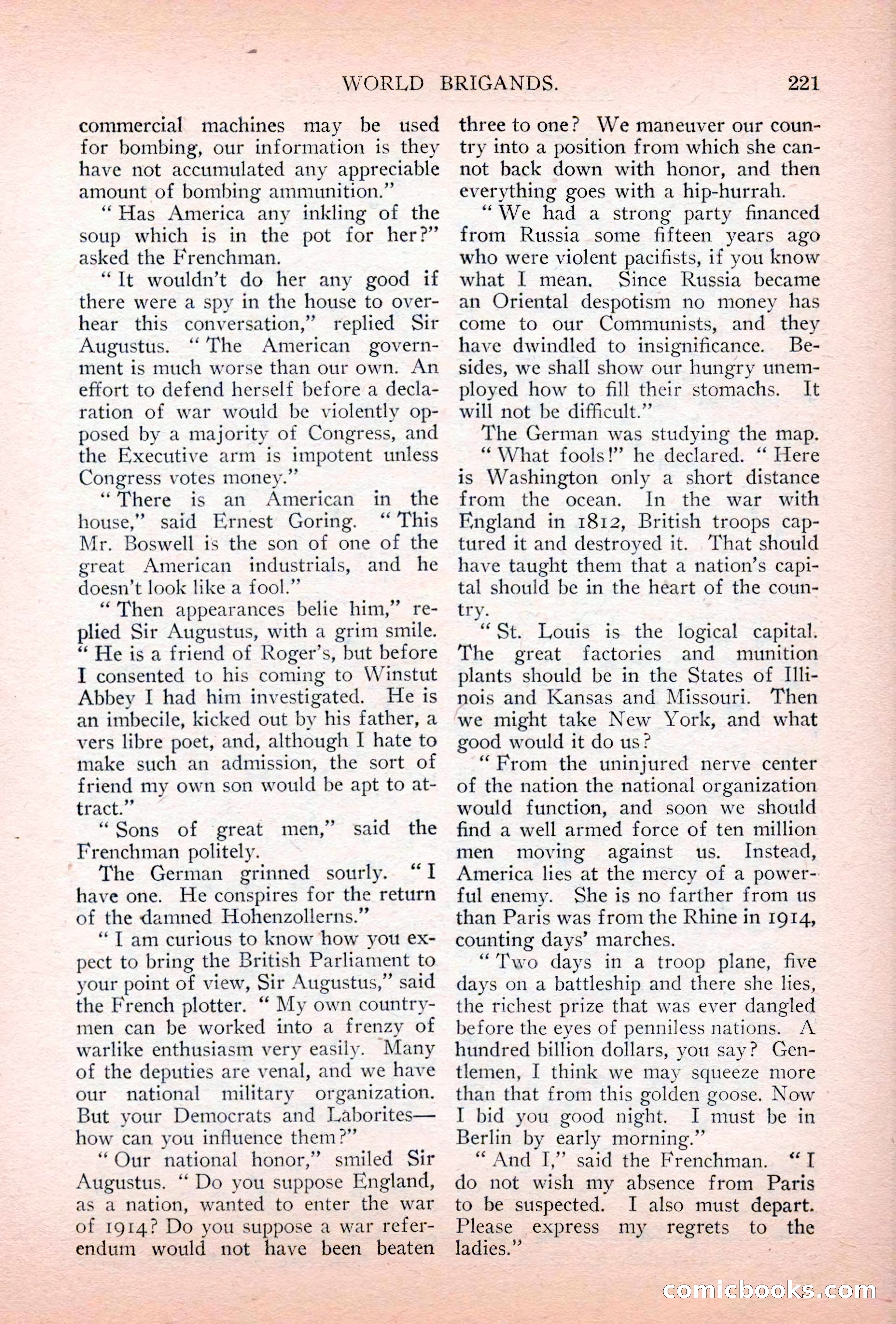
A restored page from Pulp Fiction, 1928. Page through the whole issue in the reader above.
📄 Transcribed text from this page (OCR, searchable)
Machine-transcribed from the original scan — historical spelling and the odd misread are preserved.
WORLD BRIGANDS. commercial machines may be used for bombing, our information is they have not accumulated any appreciable amount of bombing ammunition.” “Has America any inkling of the soup which is in the pot for her?” asked the Frenchman. “It wouldn’t do her any good if there were a spy in the house to over- hear this conversation,” replied Sir Augustus. “The American govern- ment is much worse than our own. An effort to defend herself before a decla- ration of war would be violently op- posed by a majority of Congress, and the Executive arm is impotent unless Congress votes money.” “There is an American in the house,” said Ernest Goring. “ This Mr. Boswell is the son of one of the great American industrials, and he doesn’t look like a fool.” “Then appearances belie him,” re- plied Sir Augustus, with a grim smile. “ He is a friend of Roger’s, but before I consented to his coming to Winstut Abbey I had him investigated. He is an imbecile, kicked out by his father, a vers libre poet, and, although I hate to make such an admission, the sort of friend my own son would be apt to at- tract.” “Sons of great men,” said the Frenchman politely. The German grinned sourly. “I have one. He conspires for the return of the damned Hohenzollerns.” “Tam curious to know how you ex- pect to bring the British Parliament to your point of view, Sir Augustus,” said the French plotter. “ My own country- men can be worked into a frenzy of warlike enthusiasm very easily. Many of the deputies are venal, and we have our national military organization. But your Democrats and Laborites— how can you influence them?” “Our national honor,” smiled Sir Augustus. “ Do you suppose England, as a nation, wanted to enter the war of 1914? Do you suppose a war refer- endum would not have been beaten 221 three to one? We maneuver our coun- try into a position from which she can- not back down with honor, and then everything goes with a hip-hurrah. “We had a strong party financed from Russia some fifteen years ago who were violent pacifists, if you know what I mean. Since Russia became an Oriental despotism no money has come to our Communists, and they have dwindled to insignificance. Be- sides, we shall show our hungry unem- ployed how to fill their stomachs. It will not be difficult.” The German was studying the map. “What fools!” he declared. “ Here is Washington only a short distance from the ocean. In the war with England in 1812, British troops cap- tured it and destroyed it. That should have taught them that a nation’s capi- tal should be in the heart of the coun- try. “St. Louis is the logical capital. The great factories and munition plants should be in the States of I[lh- nois and Kansas and Missouri. Then we might take New York, and what good would it do us? “From the uninjured nerve center of the nation the national organization would function, and soon we should find a well armed force of ten million men moving against us. Instead, America lies at the mercy of a power-: ful enemy. She is no farther from us than Paris was from the Rhine in 1914, counting days’ marches. “Two days in a troop plane, five days on a battleship and there she lies, the richest prize that was ever dangled before the eyes of penniless nations. A hundred billion dollars, you say? Gen- tlemen, [ think we may squeeze more than that from this golden goose. Now I bid you good night. I must be in Berlin by early morning.” “And I,” said the Frenchman. “TI do not wish my absence from Paris to be suspected. I also must depart. Please express my regrets to the ladies.” . Gomichbooks (E@)