
Pulp Fiction, 1928 · page 83 of 150
Argosy All-Story Weekly, July 7, 1928 — page 83: what you’re looking at
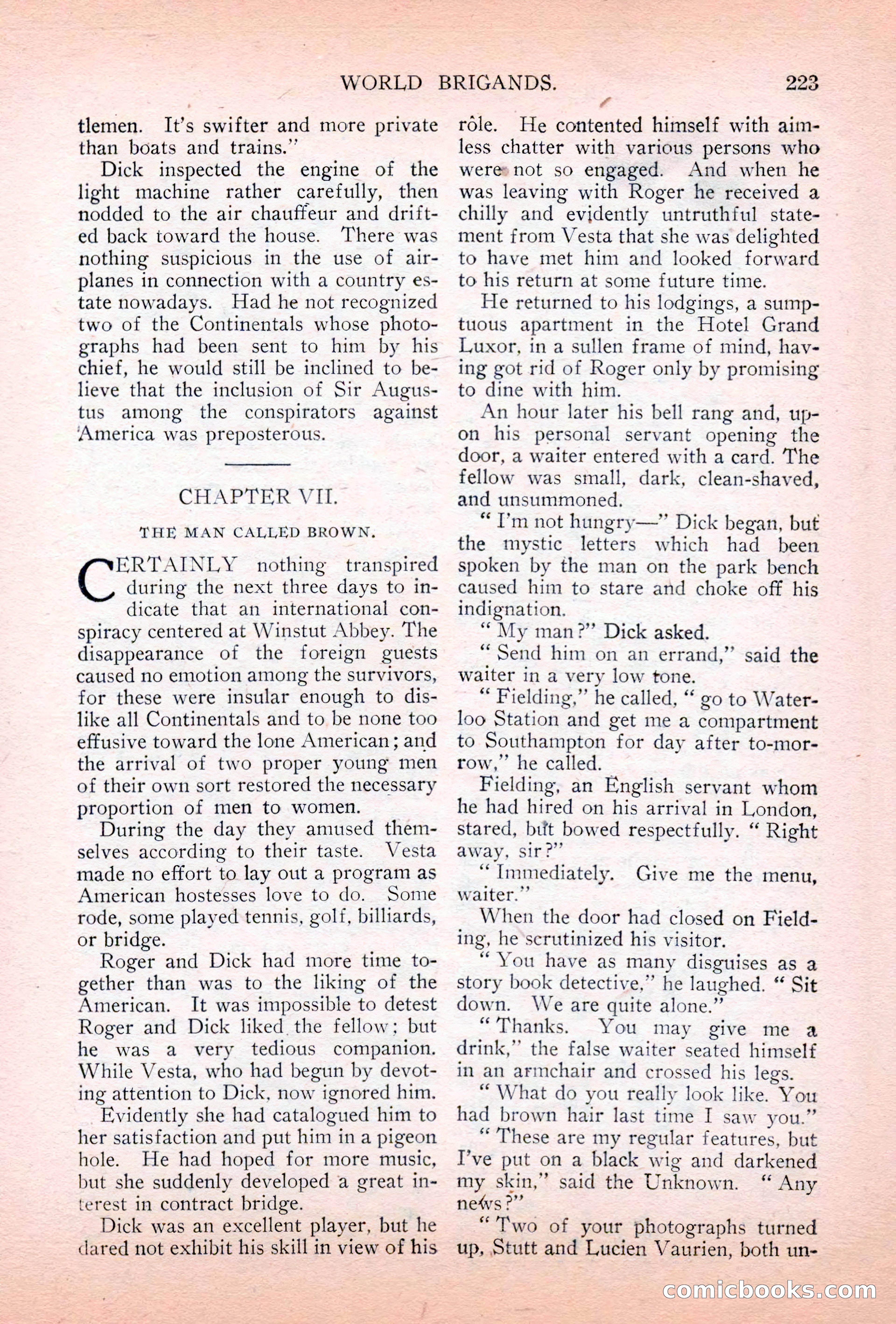
A restored page from Pulp Fiction, 1928. Page through the whole issue in the reader above.
📄 Transcribed text from this page (OCR, searchable)
Machine-transcribed from the original scan — historical spelling and the odd misread are preserved.
WORLD BRIGANDS. tlemen. It’s swifter and more private than boats and trains.” Dick inspected the engine of the light machine rather carefully, then nodded to the air chauffeur and drift- ed back toward the house. There was nothing suspicious in the use of air- planes in connection with a country es- tate nowadays. Had he not recognized two of the Continentals whose photo- graphs had been sent to him by his chief, he would still be inclined to be- lieve that the inclusion of Sir Augus- tus among the conspirators against America was preposterous. CHAPTER VE. THE MAN CALLED BROWN. ERTAINLY nothing transpired during the next three days to in- dicate that an international con- spiracy centered at Winstut Abbey. The disappearance of the foreign guests caused no emotion among the survivors, for these were insular enough to dis- like all Continentals and to be none too effusive toward the lone American; and the arrival of two proper young men of their own sort restored the necessary proportion of men to women. During the day they amused them- selves according to their taste. Vesta made no effort to lay out a program as American hostesses love to do. Some rode, some played tennis, golf, billiards, or bridge. Roger and Dick had more time to- gether than was to the liking of the American. It was impossible to detest Roger and Dick liked the fellow; but he was a very tedious companion. While Vesta, who had begun by devot- ing attention to Dick, now ignored him, FE:vidently she had catalogued him to her satisfaction and put him ina pigeon hole. He had hoped for more music, but she suddenly developed a great in- terest in contract bridge. Dick was an excellent player, but he dared not exhibit his skill in view of his 223 Fa role. He contented himself with aim- less chatter with various persons who were» not so engaged. And when he was leaving with Roger he received a chilly and evidently untruthful state- ment from Vesta that she was delighted to have met him and looked forward to his return at some future time. He returned to his lodgings, a sump- tuous apartment in the Hotel Grand Luxor, in a sullen frame of mind, hav- ing got rid of Roger only by promising to dine with him. An hour later his bell rang and, up- on his personal servant opening the door, a waiter entered with a card. The fellow was small, dark, clean-shaved, and unsummoned, “T’m not hungry—” Dick began, but the mystic letters which had been spoken by the man on the park bench caused him to stare and choke off his indignation. “My man?” Dick asked. “Send him on an errand,” said the waiter in a very low tone. “ Fielding,” he called, “ go to Water- loo Station and get me a compartment to Southampton for day after to-mor- row,’ he called. Fielding, an English servant whom he had hired on his arrival in London, stared, but bowed respectfully. “ Right away, sir?” ‘* Immediately. waiter.” When the door had closed on Field- ing, he scrutinized his visitor, “You have as many disguises as a story book detective,” he laughed. “ Sit down. We are quite alone.” “Thanks. You may give me a drink,” the false waiter seated himself in an armchair and crossed his legs. “What do you really look like. You had brown hair last time I saw you.” “These are my regular features, but I’ve put on a black wig and darkened my skin,” said the Unknown. “ Any netvs?”’ “Two of your photographs turned up, Stutt and Lucien Vaurien, both un- Give me the menu, (e(0) .OOKS AMI (E@)