
Pulp Fiction, 1928 · page 89 of 150
Argosy All-Story Weekly, July 7, 1928 — page 89: what you’re looking at
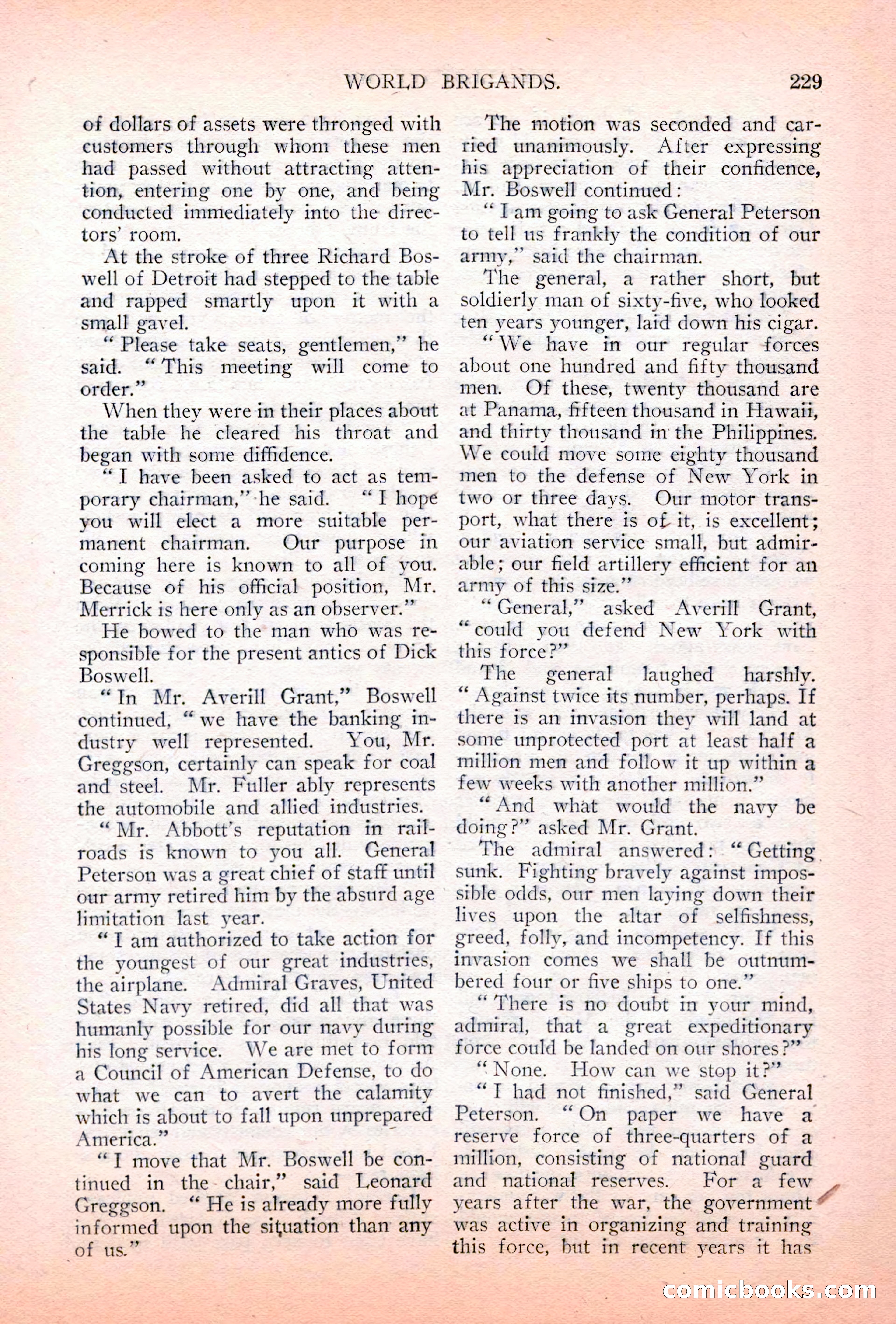
A restored page from Pulp Fiction, 1928. Page through the whole issue in the reader above.
📄 Transcribed text from this page (OCR, searchable)
Machine-transcribed from the original scan — historical spelling and the odd misread are preserved.
WORLD BRIGANDS. of dollars of assets were thronged with customers through whom these men had passed without attracting atten- tion, entering one by one, and being conducted immediately into the direc- tors’ room. At the stroke of three Richard Bos- well of Detroit had stepped to the table and rapped smartly upon it with a small gavel. “ Please take seats, gentlemen,” he said. “This meeting will come to order.” When they were in their places about the table he cleared his throat and began with some diffidence. “TI have been asked to act as tem- porary chairman,” he said. “I hope you will elect a more suitable per- manent chairman. Our purpose in coming here is known to all of you. Because of his official position, Mr. Merrick is here only as an observer.” He bowed to the man who was re- sponsible for the present antics of Dick Boswell. “Tn Mr. Averill Grant,” Boswell continued, “ we have the banking in- dustry well represented. You, Mr. Greggson, certainly can speak for coal and steel. Mr. Fuller ably represents the automobile and allied industries. “Mr. Abbott’s reputation in rail- roads is known to you all. General Peterson was a great chief of staff until our army retired him by the absurd age limitation last year. “Tam authorized to take action for the youngest of our great industries, the airplane. Admiral Graves, United States Navy retired, did all that was humanly possible for our navy during his long service. We are met to form a Council of American Defense, to do what we can to avert the calamity which is about to fall upon unprepared America.” “T move that Mr. Boswell be con- tinued in the- chair,” said Leonard Greggson. “ He is already more fully informed upon the situation than any of us.” 229 The motion was seconded and car- ried unanimously. After expressing his appreciation of their confidence, Mr. Boswell continued : ‘Tam going to ask General Peterson to tell us frankly the condition of our army, said the chairman. The general, a rather short, but soldierly man of sixty-five, who looked ten years younger, laid down his cigar. “We have in our regular forces about one hundred and fifty thousand men. Of these, twenty thousand are at Panama, fifteen thousand in Hawait, and thirty thousand in the Philippines. We could move some eighty thousand men to the defense of New York in two or three days. Our motor trans- port, what there is of it, is excellent; our aviation service small, but admir- able; our field artillery efficient for an army of this size.” “General,” asked Averill Grant, “could you defend New York with this force?” The general laughed harshly. “ Against twice its number, perhaps. If there is an invasion they will land at some unprotected port at least half a million men and follow it up within a few weeks with another million.” “And what would the navy doing?” asked Mr. Grant. be The admiral answered: “ Getting. sunk. Fighting bravely against impos- sible odds, our men laying down their lives upon the altar of selfishness, greed, folly, and incompetency. If this invasion comes we shall be outnum- bered four or five ships to one.” “There is no doubt in your mind, admiral, that a great expeditionary force could be landed on our shores?” “None. How can we stop it?” “T had not finished,” said General Peterson. “On paper we have a reserve force of three-quarters of a million, consisting of national guard and national reserves. For a few years after the war, the government was active in organizing and training this force, but in recent years it has comicbooks