
Pulp Fiction, 1928 · page 92 of 150
Argosy All-Story Weekly, July 7, 1928 — page 92: what you’re looking at
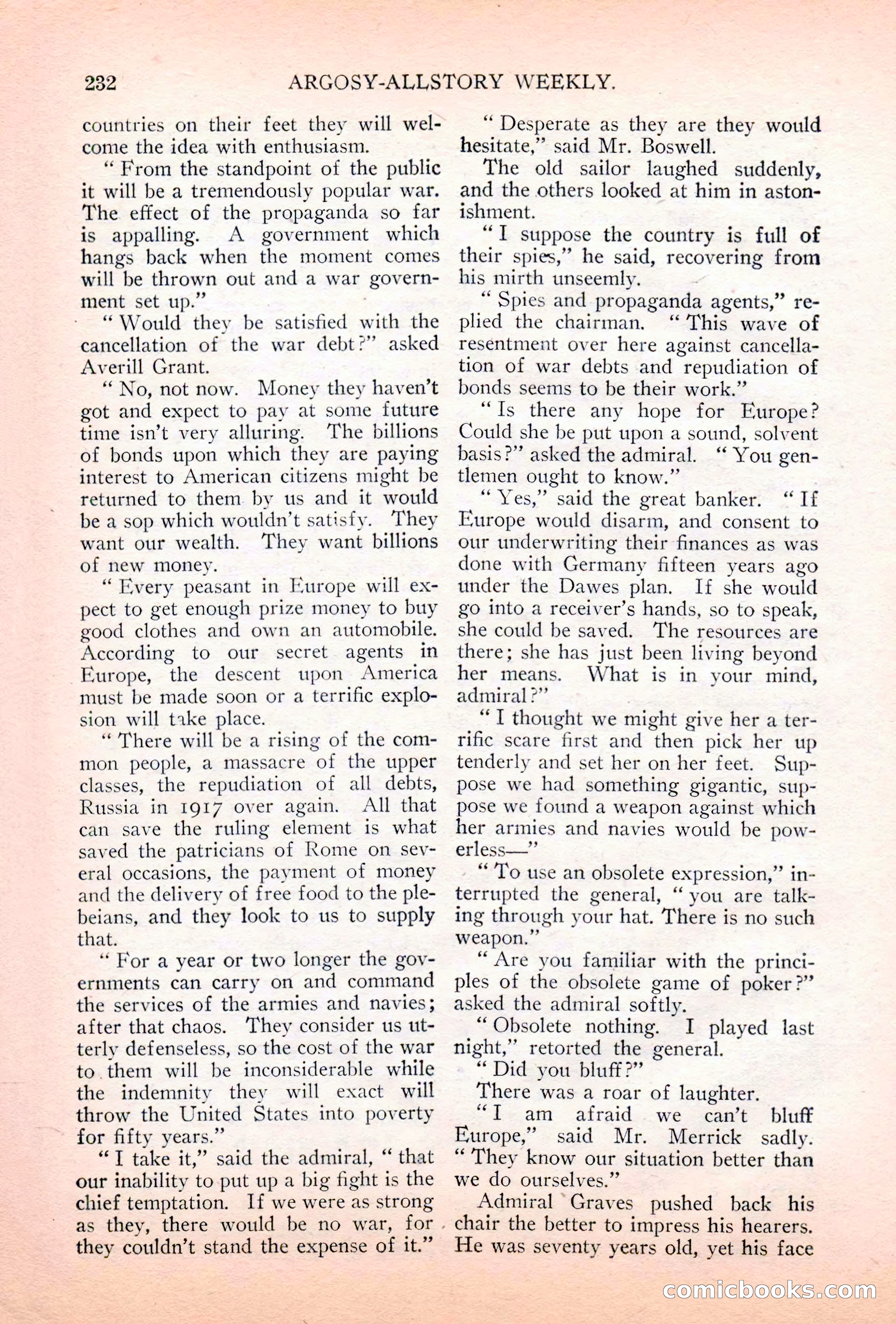
A restored page from Pulp Fiction, 1928. Page through the whole issue in the reader above.
📄 Transcribed text from this page (OCR, searchable)
Machine-transcribed from the original scan — historical spelling and the odd misread are preserved.
232 countries on their feet they will wel- come the idea with enthusiasm. “From the standpoint of the public it will be a tremendously popular war. The effect of the propaganda so far is appalling. A government which hangs back when the moment comes will be thrown out and a war govern- ment set up.” “Would they be satisfied with the cancellation of the war debt?” asked Averill Grant. ‘No, not now. Money they haven’t got and expect to pay at some future time isn’t very alluring. The billions of bonds upon which they are paying interest to American citizens might be returned to them by us and it would be a sop which wouldn’t satisfy. They want our wealth. They want billions of new money. “Every peasant in Europe will ex- pect to get enough prize money to buy good clothes and own an automobile. According to our secret agents in Europe, the descent upon America must be made soon or a terrific explo- sion will take place. “There will be a rising of the com- mon people, a massacre of the upper classes, the repudiation of all debts, Russia in 1917 over again. All that can save the ruling element is what saved the patricians of Kome on sevy- eral occasions, the payment of money and the delivery of free food to the ple- beians, and they look to us to supply that. “For a year or two longer the gov- ernments can carry on and command the services of the armies and navies; after that chaos. They consider us ut- terly defenseless, so the cost of the war to. them will be inconsiderable while the indemnity they will exact will throw the United States into poverty for fifty years.” “T take it,” said the admiral, “ that our inability to put up a big fight is the chief temptation. If we were as strong as they, there would be no war, for . they couldn’t stand the expense of it.” ARGOSY-ALLSTORY WEEKLY. “ Desperate as they are they would hesitate,” said Mr. Boswell. The old sailor laughed suddenly, and the others looked at him in aston- ishment. “I suppose the country is full of their spies,” he said, recovering from his mirth unseemly. “ Spies and propaganda agents,” re- plied the chairman. ‘ This wave of resentment over here against cancella- tion of war debts and repudiation of bonds seems to be their work.” “Is there any hope for Europe? Could she be put upon a sound, solvent basis?” asked the admiral. “‘ You gen- tlemen ought to know.” “Yes,” said the great banker. “If Europe would disarm, and consent to our underwriting their finances as was done with Germany fifteen years ago under the Dawes plan. If she would go into a receiver’s hands, so to speak, she could be saved. The resources are there; she has just been living beyond her means. What is in your mind, admiral ?”’ ‘I thought we might give her a ter- rific scare first and then pick her up tenderly and set her on her feet. Sup- pose we had something gigantic, sup- pose we found a weapon against which her armies and navies would be pow- erless—” “To use an obsolete expression,” in- terrupted the general, “ you are talk- ing through your hat. There is no such weapon.” “ Are you familiar with the princi- ples of the obsolete game of poker?” asked the admiral softly. “Obsolete nothing. I played last night,” retorted the general. “Did you bluff?” There was a roar of laughter. “Tam afraid we can’t bluff Europe,” said Mr. Merrick sadly. “They know our situation better than we do ourselves.” Admiral Graves pushed back his chair the better to impress his hearers. He was seventy years old, yet his face CORNICE OOOKS (C@