
Pulp Fiction, 1928 · page 128 of 156
Argosy All-Story Weekly — "Sea Marauders" — page 128: what you’re looking at
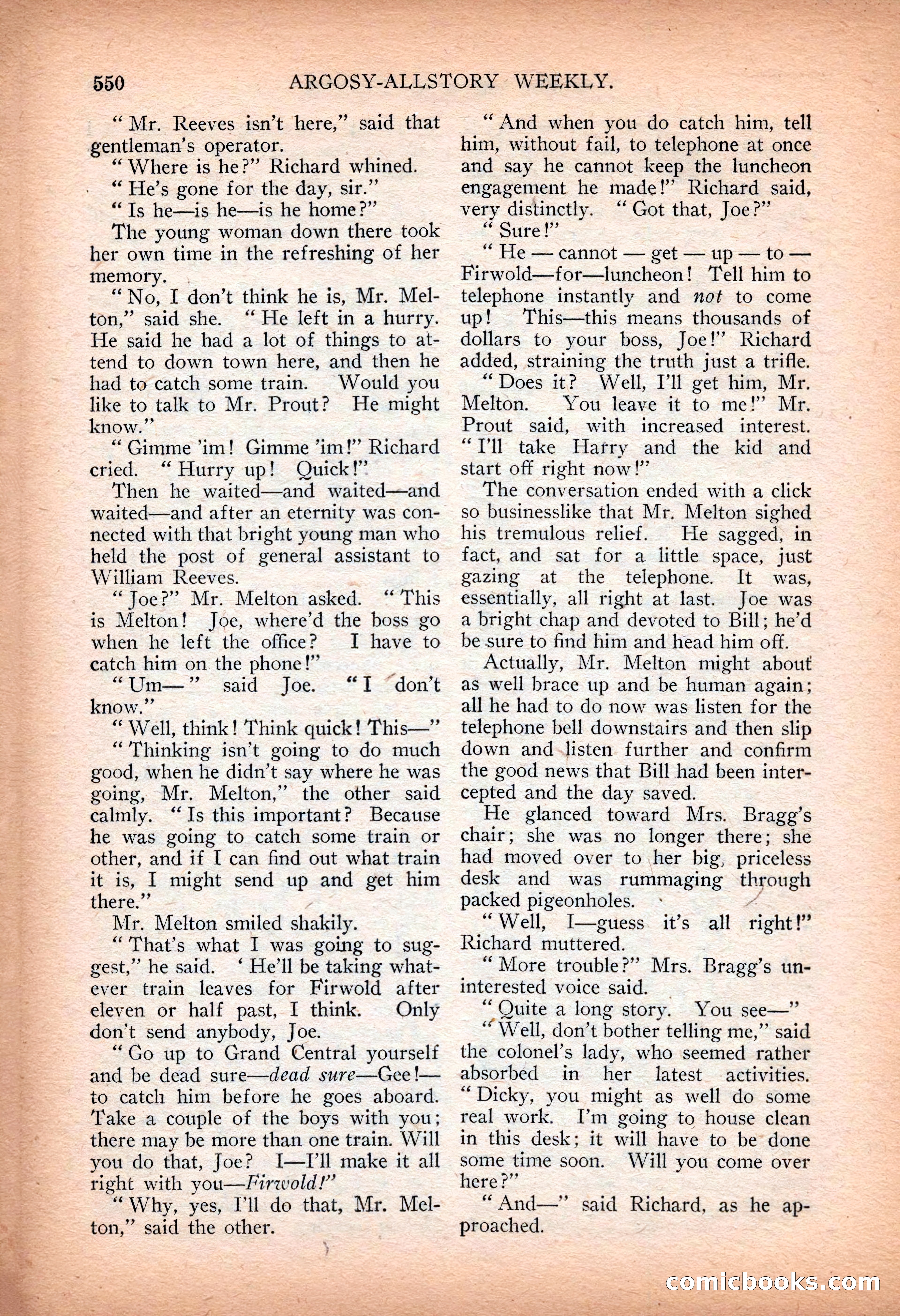
A restored page from Pulp Fiction, 1928. Page through the whole issue in the reader above.
📄 Transcribed text from this page (OCR, searchable)
Machine-transcribed from the original scan — historical spelling and the odd misread are preserved.
— wo ~ + - * = s a ek iT Oe =~ Sl ee ed Ye, wie og * oe es “he eee ee gt ew ee ee ee en ee ee Oe ahd og a | Eee pan LY 58 ee Nnwe de ee es oe a . ay os pg mS Oe SE an) Ris TRA Fe ge en + PS Sei Ph an a Ae aoe Ss ; el or as ~~ + ; es a ne ee << —— mS 9) - —" - 550 ARGOSY-ALLSTORY WEEKLY. “Mr. Reeves isn’t here,” said that gentleman's operator. “Where is he?” Richard whined. “ He’s gone for the day, sir.” “Ts he—is he—is he home?” The young woman down there took her own time in the refreshing of her memory. . “No, I don’t think he is, Mr. Mel- ton,” said she. “ He left in a hurry. He said he had a lot of things to at- tend to down town here, and then he had to catch some train. Would you like to talk to Mr. Prout? He might know.” “ Gimme ’im! Gimme ’im!” Richard cried. “ Hurry up! Quick!” Then he waited—and waited—and waited—and after an eternity was con- nected with that bright young man who held the post of general assistant to William Reeves. “Joe?” Mr. Melton asked. ‘ This is Melton! Joe, where’d the boss go when he left the office? I have to catch him on. the phone!” “Um—” said Joe. “I ‘don't know.” “ Well, think! Think quick! This—” “Thinking isn’t going to do much good, when he didn’t say where he was going, Mr. Melton,” the other said calmly. “Is this important? Because he was going to catch some train or other, and if I can find out what train it is, I might send up and get him there.” Mr. Melton smiled shakily. “That’s what I was going to sug- gest,” he said. ‘ He’ll be taking what- ever train leaves for Firwold after eleven or half past, I think. Only don’t send anybody, Joe. “Go up to Grand Central yourself and be dead sure—dead sure—Gee!— to catch him before he goes aboard. Take a couple of the boys with you; there may be more than one train. Will you do that, Joe? I—TIl make it all right with you—Firwold!”’ “Why, yes, Pll do that, Mr. Mel- ton,” said the other. “And when you do catch him, tell him, without fail, to telephone at once and say he cannot keep the luncheon engagement he made!” Richard said, very distinctly. ‘“ Got that, Joe?” “Sure!” “ He — cannot — get — up — to — Firwold—for—luncheon! Tell him to telephone instantly and not to come up! This—this means thousands of dollars to your boss, Joe!” Richard added, straining the truth just a trifle. “Does it? Well, I'll get him, Mr. Melton. You leave it to me!” Mr, Prout said, with increased interest. “Till take Hafry and the kid and start off right now!” The conversation ended with a click so businesslike that Mr. Melton sighed his tremulous relief. He sagged, in fact, and sat for a little space, just gazing at the telephone. It was, essentially, all right at last. Joe was a bright chap and devoted to Bill; he’d be sure to find him and head him off. Actually, Mr. Melton might about as well brace up and be human again; all he had to do now was listen for the telephone bell downstairs and then slip down and-listen further and confirm the good news that Bill had been inter- cepted and the day saved. He glanced toward Mrs. Bragg’s chair; she was no longer there; she had moved over to her big, priceless desk and was rummaging through packed pigeonholes. “Well, I—guess it’s all ha i Richard muttered. “More trouble?” Mrs. Bragg’s un- interested voice said. _ “ Quite a long story. You see—" “Well, don’t bother telling me,” said the colonel’s lady, who seemed rather absorbed in her latest activities. “Dicky, you might as well do some real work. I’m going to house clean in this desk; it will have to be done some time soon. Will you come over here?” said Richard, as he ap- proached. comicbooks:com — % = en - ml ~ “¢ +. oe ‘ ay & ‘ae fas IEF ie Oe oe ne a. Oh a.