
Pulp Fiction, 1928 · page 13 of 156
Argosy All-Story Weekly — "Sea Marauders" — page 13: what you’re looking at
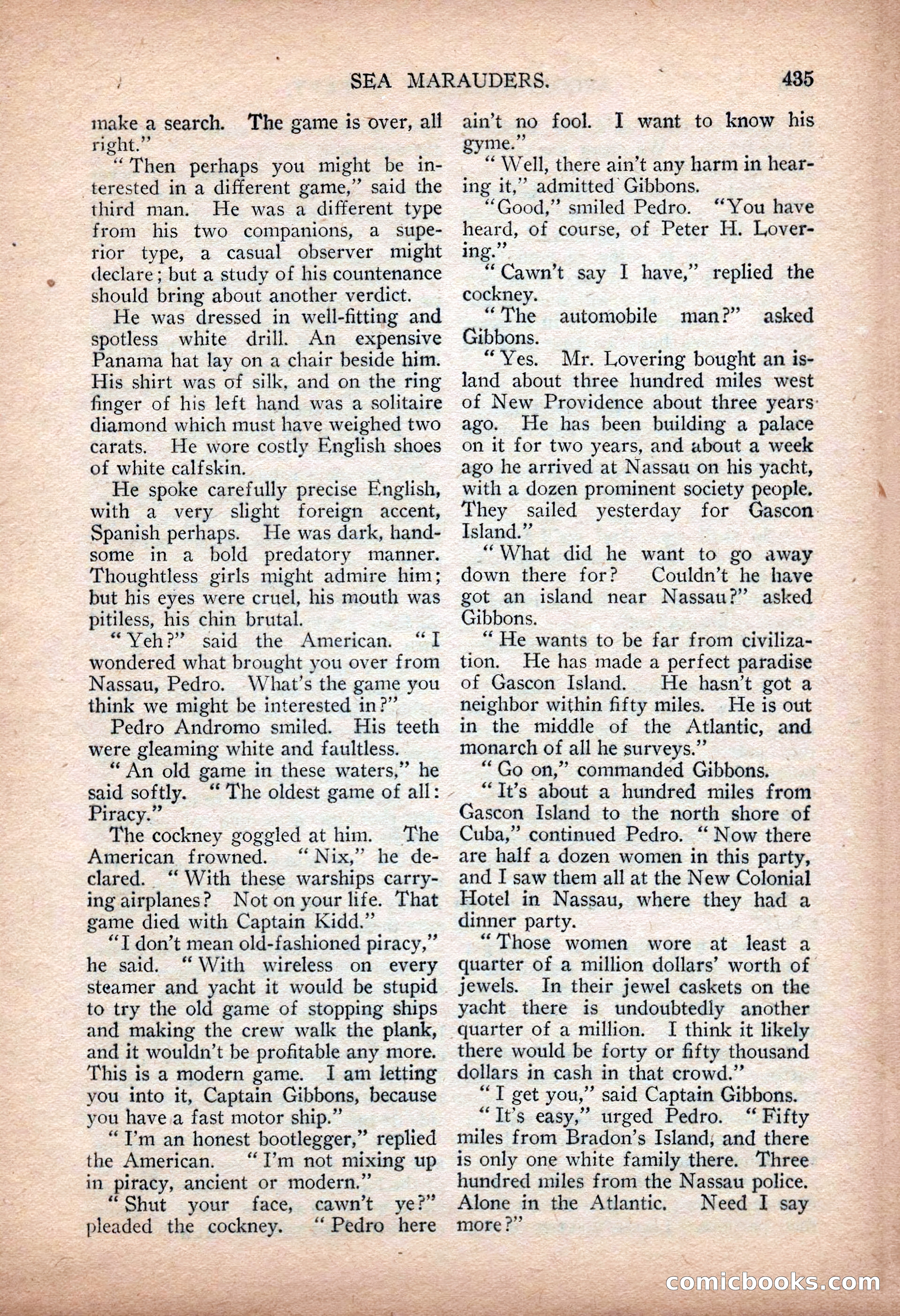
A restored page from Pulp Fiction, 1928. Page through the whole issue in the reader above.
📄 Transcribed text from this page (OCR, searchable)
Machine-transcribed from the original scan — historical spelling and the odd misread are preserved.
SEA MARAUDERS. make a search. The game is over, all right.” “Then perhaps you might be in- terested in a different game,” said the third man. He was a different type from his two companions, a swpe- rior type, a casual observer might declare; but a study of his countenance should bring about another verdict. He was dressed in well-fitting and spotless white drill. An expensive Panama hat lay on a chair beside him. His shirt was of silk, and on the ring finger of his left hand was a solitaire diamond which must have weighed two carats. He wore costly English shoes of white calfskin. He spoke carefully precise English, with a very slight foreign accent, Spanish perhaps. He was dark, hand- some in a hold predatory manner. Thoughtless girls might admire him; but his eyes were cruel, his mouth was pitiless, his chin brutal. “Yeh?” said the American. “I wondered what brought you over from Nassau, Pedro. What's the game you think we might be interested in?” Pedro Andromo smiled. His teeth were gleaming white and faultless. “An old game in these waters,” he said softly. Piracy.” The cockney goggled at him. The American frowned. “Nix,” he de- clared. ‘‘ With these warships carry- ing airplanes? Not on your life. That game died with Captain Kidd.” “T don’t mean old-fashioned piracy,” he said. “‘ With wireless on every steamer and yacht it would be stupid to try the old game of stopping ships and making the crew walk the plank, and it wouldn’t be profitable any more. This is a modern game. I am letting you into it, Captain Gibbons, because you have a fast motor ship.” “T’m an honest bootlegger,” replied the American. “I’m not mixing up in piracy, ancient or modern.” “Shut your face, cawn’t ye?” “Pedro here pleaded the cockney. “The oldest game of all: - - Fat » ad ~ ad =e ore > = a ~ Pe . > 4 4 E ~- = a=. > ny Py —_ ~ « a hp a OA a eS FOI ag = gg gg Oe ge Om ee ae ¥ i te howe, “ - ot < I, Re er ae Ge eT OE a ee RENT eRe Ae aT 435 ain’t no fool. J want to know his me.” “Well, there ain’t any harm in hear-— ing it,’ admitted Gibbons. ‘““Good,” smiled Pedro. ‘You have heard, of course, of Peter H. Lover- ing.” “Cawn’t say I have,” replied the cockney. “The automobile man?’ asked Gibbons. “Yes. Mr. Lovering bought an is- land about three hundred miles west of New Providence about three years: ago. He has been building a palace on it for two years, and about a week ago he arrived at Nassau on his yacht, with a dozen prominent society people. They sailed yesterday for Gascon: Island.” , “What did he want to go away down there for? Couldn’t he have got an island near Nassau?” asked Gibbons. * He wants to be far from civiliza- tion. He has made a perfect paradise of Gascon Island. He hasn’t got a neighbor within fifty miles. He is out in the middle of the Atlantic, and monarch of all he surveys.”’ “Go on,” commanded Gibbons. “It’s about a hundred miles from Gascon Island to the north shore of Cuba,” continued Pedro. “‘ Now there are half a dozen women in this party, and I saw them all at the New Colonial Hotel in Nassau, where they had a dinner party. “Those women wore at least a quarter of a million dollars’ worth of jewels. In their jewel caskets on the yacht there is undoubtedly another quarter of a million. I think it likely there would be forty or fifty thousand dollars in cash in that crowd.” “T get you,” said Captain Gibbons. “It’s easy,” urged Pedro. “ Fifty miles from Bradon’s Island; and there is only one white family there. Three hundred miles from the Nassau police. Alone in the Atlantic. Need I say more?” comicboo ™ Le oS om , “ ~~ Pe ce ee tae _ x — 3