
Pulp Fiction, 1928 · page 46 of 156
Argosy All-Story Weekly — "Sea Marauders" — page 46: what you’re looking at
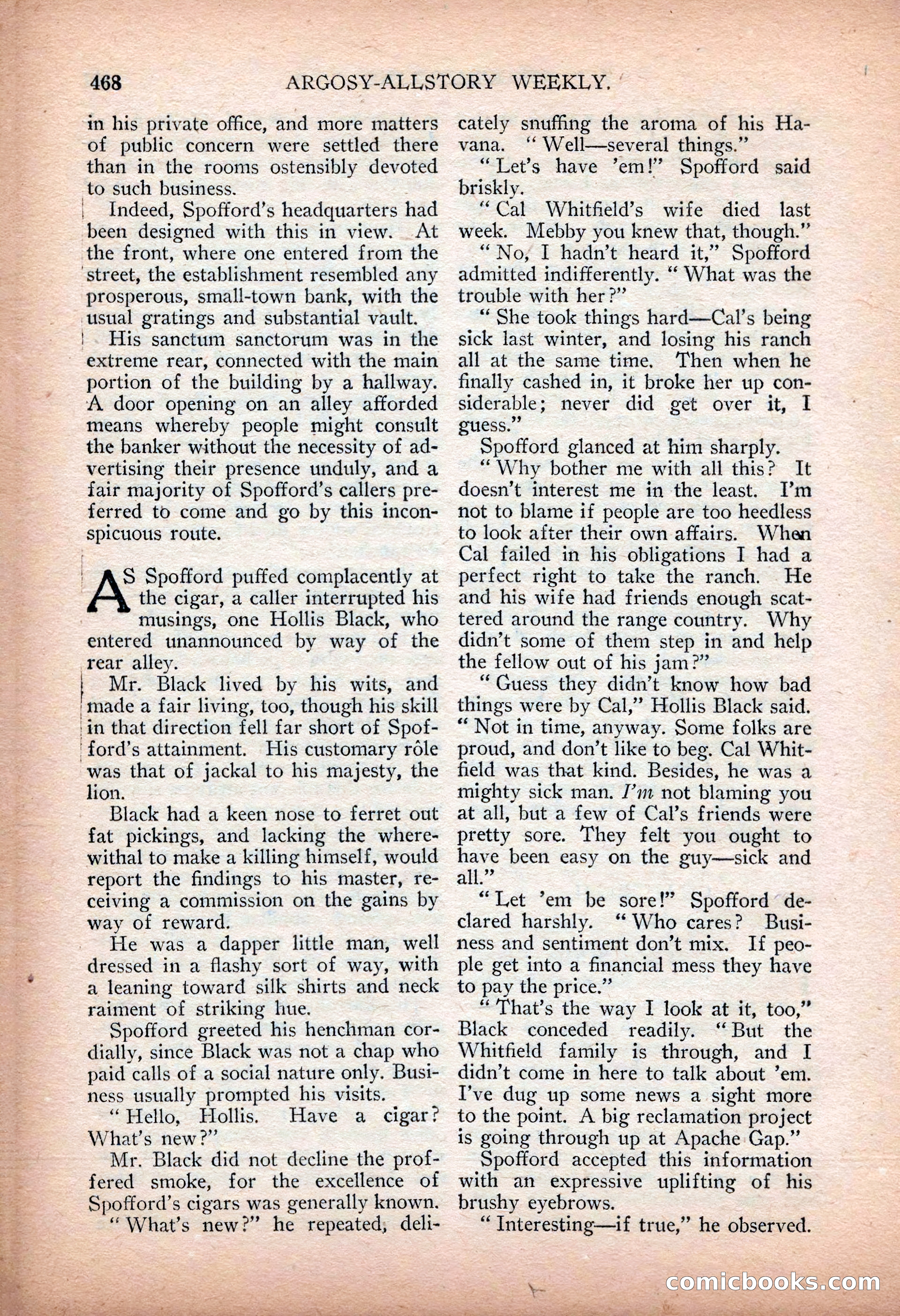
A restored page from Pulp Fiction, 1928. Page through the whole issue in the reader above.
📄 Transcribed text from this page (OCR, searchable)
Machine-transcribed from the original scan — historical spelling and the odd misread are preserved.
oa 468 i his private office, and more matters of public concern were settled there than in the rooms ostensibly devoted to such business. | Indeed, Spofford’s headquarters had been designed with this in view. At the front, where one entered from the ‘street, the establishment resembled any prosperous, small-town bank, with the ustial gratings and substantial vault. |. His sanctum sanctorum was in the extreme rear, connected with the main portion of the building by a hallway. A door opening on an alley afforded means whereby people might consult the banker without the necessity of ad- vertising their presence unduly, and a fair majority of Spofford’s callers pre- ferred to come and go by this incon- spicuous route. S Spofford puffed complacently at the cigar, a caller interrupted his musings, one Hollis Black, who entered unannounced by way of the rear alley. | Mr. Black lived by his wits, and ‘made a fair living, too, though his skill ‘in that direction fell far short of Spof- ford’s attainment. His customary role was that of jackal to his majesty, the lion. Black had a keen nose to ferret out fat pickings, and lacking the where- withal to make a killing himself, would report the findings to his master, re- ceiving a commission on the gains by way of reward. He was a dapper little man, well dressed in a flashy sort of way, with a leaning toward silk shirts and neck raiment of striking hue. Spofford greeted his henchman cor- dially, since Black was not a chap who paid calls of a social nature only. Busi- ness usually prompted his visits. “Hello, Hollis. Have a cigar? What’s new?” Mr. Black did not decline the prof- fered smoke, for the excellence of Spofford’s cigars was generally known. ‘What’s new?” he repeated, deli- ARGOSY-ALLSTORY WEEKLY, | cately snuffing the aroma of his Ha- vana. ‘‘ Well—several things.” “Let’s have ’em!”’ Spofford said briskly. “Cal Whitfield’s wife died last week. Mebby you knew that, though.” “No, I hadn’t heard it,” Spofford admitted indifferently. ‘‘ What was the trouble with her?” “ She took things hard—Cal’s being sick last winter, and losing his ranch all at the same time. ‘Then when he finally cashed in, it broke her up con- siderable; never did get over it, I guess.” Spofford glanced at him sharply. “Why bother me with all this? It doesn’t interest me in the least. I’m not to blame if people are too heedless to look after their own affairs. When Cal failed in his obligations I had a perfect right to take the ranch. He and his wife had friends enough scat- tered around the range country. Why didn’t some of them step in and help the fellow out of his jam?” “Guess they didn’t know how bad things were by Cal,” Hollis Black said. “ Not in time, anyway. Some folks are proud, and don’t like to beg. Cal Whit- field was that kind. Besides, he was a mighty sick man. J’m not blaming you at all, but a few of Cal’s friends were pretty sore. They felt you ought to ods been easy on the guy—sick and al +9 “Let ’em be sore!” Spofford de- clared harshly. ‘‘ Who cares? Busi- ness and sentiment don’t mix. If peo- ple get into a financial mess they have to pay the price.” “That’s the way I look at it, too,” Black conceded readily. “But the Whitfield family is through, and I didn’t come in here to talk about ’em. I’ve dug up some news a sight more to the point. A big reclamation proj ect is going through up at Apache Gap.” Spofford accepted this information with an expressive uplifting of his brushy eyebrows. “ Interesting—if true,” he observed. \ | po eee com a -s |e 2 2 | Pind ER | - _— “van Meas ee