
Pulp Fiction, 1928 · page 49 of 156
Argosy All-Story Weekly — "Sea Marauders" — page 49: what you’re looking at
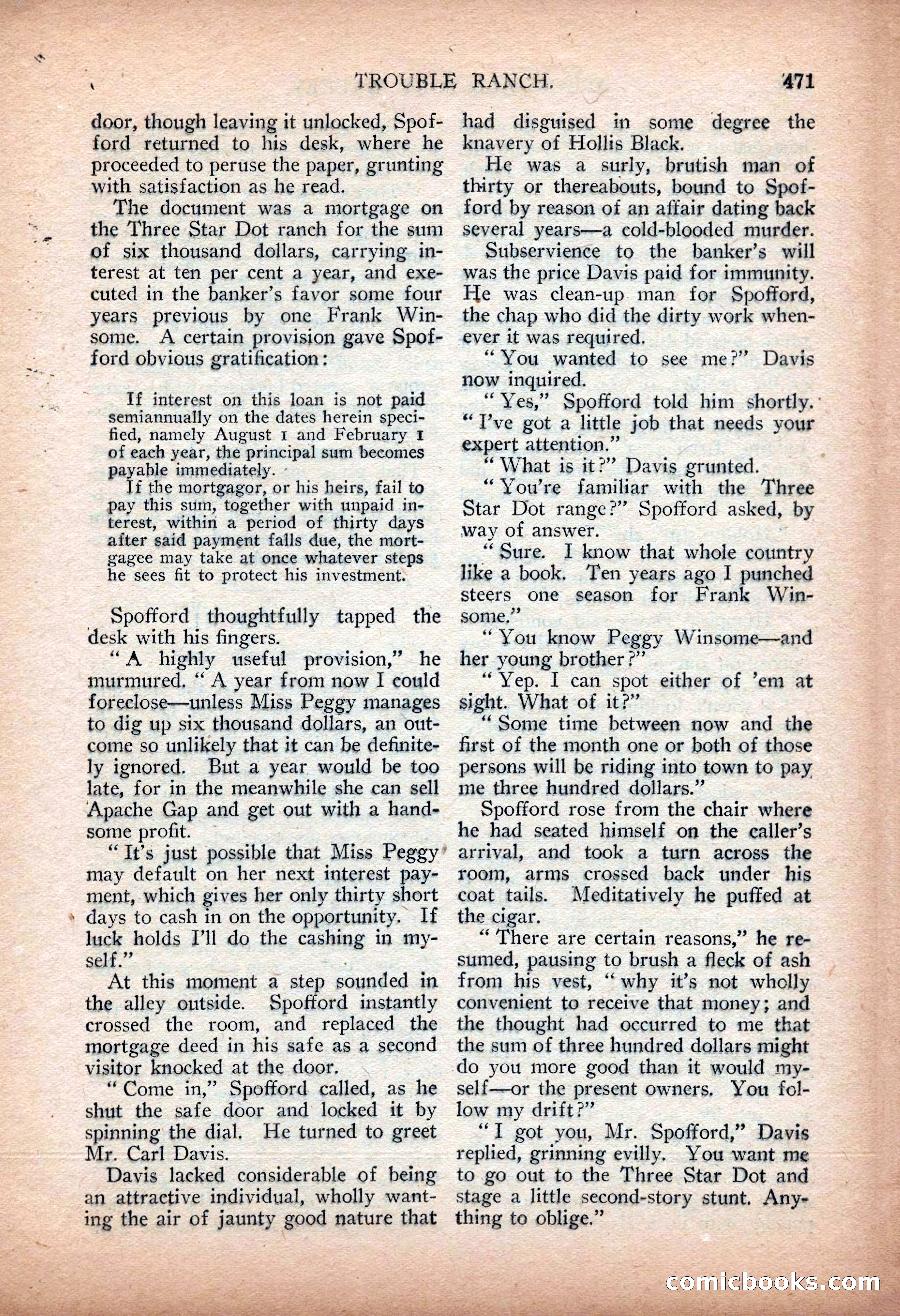
A restored page from Pulp Fiction, 1928. Page through the whole issue in the reader above.
📄 Transcribed text from this page (OCR, searchable)
Machine-transcribed from the original scan — historical spelling and the odd misread are preserved.
< door, though leaving it unlocked, Spof- ford returned to his desk, where he proceeded to peruse the paper, grunting with satisfaction as he read. The document was a mortgage on the Three Star Dot ranch for the sum of six thousand dollars, carrying. in- terest at ten per cent a year, and exe- cuted in the banker’s favor some four years previous by one Frank Win- some. A certain provision gave Spof- ford obvious gratification: If interest on this loan is not paid semiannually on the dates herein speci- fied, namely August 1 and February 1 of each year, the principal sum becomes payable immediately. - | f the mortgagor, or his heirs, fail to pay this sum, together with unpaid in- terest, within a period of thirty days after said payment falls due, the mort- gagee may take at once whatever steps he sees fit to protect his investment. Spofford thoughtfully tapped the desk with his fingers. “A highly useful provision,’ he murmured. “A year from now I could foreclose—unless Miss Peggy manages to dig up six thousand dollars, an out- come so unlikely that it can be definite- ly ignored. But a year would be too late, for in the meanwhile she can sell Apache Gap and get out with a hand- some profit. — “It’s just possible that Miss Peggy’ may default on her next interest pay- ment, which gives her only thirty short days to cash in on the opportunity. If luck holds Pll do the cashing in my- self.” At this moment a step sounded in the alley outside. Spofford instantly crossed the room, and replaced the mortgage deed in his safe as a second visitor knocked at the door. “Come in,” Spofford called, as he shut the safe door and locked it by spinning the dial. Mr. Carl Davis. Davis lacked considerable of being an attractive individual, wholly want- ing the air of ae, good nature that He turned to greet TROUBLE RANCH. AT1 had disguised in some degree the knavery of Hollis Black. He was a surly, brutish man of thirty or thereabouts, bound to Spof- ford by reason of an affair dating back several years—a cold-blooded murder. Subservience to the banker’s will was the price Davis paid for immunity. He was clean-up man for Spofford, the chap who did the dirty work when- ever it was required. “You wanted to see me?’ Davis now inquired. ‘ec Yes,” “T’ve got a little job that needs your expert attention.” “What is it?” Davis grunted. “You're familiar with the Three star Dot range?” Spofford asked, by way of answer. “Sure. I know that whole sonnkes like a book. Ten years ago I punched steers one season for Frank Win- some,”’ “You know Peggy Winsome—and her young brother ?” “Yep. I can spot either of ’em at sight. What of it?” “Some time between now and the first of the month one or both of those persons will be riding into town to pay me three hundred dollars.” Spofford rose from the chair where he had seated himself on the caller’s arrival, and took a turn across the room, arms crossed back under his coat tails. Meditatively he puffed at the cigar. “There are certain reasons,” he re- sumed, pausing to brush a fleck of ash from his vest, “why it’s not wholly convenient to receive that money; and the thought had occurred to me that the sum of three hundred dollars might do you more good than it would my- self—or the present owners, You fol- low my drift?” “T got you, Mr. Spofford,” Davis replied, grinning evilly. You want me to go out to the Three Star Dot and stage a little second-story stunt. Any- thing to oblige.” = souleoo sic, com ——- spofford told him shortly.