
Pulp Fiction, 1928 · page 52 of 156
Argosy All-Story Weekly — "Sea Marauders" — page 52: what you’re looking at
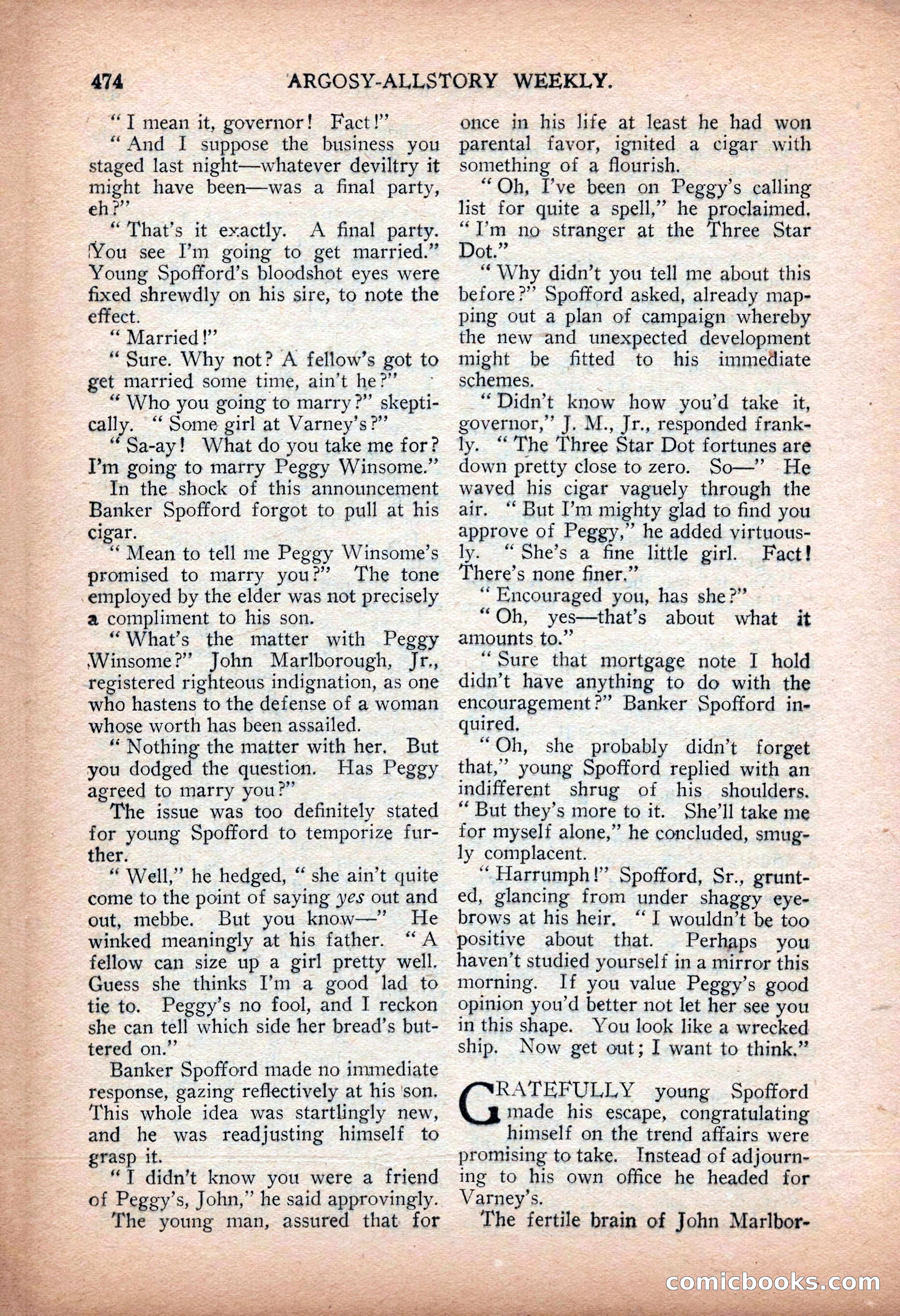
A restored page from Pulp Fiction, 1928. Page through the whole issue in the reader above.
📄 Transcribed text from this page (OCR, searchable)
Machine-transcribed from the original scan — historical spelling and the odd misread are preserved.
474 ARGOSY-ALLSTORY WEEKLY. “T mean it, governor! Fact!” “And I suppose the business you staged last night—whatever deviltry it might have been—was a final party, eh?” | “ That’s it exactly. <A final party. You see I’m going to get married.” Young Spofford’s bloodshot eyes were fixed shrewdly on his sire, to note the effect. “ Married!” “Sure. Why not? A fellow’s got to get married some time, ain’t her” ~ “ Who you going to marry ?”’ skepti- cally. ‘‘ Some girl at Varney’s ?”’ ““Sa-ay! What do you take me for? I’m going to marry Peggy Winsome.” In the shock of this announcement Banker Spofford forgot to pull at his cigar. ‘Mean to tell me Peggy Winsome’s promised to marry you?’ The tone -employed by the elder was not precisely a compliment to his son. “What's the matter with Peggy Winsome?” John Marlborough, Jr., registered righteous indignation, as one who hastens to the defense of a woman whose worth has been assailed. “ Nothing the matter with her. But you Peres the question. Has Peggy agreed to marry you?” The issue was too definitely stated for young Spofford to temporize fur- ther. “ Well,” he hedged, “ she ain’t quite come to the point of saying yes out and out, mebbe. But you know—’” He winked meaningly at his father. “A fellow can size up a girl pretty well. Guess she thinks I’m a good lad to tie to. Peggy’s no fool, and I reckon she can tell which side her bread’s but- tered on.” Banker Spofford made no immediate response, gazing reflectively at his ‘son. This whole idea was startlingly new, and he was readjusting himself to grasp it. “T didn’t know you were a friend of Peggy’s, John,” he said approvingly. The young man, assured that for once in his life at least he had won parental favor, ignited a cigar with something of a flourish. : “Oh, I’ve been on Peggy’s calling list for quite a spell,” he proclaimed, “I’m no stranger at the Three Star Dot.” “Why didn’t you tell me about this before?” Spofford asked, already map- ping out a plan of campaign whereby the new and unexpected development might be fitted to his immediate schemes. “Didn’t know how you'd take it, governor,” J. M., Jr., responded frank- ly. “The Three Star Dot fortunes are down pretty close to zero. So—’ He waved his cigar vaguely through the air. “* But I’m mighty glad to find you approve of Peggy,’ he added virtuous- ly. “She’s a fine little girl. Fact! There’s none finer.” “Encouraged you, has she?” “Oh, yes—that’s about what it amounts to.”’ “Sure that mortgage note I hold didn’t have anything to do with the encouragement?” Banker Spofford in- quired, “Oh, she probably didn’t forget that,” young Spofford replied with an indifferent shrug of his shoulders. “But they’s more to it. She’ll take me for myself alone,” he concluded, smug- ly complacent. “ Harrumph!” Spofford, Sr., grunt- ed, glancing from under shaggy eye- brows at his heir. “I wouldn’t be too positive about that. Perhaps you haven’t studied yourself in a mirror this morning. If you value Peggy’s good opinion you'd better not let her see you in this shape. You look like a wrecked ship. Now get out; I want to think,” RATEFULLY young Spofford made his escape, congratulating himself on the trend affairs were promising to take. Instead of adjourn- ing to his own office he headed for Varney’s. The fertile brain of John Marlbor- * —- ‘ — S icbooks-.com —