
Pulp Fiction, 1920 · page 110 of 232
Argosy All-Story Weekly, Vol. 123, No. 3 — page 110: what you’re looking at
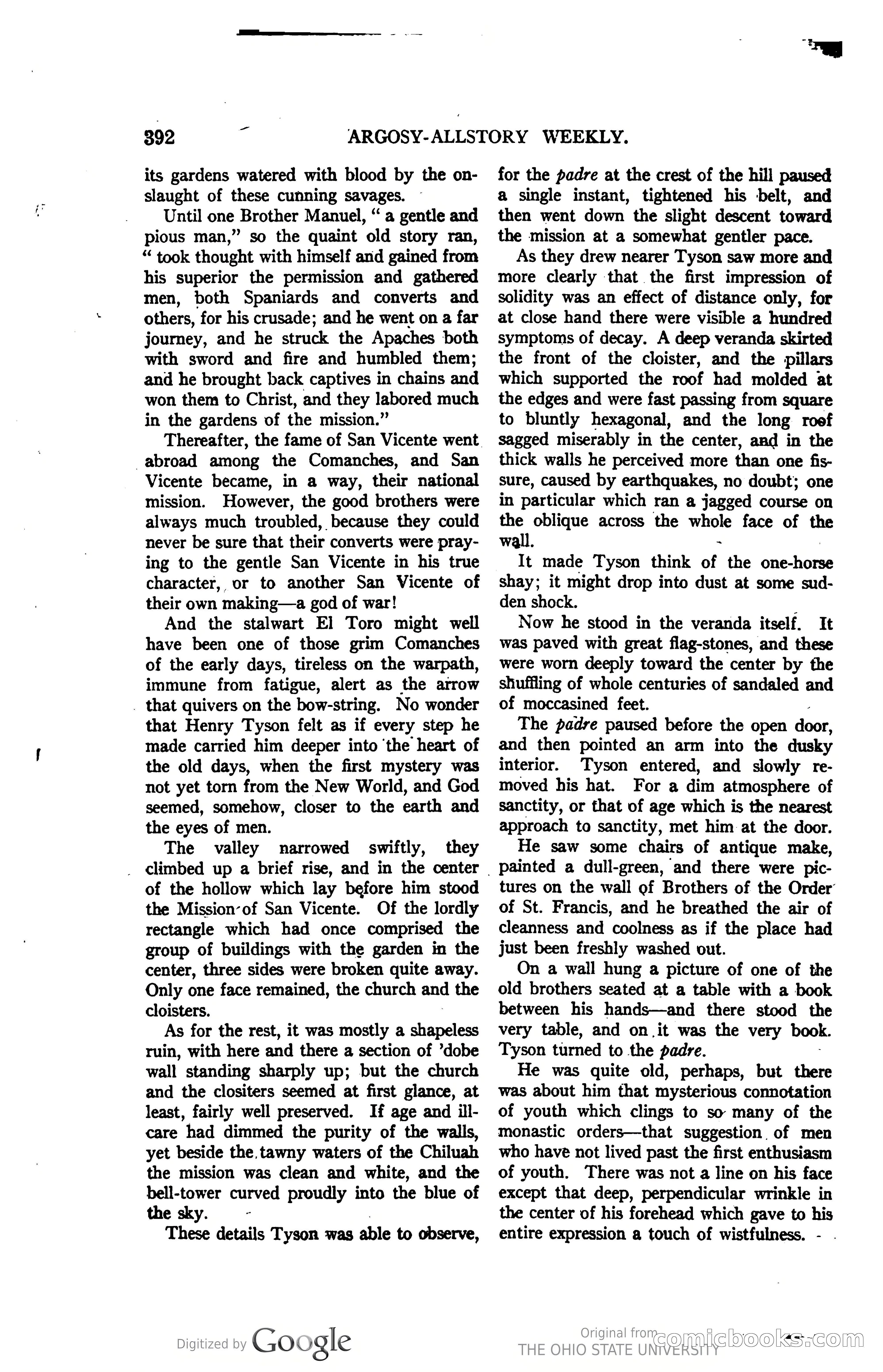
A restored page from Pulp Fiction, 1920. Page through the whole issue in the reader above.
📄 Transcribed text from this page (OCR, searchable)
Machine-transcribed from the original scan — historical spelling and the odd misread are preserved.
392 its gardens watered with blood by the on- slaught of these cunning savages. ~ Until one Brother Manuel, “ a gentle and pious man,” so the quaint old story ran, “ took thought with himself and gained from his superior the permission and gathered men, both Spaniards and converts and others, for his crusade; and he went on a far journey, and he struck the Apaches both with sword and fire and humbled them; and he brought back captives in chains and won them to Christ, and they labored much in the gardens of the mission.” Thereafter, the fame of San Vicente went. abroad among the Comanches, and San Vicente became, in a way, their national mission. However, the good brothers were always much troubled, because they could never be sure that their converts were pray- ing to the gentle San Vicente in his true character, or to another San Vicente of their own making—a god of war! And the stalwart El Toro might well have been one of those grim Comanches of the early days, tireless on the warpath, immune from fatigue, alert as the arrow . that quivers on the bow-string. No wonder that Henry Tyson felt as if every step he made carried him deeper into ‘the heart of the old days, when the first mystery was not yet torn from the New World, and God seemed, somehow, closer to the earth and the eyes of men. The valley narrowed swiftly, they climbed up a brief rise, and in the center | of the hollow which lay before him stood the Mission-of San Vicente. Of the lordly rectangle which had once comprised the group of buildings with the garden in the center, three sides were broken quite away. Only one face remained, the church andl the cloisters. As for the rest, it was mostly a shapeless ruin, with here and there a section of ’dobe wall standing sharply up; but the church and the clositers seemed at first glance, at least, fairly well preserved. If age and ill- care had dimmed the purity of the walls, yet beside the tawny waters of the Chiluah the mission was clean and white, and the bell-tower curved proudly into the blue of the sky. - These details Tyson was able to observe, Digitized by Google ARGOSY-ALLSTORY WEEKLY. for the padre at the crest of the hill paused a@ single instant, tightened his belt, and then went down the slight descent toward the mission at a somewhat gentler pace. As they drew nearer Tyson saw more and more clearly that the first impression of solidity was an effect of distance only, for at close hand there were visible a hundred symptoms of decay. A deep veranda skirted the front of the cloister, and the pillars which supported the roof had molded at the edges and were fast passing from square to bluntly hexagonal, and the long roof sagged miserably in the center, and in the thick walls he perceived more than one fis- sure, caused by earthquakes, no doubt; one in particular which ran a jagged course on the oblique across the whole face of the wall. - It made Tyson think of the one-horse shay; it might drop into dust at some sud- den shock. ; Now he stood in the veranda itself. It was paved with great flag-stones, and these were worn deeply toward the center by the shuffling of whole centuries of sandaled and of moccasined feet. The padre paused before the open door: and then pointed an arm into the dusky interior. Tyson entered, and slowly re- moved his hat. For a dim atmosphere of sanctity, or that of age which is the nearest approach to sanctity, met him at the door. He saw some chairs of antique make, painted a dull-green, and there were pic- tures on the wall of Brothers of the Order of St. Francis, and he breathed the air of cleanness and coolness as if the place had just been freshly washed out. On a wall hung a picture of one of the old brothers seated at a table with a book between his hands—and there stood the very table, and on it was the very book. Tyson tired to the padre. He was quite old, perhaps, but there was about him that mysterious connotation of youth which clings to so many of the monastic orders—that suggestion of men who have not lived past the first enthusiasm of youth. There was not a line on his face except that deep, perpendicular wrinkle in the center of his forehead which gave to his entire expression a touch of wistfulness. - . i irc INGOELMICE JOO oe) aCoO) TH | O