
Pulp Fiction, 1920 · page 20 of 232
Argosy All-Story Weekly, Vol. 123, No. 3 — page 20: what you’re looking at
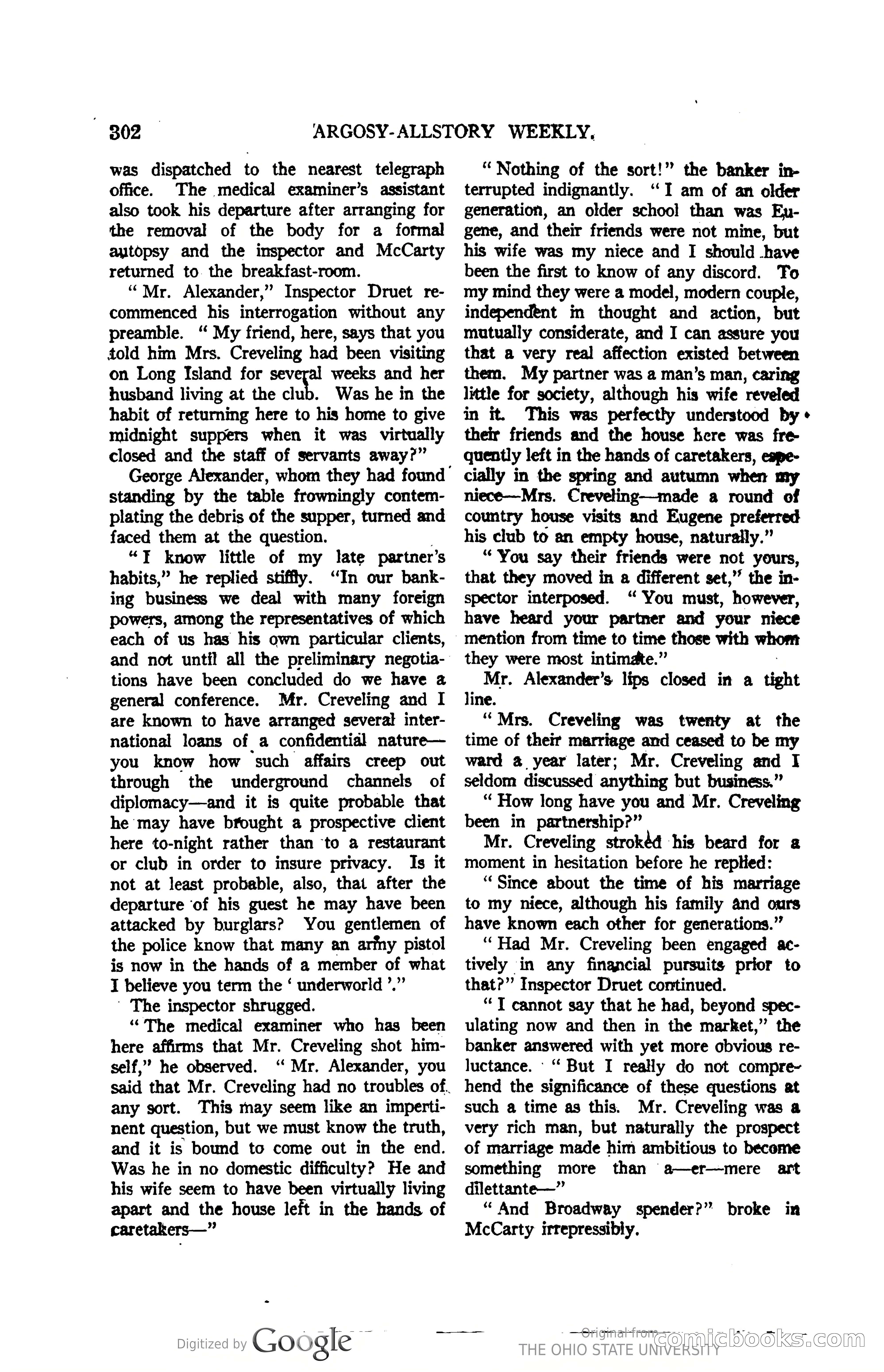
A restored page from Pulp Fiction, 1920. Page through the whole issue in the reader above.
📄 Transcribed text from this page (OCR, searchable)
Machine-transcribed from the original scan — historical spelling and the odd misread are preserved.
302 was dispatched to the nearest telegraph office. The medical examiner’s assistant also took his departure after arranging for the removal of the body for a formal autopsy and the inspector and McCarty returned to the breakfast-room “Mr. Alexander,” Inspector Druet re- commenced his interrogation without any preamble. “ My friend, here, says that you told him Mrs. Creveling had been visiting on Long Island for several weeks and her husband living at the club. Was he in the habit of returning here to his home to give midnight suppers when it was virtually closed and the staff of servants away?” George Alexander, whom they had found standing by the table frowningly contem- plating the debris of the supper, turned and faced them at the question. “F know little of my late partner’s habits,” he replied stiffly. ‘In our bank- ing business we deal with many foreign powers, among the representatives of which each of us has his own particular clients, and not until all the preliminary negotia- tions have been concluded do we have 2 general conference. Mr. Creveling and I are known to have arranged several inter- national loans of a confidential nature— you know how such affairs creep out through the underground channels of diplomacy—and it is quite probable that he may have brought a prospective client here to-night rather than to a restaurant or club in order to insure privacy. Is it not at least probable, also, that after the departure ‘of his guest he may have been attacked by burglars? You gentlemen of the police know that many an army pistol is now in the hands of a member of what I believe you term the ‘ underworld ’.” ' The inspector shrugged. ‘“The medical examiner who has been here affirms that Mr. Creveling shot him- self,’ he observed. ‘ Mr. Alexander, you said that Mr. Creveling had no troubles of. any sort. This may seem like an imperti- nent question, but we must know the truth, and it is bound to come out in the end. Was he in no domestic difficulty? He and his wife seem to have been virtually living apart and the house left in the hands of caretakers—” Digitized by Go ogle 7 ARGOSY-ALLSTORY WEEKLY, “Nothing of the sort!” the banker in- terrupted indignantly. ‘I am of an older generation, an older school than was Eu- gene, and their friends were not mine, but his wife was my niece and I should -have been the first to know of any discord. To my mind they were a model, modern couple, independent in thought and action, but mutually considerate, and I can assure you that a very real affection existed between them. My partner was a man’s man, caring little for society, although his wife reveled in it. This was perfectly understood by ¢ their friends and the house here was fre- quently left in the hands of caretakers, espe- cially in the spring and autumn when my niece—Mrs. Creveling—made a round of country house visits and Eugene preferred his club to an empty house, naturally.” “You say their friends were not yours, that they moved in a different set,” the in- spector interposed. “You must, however, have heard your partner and your niece -mention from time to time those with whom they were most intimate.” Mr. Alexander’s lips closed in a tight line. “Mrs. Creveling was twenty at the time of their marriage and ceased to be my ward a year later; Mr. Creveling and I seldom discussed anything but business.” “How long have you and Mr. Creveling been in partnership?” Mr. Creveling strokdd his beard for a moment in hesitation before he replied: “Since about the time of his marriage to my niece, although his family and ours have known each other for generations.” ‘““Had Mr. Creveling been engaged ac- tively in any financial pursuits prior to that?” Inspector Druet continued. “‘T cannot say that he had, beyond spec- ulating now and then in the market,” the banker answered with yet more obvious re- luctance. “‘ But I reaHy do not compre- hend the significance of these questions at such a time as this. Mr. Creveling was a very rich man, but naturally the prospect of marriage made him ambitious to become something more than a—er—mere art dilettante—” “And Broadway spender?” broke in McCarty irrepressibly. Fs e+ snatt <i) A CO Al El