
Pulp Fiction, 1920 · page 207 of 232
Argosy All-Story Weekly, Vol. 123, No. 3 — page 207: what you’re looking at
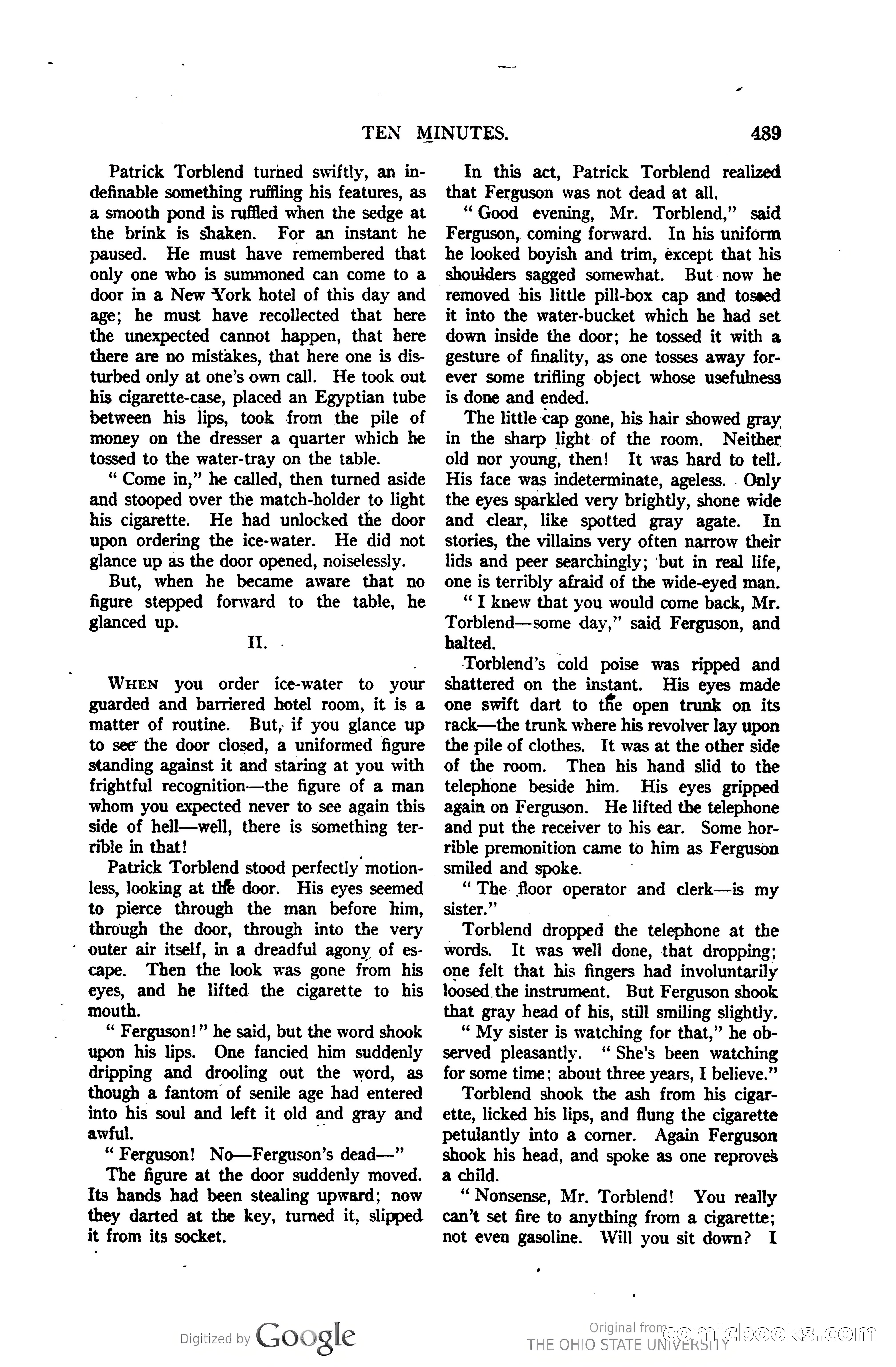
A restored page from Pulp Fiction, 1920. Page through the whole issue in the reader above.
📄 Transcribed text from this page (OCR, searchable)
Machine-transcribed from the original scan — historical spelling and the odd misread are preserved.
TEN Patrick Torblend turned swiftly, an in- definable something ruffling his features, as a smooth pond is ruffled when the sedge at the brink is shaken. For an. instant he paused. He must have remembered that only one who is summoned can come to a door in a New York hotel of this day and age; he must have recollected that here the unexpected cannot happen, that here there are no mistakes, that here one is dis- turbed only at one’s own call. He took out his cigarette-case, placed an Egyptian tube between his lips, took from the pile of money on the dresser a quarter which he tossed to the water-tray on the table. “Come in,” he called, then turned aside and stooped over the match-holder to light his cigarette. He had unlocked the door upon ordering the ice-water. He did not glance up as the door opened, noiselessly. But, when he became aware that no figure stepped forward to the table, he glanced up. II. . WHEN you order ice-water to your guarded and barriered hotel room, it is a matter of routine. But, if you glance up to see the door closed, a uniformed figure standing against it and staring at you with frightful recognition—the figure of a man whom you expected never to see again this side of hell—well, there is something ter- rible in that! _ Patrick Torblend stood perfectly motion- less, looking at the door. His eyes seemed to pierce through the man before him, through the door, through into the very ‘ outer air itself, in a dreadful agony of es- cape. Then the look was gone from his eyes, and he lifted the cigarette to his mouth. “ Ferguson!” he said, but the word shook upon his lips. One fancied him suddenly dripping and drooling out the word, as though a fantom of senile age had entered into his soul and left it old and gray and awful. “‘ Ferguson! No—Ferguson’s dead—” The figure at the door suddenly moved. Its hands had been stealing upward; now they darted at the key, turned it, slipped it from its socket. MINUTES. Shoulders sagged somewhat. 489 In this act, Patrick Torblend realized that Ferguson was not dead at all. “Good evening, Mr. Torblend,” said Ferguson, coming forward. In his uniform he looked boyish and trim, except that his But now he removed his little pill-box cap and toseed it into the water-bucket which he had set down inside the door; he tossed it with a gesture of finality, as one tosses away for- ever some trifling object whose usefulness is done and ended. The little cap gone, his hair showed gray in the sharp light of the room. Neither old nor young, then! It was hard to tell. His face was indeterminate, ageless. . Only the eyes sparkled very brightly, shone wide and clear, like spotted gray agate. In stories, the villains very often narrow their lids and peer searchingly; ‘but in real life, one is terribly afraid of the wide-eyed man. “ T knew that you would come back, Mr. Torblend—some day,” said Ferguson, and halted. | Torblend’s cold poise was ripped and shattered on the instant. His eyes made one swift dart to the open trunk on its rack—the trunk where his revolver lay upon the pile of clothes. It was at the other side of the room. Then his hand slid to the telephone beside him. His eyes gripped again on Ferguson. He lifted the telephone and put the receiver to his ear. Some hor- rible premonition came to him as Ferguson smiled and spoke. “The: floor operator and clerk—is my sister.”’ Torblend dropped the telephone at the words. It was well done, that dropping; one felt that his fingers had involuntarily loosed the instrument. But Ferguson shook that gray head of his, still smiling slightly. “ My sister is watching for that,” he ob- served pleasantly. “ She’s been watching for some time; about three years, I believe.” Torblend shook the ash from his cigar- ette, licked his lips, and flung the cigarette petulantly into a corner. Again Ferguson shook his head, and spoke as one reproved a child. ‘““ Nonsense, Mr. Torblend! You really can’t set fire to anything from a cigarette; not even gasoline. Will you sit down? I ginal fro THE O ‘IC 6] TATE UN ee WER SI DOO S CO