
Pulp Fiction, 1920 · page 216 of 232
Argosy All-Story Weekly, Vol. 123, No. 3 — page 216: what you’re looking at
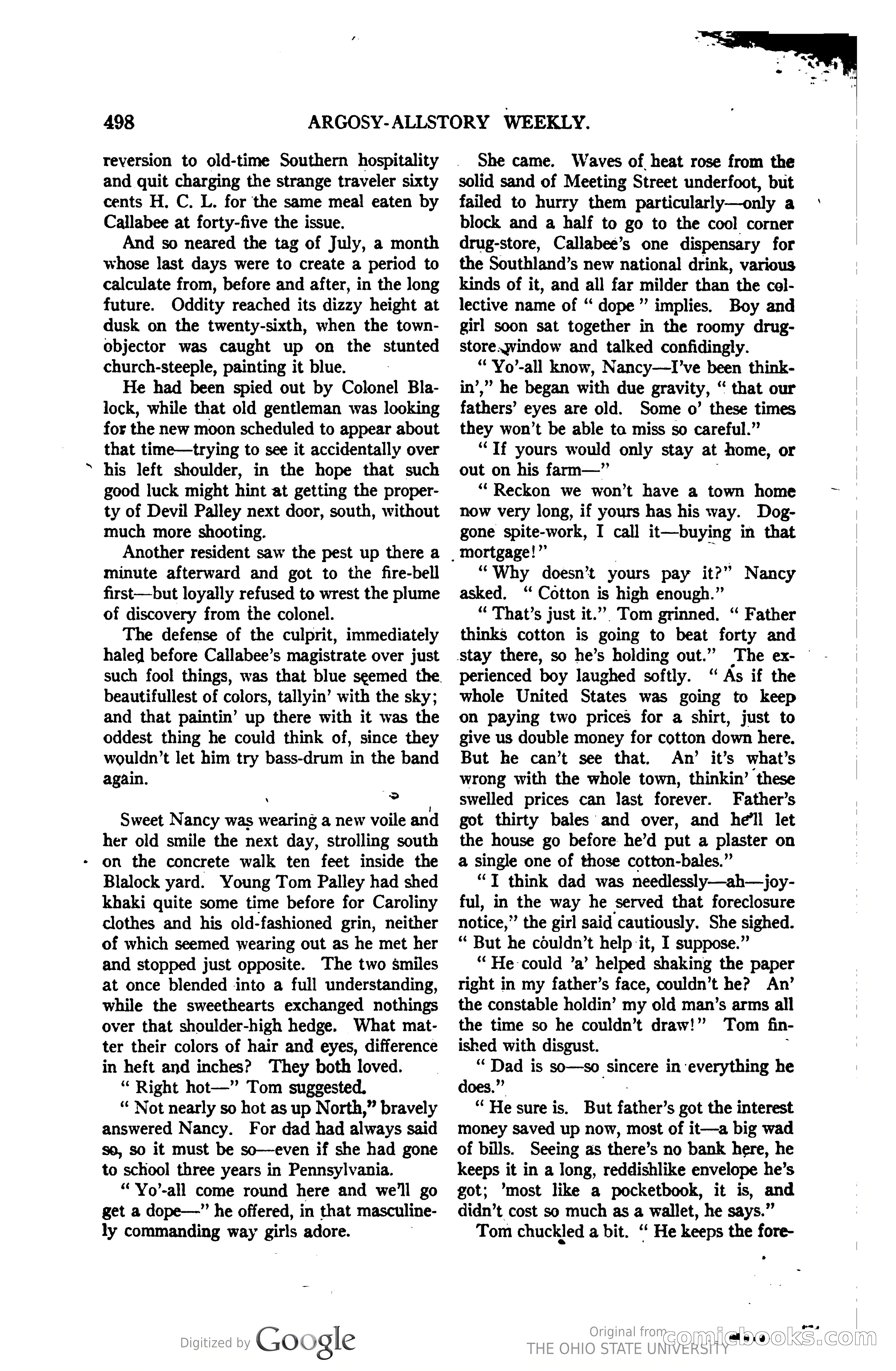
A restored page from Pulp Fiction, 1920. Page through the whole issue in the reader above.
📄 Transcribed text from this page (OCR, searchable)
Machine-transcribed from the original scan — historical spelling and the odd misread are preserved.
4 498 reversion to old-time Southern hospitality and quit charging the strange traveler sixty cents H. C. L. for the same meal eaten by Callabee at forty-five the issue. And so neared the tag of July, a month whose last days were to create a period to calculate from, before and after, in the long future. Oddity reached its dizzy height at dusk on the twenty-sixth, when the town- objector was caught up on the stunted church-steeple, painting it blue. He had been spied out by Colonel Bla- lock, while that old gentleman was looking for the new moon scheduled to appear about that time—trying to see it accidentally over his left shoulder, in the hope that such good luck might hint at getting the proper- ty of Devil Palley next door, south, without much more shooting. Another resident saw the pest up there a minute afterward and got to the fire-bell first—but loyally refused to wrest the plume of discovery from the colonel. The defense of the culprit, immediately haled before Callabee’s magistrate over just such fool things, was that blue seemed the. beautifullest of colors, tallyin’ with the sky; and that paintin’ up there with it was the oddest thing he could think of, since they wouldn’t let him try bass-drum in the band again. ‘ > Sweet Nancy was wearing a new voile and her old smile the next day, strolling south - on the concrete walk ten feet inside the Blalock yard. Young Tom Palley had shed khaki quite some time before for Caroliny clothes and his old-fashioned grin, neither of which seemed wearing out as he met her and stopped just opposite. The two Smiles at once blended into a full understanding, while the sweethearts exchanged nothings over that shoulder-high hedge. What mat- ter their colors of hair and eyes, difference in heft and inches? They both loved. “ Right hot—” Tom suggested. ‘Not nearly so hot as up North,” bravely answered Nancy. For dad had always said se, so it must be so—even if she had gone to school three years in Pennsylvania. “Yo’-all come round here and we'll go get a dope—.”’ he offered, in that masculine- ly commanding way girls adore. Stay there, so he’s holding out.” ARGOSY-ALLSTORY WEEKLY. She came. Waves of heat rose from the solid sand of Meeting Street underfoot, but failed to hurry them particularly—only a block and a half to go to the cool corner drug-store, Callabee’s one dispensary for the Southland’s new national drink, various kinds of it, and all far milder than the cel- lective name of “ dope ”’ implies. Boy and girl soon sat together in the roomy drug- store.window and talked confidingly. “Yo’-all know, Nancy—I’ve been think- in’,” he began with due gravity, “ that our fathers’ eyes are old. Some o’ these times they won’t be able ta miss so careful.” ‘“‘If yours would only stay at home, or out on his farm—’’ “ Reckon we won’t have a town home now very long, if yours has his way. Dog- gone spite-work, I call it—buying in that _ mortgage!” “Why doesn’t yours pay it?” Nancy asked. “ Cotton is high enough.” “That’s just it.” Tom grinned. “ Father thinks cotton is going to beat forty and perienced boy laughed softly. “ As if the whole United States was going to keep on paying two prices for a shirt, just to give us double money for cotton down here. But he can’t see that. An’ it’s what’s wrong with the whole town, thinkin’ these swelled prices can last forever. Father’s got thirty bales and over, and he'll let the house go before he’d put a plaster on a single one of those cotton-bales.” “TI think dad was needlessly—ah—joy- ful, in the way he served that foreclosure notice,’’ the girl said cautiously. She sighed. “ But he couldn’t help it, I suppose.” ““He could ’a’ helped shaking the paper right in my father’s face, couldn’t he? An’ the constable holdin’ my old man’s arms all the time so he couldn’t draw!” Tom fin- ished with disgust. : “‘ Dad is so—so sincere in everything he does.” a “He sure is. But father’s got the interest money saved up now, most of it—a big wad of bills. Seeing as there’s no bank here, he keeps it in a long, reddishlike envelope he’s got; ’most like a pocketbook, it is, and didn’t cost so much as a wallet, he says.” Tom chuckled a bit. ‘‘ He keeps the fore- Original fre NEO) (al JOO (n— a) — The ex- | CO