
Pulp Fiction, 1920 · page 29 of 232
Argosy All-Story Weekly, Vol. 123, No. 3 — page 29: what you’re looking at
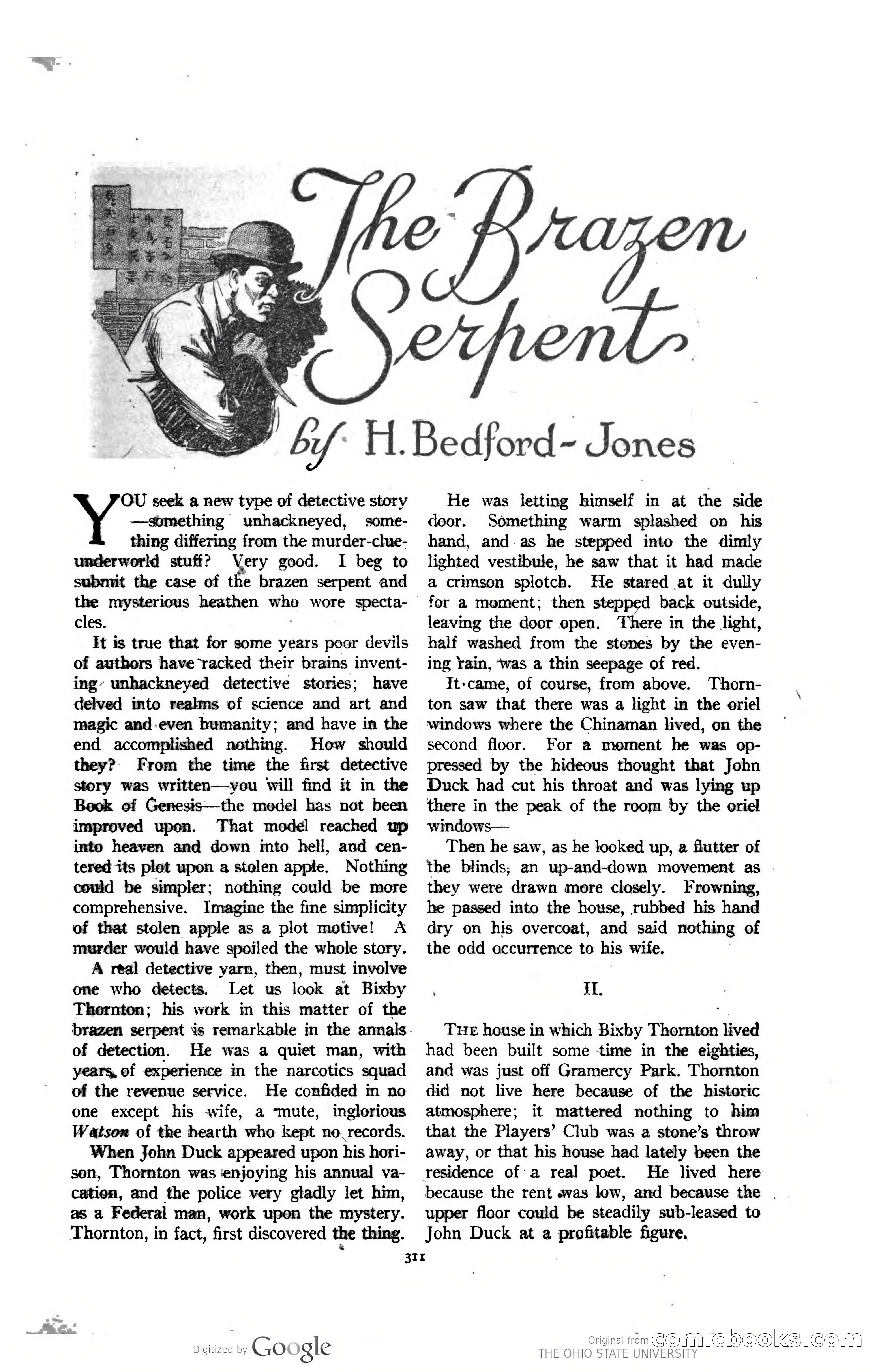
A restored page from Pulp Fiction, 1920. Page through the whole issue in the reader above.
📄 Transcribed text from this page (OCR, searchable)
Machine-transcribed from the original scan — historical spelling and the odd misread are preserved.
g TP, H. Bedford- Jones —something unhackneyed, some- thing differing from the murder-clue- underworld stuff? Very good. I beg to submit the case of the brazen serpent and yes seek a new type of detective story the mysterious heathen me wore specta- cles. It is true that for some years poor devils of authors have ‘racked their brains invent- ing’ unhackneyed detective stories; have delved imto realms of science and art and magic and.even humanity; and have in the end accomplished nothing. How should they? From the time the first detective story was written—you will find it in the Book of Genesis—the model has net been improved upon. That model reached up into heaven and down into hell, and cen- tered its plot upon a stolen apple. Nothing cowd be simpler; nothing could be more comprehensive. Imagine the fine simplicity of that stolen apple as a plot motive! A murder would have spoiled the whole story. A real detective yarn, then, must involve one who detects. Let us look at Bixby Thornton; his work in this matter of the brazen serpent is remarkable in the annals. of detection. He was a quiet man, with years, of experience in the narcotics squad of the revenue service. He confided in no one except his wife, a ‘mute, inglorious Watson of the hearth who kept no_records. When John Duck appeared upon his hori- sen, Thornton was enjoying his annual va- cation, and the police very gladly let him, as a Federal man, work upon the mystery. Thornton, in fact, first discovered the thing. residence of: a real poet. because the rent eas low, and because the . He was letting himself a at the side door. Something warm splashed on his hand, and as he stepped into the dimly lighted vestibule, he saw that it had made a crimson splotch. He stared at it dully for a moment; then stepped back outside, leaving the door open. There in the light, half washed from the stones by the even- ing rain, ‘was a thin seepage of red. It-came, of course, from above. Thorn- ton saw that there was a light in the oriel windows where the Chinaman lived, on the second floor. For a moment he was op- pressed by the hideous thought that John Duck had cut his throat and was lying up there in the peak of the room by the oriel windows— Then he saw, as he looked up, a flutter of the blinds; an up-and-down movement as - they were drawn more closely. Frowning, he passed into the house, rubbed his hand dry on his overcoat, and said nothing of the odd occurrence to his wife. iI, Tue house in which Bixby Thornton lived had been built some time in the eighties, and was just off Gramercy Park. Thornton did not live here because of the historic atmosphere; it mattered nothing to him that the Players’ Club was a stone’s throw away, or that his house had lately been the He lived here upper floor could be steadily sub-leased to John Duck at a profitable figure, 311 Digitized by (Go gle Original from (CO) [ICC 6)(0)) EO E OHIO STATE UNIVERSITY T