
Pulp Fiction, 1920 · page 39 of 232
Argosy All-Story Weekly, Vol. 123, No. 3 — page 39: what you’re looking at
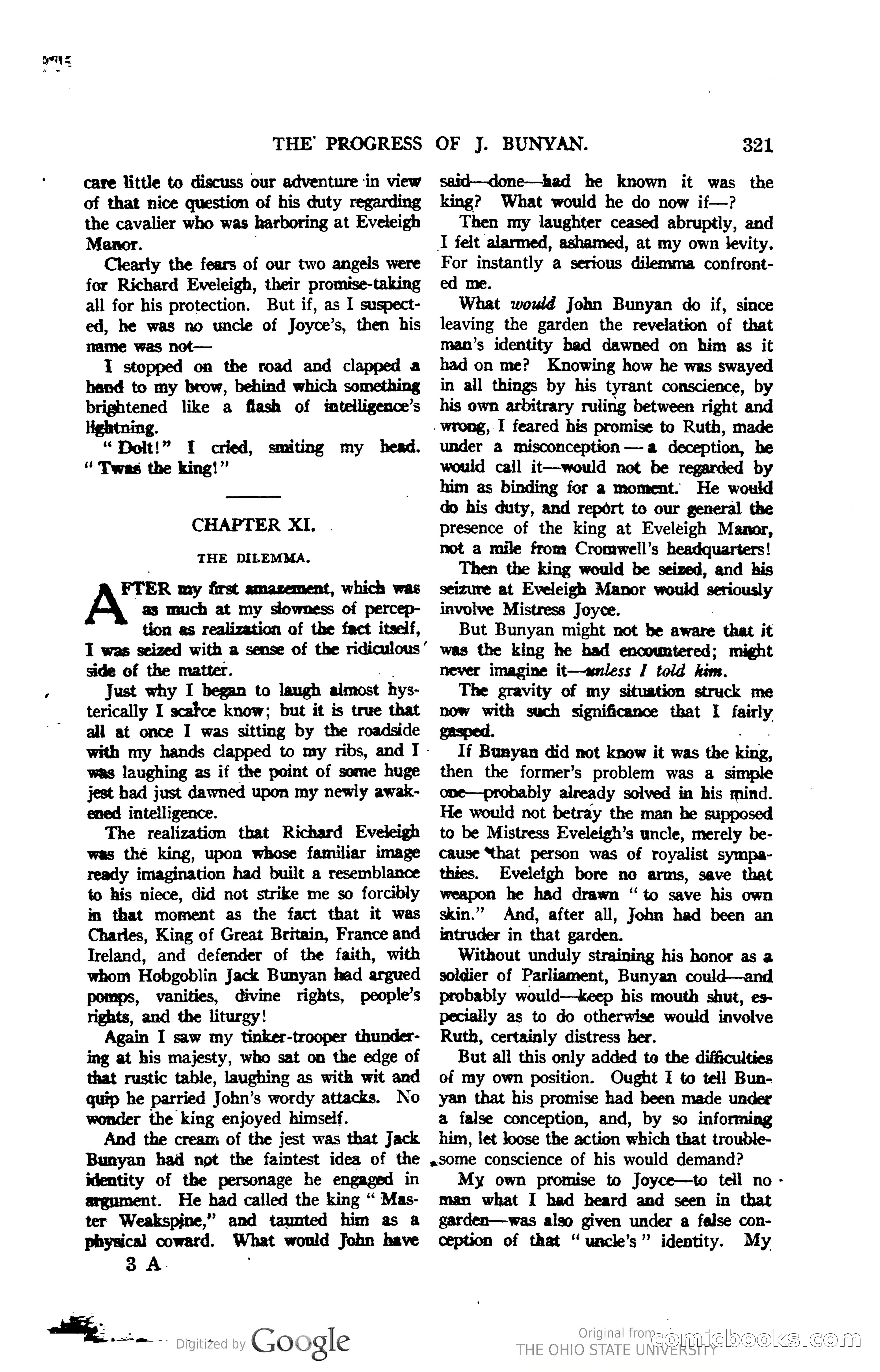
A restored page from Pulp Fiction, 1920. Page through the whole issue in the reader above.
📄 Transcribed text from this page (OCR, searchable)
Machine-transcribed from the original scan — historical spelling and the odd misread are preserved.
od ES “ge THE PROGRESS care little to discuss our adventure in view of that nice question of his duty regarding the cavalier who was harboring at Eveleigh Manor. . Clearly the fears of our two angels were for Richard Eveleigh, their promise-taking all for his protection. But if, as I suspect- ed, he was no uncle of Joyce’s, then his name was not— I stopped on the road and clapped a hand to my brow, behind which something brightened like a flash of imtelligence’s lightning. “ Dolt!” 1 cried, smiting my head. “Twas the king!” CHAPTER XI, THE DILEMMA. FTER ny first amazement, which was as much at my slowness of percep- tion as realization of the fact itself, I was seized with a sense of the ridiculous ’ side of the matter. Just why I began to laugh almost hys- terically I scatce know; but it is true that all at once I was sitting by the roadside with my hands clapped to my ribs, and I - was laughing as if the point of some huge jest had just dawned upon my newly awak- ened intelligence. The realization that Richard Eveleigh was thé king, upon whose familiar image ready imagination had built a resemblance to his niece, did not strike me so forcibly in that moment as the fact that it was Charles, King of Great Britain, France and Ireland, and defender of the faith, with whom Hobgoblin Jack Bunyan had argued , vanities, divine rights, people’s rights, and the liturgy! Again I saw my tinker-trooper thunder- ing at his majesty, who sat on the edge of that rustic table, laughing as with wit and quip he parried John’s wordy attacks. No wonder the king enjoyed himself. And the cream of the jest was that Jack OF J. BUNYAN. 321 said—done—had he known it was the king? What would he do now if—? Then my laughter ceased abruptly, and I felt alarmed, ashamed, at my own levity. For instantly a serious dilemma confront- ed me. What would John Bunyan do if, since leaving the garden the revelation of that man’s identity had dawned on him as it had on me? Knowing how he was swayed in ail things by his tyrant conscience, by his own arbitrary ruling between right and . wrong, I feared his promise to Ruth, made under a misconception — a deception, he would cail it—would net be regarded by him as binding for a moment. He would do his duty, and repdrt to our general the presence of the king at Eveleigh Manor, not a mile from Cromwell’s headquarters! Then the king would be seized, and his seizure at Eveleigh Manor would seriously involve Mistress Joyce. But Bunyan might not be aware that it was the king he had encountered; might never imagine it—smnless I told him. The gravity of my situation struck me now with such significance that I fairly If Bunyan did not know it was the king, then the former’s problem was a simple one—probably already solved in his mind. He would not betray the man he supposed to be Mistress Eveleigh’s uncle, merely be- cause “that person was of royalist sympa- thies. Eveleigh bore no arms, save that weapon he had drawn “to save his own skin.”” And, after all, John had been an intruder in that garden. Without unduly straining his honor as a soldier of Parliament, Bunyan could—and probably would—keep his mouth shut, es- pecially as to do otherwise would involve Ruth, certainly distress her. But all this only added to the difficulties of my own position. Ought I to tell Bun- yan that his promise had been made under a false conception, and, by so informing him, let joose the action which that trouble- Bunyan had not the faintest idea of the .some conscience of his would demand? My own promise to Joyce—to tell no- identity of the personage he engaged in argument. He had called the king “ Mas- ter Weakspine,” and taunted him as a physical coward. What would John have oA. man what I had heard and seen in that garden—was also given under a false con- ception of that “ uncle’s” identity. My a) S C@ THE OHIO STATE UNTV