
Pulp Fiction, 1920 · page 50 of 232
Argosy All-Story Weekly, Vol. 123, No. 3 — page 50: what you’re looking at
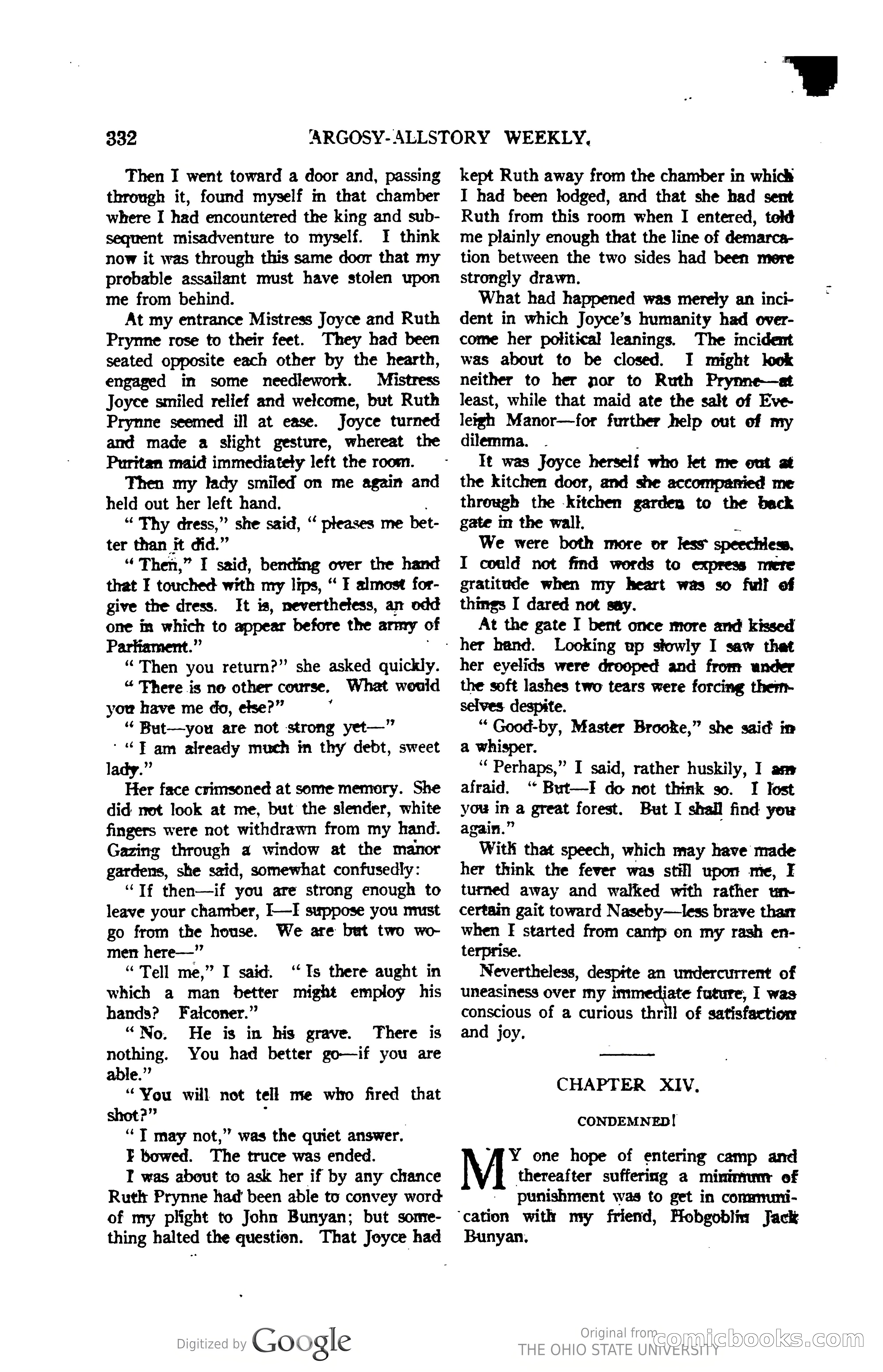
A restored page from Pulp Fiction, 1920. Page through the whole issue in the reader above.
📄 Transcribed text from this page (OCR, searchable)
Machine-transcribed from the original scan — historical spelling and the odd misread are preserved.
332 Then I went toward a door and, passing through it, found myself m that chamber where I had encountered the king and sub- sequent misadventure to myself. I think now it was through this same door that my probable assailant must have stolen upon me from behind. At my entrance Mistress Joyce and Ruth Prynne rose to their feet. They had been seated opposite each other by the hearth, engaged in some needlework. Mistress Joyce smiled relief and welcome, but Ruth Prynne seemed ill at ease. Joyce turned and made a stight gesture, whereat the Puritan maid immediately left the room. Then my lady smiled on me again and held out her left hand. “ Fhy dress,” she said, ‘ pteases me bet- ter than it did.” ‘“‘ Then,” I said, bending over the hand that I touched with my lips, “ F almost for- give the dress. It is, neverthetess, an odd one in which to appear before the army of Parliament.” “Then you return?” she asked quickly. “ There is no other course. What would you have me do, else?” , ‘‘ But—you are not strong yet—” ‘Fam already much in thy debt, sweet lady.” Her face crimsoned at some memory. She did net look at me, but the slender, white fingers were not withdrawn from my hand. Gazing through a window at the manor gardens, she said, somewhat confusedly: “Tf then—if you are strong enough to leave your chamber, I—I suppose you must go from the house. We are but two wo- met here—”’ “Tell me,” I said. ‘Is there aught in which a man better might employ his hands? Fatconer.” “No. He is in his grave. There is nothing. You had better go—if you are able.”’ “You will not tell me who fired that shot?” “T may not,” was the quiet answer. ¥ bowed. The truce was ended. I was about to ask her if by any chance Ruth Prynne had’ been able to convey word of my plight to John Bunyan; but some- thing halted the question. That Joyce had ¥ ‘ARGOSY- ALLSTORY WEEKLY, kept Ruth away from the chamber in which I had been lodged, and that she had sent Ruth from this room when I entered, told me plainly enough that the line of demarca- tion between the two sides had been mere strongly drawn. What had happened was merely an inci- dent in which Joyce’s humanity had over- come her political leanings. The incident was about to be closed. I might lok neither to her nor to Ruth Prynne—at least, while that maid ate the salt of Eve- leigh Manor—for further help out of my dilemma. It was Joyce herself who let me out at the kitchen door, and she accompanied me through the kitchen garden to the back gate in the wall. We were both more or less: speechless. I could not fmd words to express mere gratitude when my heart was so full of things I dared not say. At the gate I bent once more and kissed - her hand. Looking up stowly I saw thet her eyelids were drooped and from under the soft lashes two tears were forcing ther selves. despite. “ Good-by, Master Brooke,” a whisper. ‘‘ Perhaps,” I said, rather huskily, I ass afraid. ‘“‘ But—I do not think 30. I lost you m a great forest. But I shall find you again.” With that speech, which may have made her think the fever was still upon mie, FE turned away and walked with rather un- certain gait toward Naseby—less brave thazr she said in when EF started from cantp on my rash en- terprise. Nevertheless, despite an undercurrent of uneasiness over my immediate future, I was conscious of a curious thrill of satisfaction and joy. TRS CHAPTER XIV. CONDEMNED! Y one hope of entering camp and thereafter suffering a minimum of punishment was to get in communi- ‘cation with my friend, Hobgoblin Jaclt Bunyan, JOO 0 STATE UNE =e) So C@