
Pulp Fiction, 1920 · page 10 of 200
Argosy All-Story Weekly, Vol. 123, No. 4 — page 10: what you’re looking at
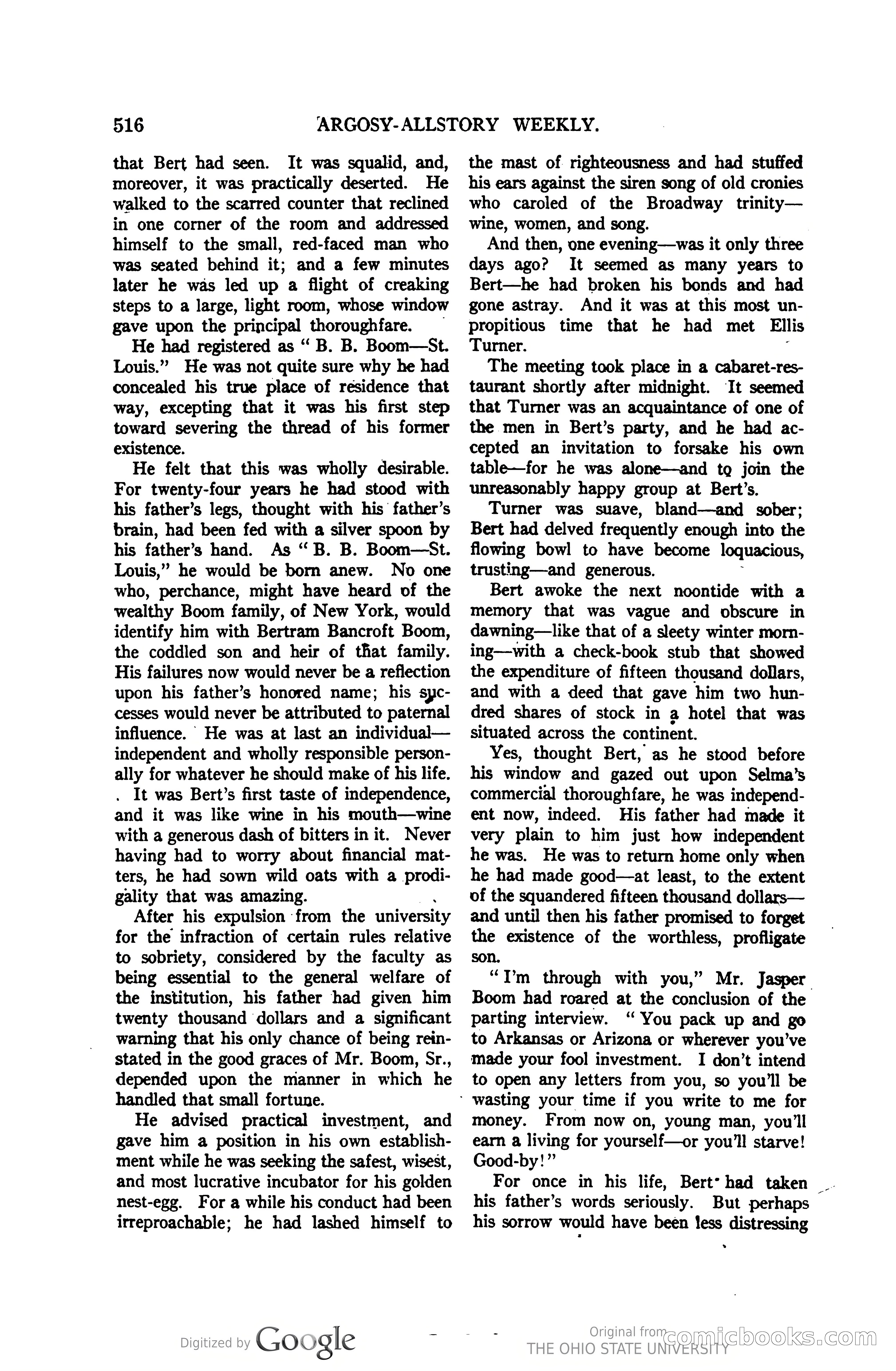
A restored page from Pulp Fiction, 1920. Page through the whole issue in the reader above.
📄 Transcribed text from this page (OCR, searchable)
Machine-transcribed from the original scan — historical spelling and the odd misread are preserved.
516 that Bert had seen. It was squalid, and, moreover, it was practically deserted. He walked to the scarred counter that reclined in one corner of the room and addressed himself to the small, red-faced man who was seated behind it; and a few minutes later he was led up a flight of creaking steps to a large, light room, whose window gave upon the principal thoroughfare. He had registered as ‘“‘ B. B. Boom—St. Louis.”” He was not quite sure why he had concealed his true place of residence that way, excepting that it was his first step toward severing the thread of his former existence. He felt that this was wholly desirable. For twenty-four years he had stood with his father’s legs, thought with his father’s brain, had been fed with a silver spoon by his father’s hand. As “ B. B. Boom—St. Louis,” he would be born anew. No one who, perchance, might have heard of the wealthy Boom family, of New York, would identify him with Bertram Bancroft Boom, the coddled son and heir of that family. His failures now would never be a reflection upon his father’s honored name; his syc- cesses would never be attributed to paternal influence. He was at last an individual— independent and wholly responsible person- ally for whatever he should make of his life. . It was Bert’s first taste of independence, and it was like wine in his mouth—wine with a generous dash of bitters in it. Never having had to worry about financial mat- ters, he had sown wild oats with a prodi- gality that was amazing. After his expulsion from the university for the infraction of certain rules relative to sobriety, considered by the faculty as being essential to the general welfare of the institution, his father had given him twenty thousand dollars and a significant warning that his only chance of being rein- stated in the good graces of Mr. Boom, Sr., depended upon the manner in which he handled that small fortune. He advised practical investment, and gave him a position in his own establish- ment while he was seeking the safest, wisest, and most lucrative incubator for his golden nest-egg. For a while his conduct had been irreproachable; he had lashed himself to ARGOSY-ALLSTORY WEEKLY. the mast of righteousness and had stuffed his ears against the siren song of old cronies who caroled of the Broadway trinity— wine, women, and song. And then, one evening—was it only three days ago? It seemed as many years to Bert—he had broken his bonds and had gone astray. And it was at this most un- propitious time that he had met Ellis Turner. The meeting took place in a cabaret-res- taurant shortly after midnight. It seemed that Turner was an acquaintance of one of the men in Bert’s party, and he had ac- cepted an invitation to forsake his own table—for he was alone—and tq join the unreasonably happy group at Bert’s. Turner was suave, bland—and sober; Bert had delved frequently enough into the flowing bowl to have become loquacious, trusting—and generous. Bert awoke the next noontide with a memory that was vague and obscure in dawning—like that of a sleety winter morn- ing—with a check-book stub that showed the expenditure of fifteen thousand dollars, and with a deed that gave him two hun- dred shares of stock in a hotel that was situated across the continent. Yes, thought Bert, as he stood before his window and gazed out upon Selma’s commercial thoroughfare, he was independ- ent now, indeed. His father had made it very plain to him just how independent he was. He was to return home only when he had made good—at least, to the extent of the squandered fifteen thousand dollars— and until then his father promised to forget the existence of the worthless, profligate son. “Tm through with you,” Mr. Jasper Boom had roared at the conclusion of the parting interview. “ You pack up and go to Arkansas or Arizona or wherever you’ve made your fool investment. I don’t intend to open any letters from you, so you'll be " wasting your time if you write to me for money. From now on, young man, you'll earn a living for yourself—or you'll starve! Good-by!”’ For once in his life, his father’s words seriously. But perhaps his sorrow would have been less distressing 6 ere UNG LMC DOO =) aun Bert had taken _. CO THE OHIO ST/