
Pulp Fiction, 1920 · page 135 of 200
Argosy All-Story Weekly, Vol. 123, No. 4 — page 135: what you’re looking at
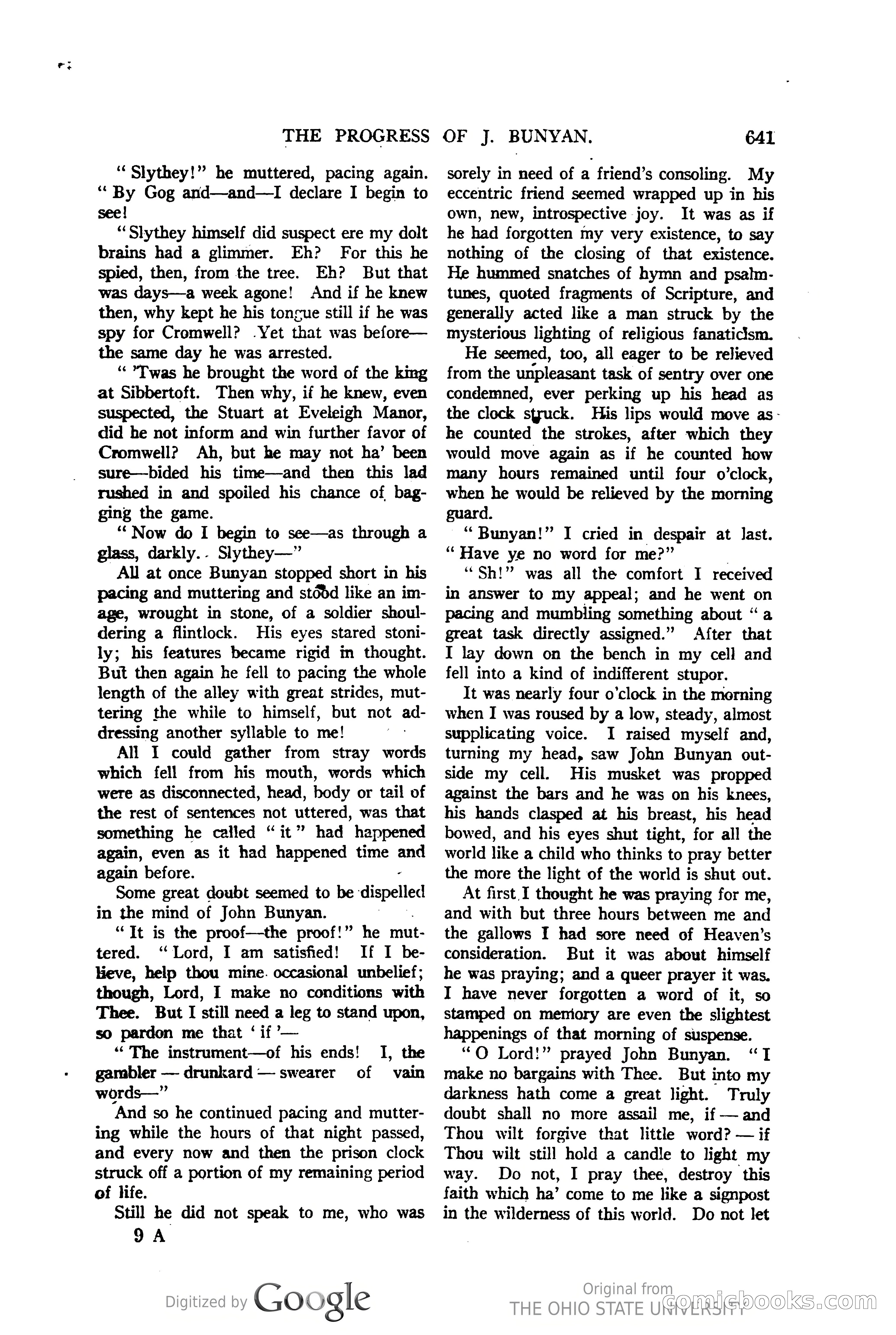
A restored page from Pulp Fiction, 1920. Page through the whole issue in the reader above.
📄 Transcribed text from this page (OCR, searchable)
Machine-transcribed from the original scan — historical spelling and the odd misread are preserved.
THE PROGRESS ‘“ Slythey!” he muttered, pacing again. ‘““ By Gog and—and—I declare I begin to see! “‘Slythey himself did suspect ere my dolt brains had a glimmer. Eh? For this he spied, then, from the tree. Eh? But that was days—a week agone! And if he knew then, why kept he his tonsue still if he was spy for Cromwell? Yet that was before— the same day he was arrested. ‘“‘*Twas he brought the word of the king at Sibbertoft. Then why, if he knew, even suspected, the Stuart at Eveleigh Manor, did he not inform and win further favor of Cromwell? Ah, but he may not ha’ been sure—bided his time—and then this lad rushed in and spoiled his chance of bag- ging the game. ‘“* Now do I begin to see—as through a glass, darkly.. Slythey—”’ All at once Bunyan stopped short in his pacing and muttering and std6d like an im- age, wrought in stone, of a soldier shoul- dering a flintlock. His eyes stared stoni- ly; his features became rigid m thought. But then again he fell to pacing the whole length of the alley with great strides, mut- tering the while to himself, but not ad- dressing another syllable to me! All I could gather from stray words which fell from his mouth, words which were as disconnected, head, body or tail of the rest of sentences not uttered, was that something he called “it” had happened again, even as it had happened time and again before. Some great doubt seemed to be dispelled in the mind of John Bunyan. : “It is the proof—the proof!” he mut- tered. ‘Lord, I am satisfied! If I be- Heve, help thou mine. occasional unbelief; though, Lord, I make no conditions with Thee. But I still need a leg to stand upon, so pardon me that ‘ if ’— ““The instrument—of his ends! gambler — drunkard — swearer of words—”’ And so he continued pacing and mutter- ing while the hours of that night passed, and every now and then the prison clock struck off a portion of my remaining period of life. Still he did not speak to me, who was 9A I, the vain 641 sorely in need of a friend’s consoling. My eccentric friend seemed wrapped up in his own, new, introspective joy. It was as if he had forgotten my very existence, to say nothing of the closing of that existence. He hummed snatches of hymn and psaln- tunes, quoted fragments of Scripture, and generally acted like a man struck by the mysterious lighting of religious fanaticism. He seemed, too, all eager to be relieved from the unpleasant task of sentry over one condemned, ever perking up his head as OF J. BUNYAN, the clock struck. His lips would move as- he counted the strokes, after which they would move again as if he counted how many hours remained until four o’clock, when he would be relieved by the morning guard. _“ Bunyan!” I cried in despair at Jast. “Have ye no word for me?” | “Sh!” was all the comfort I received in answer to my appeal; and he went on pacing and mumbling something about “a great task directly assigned.” After that I lay down on the bench in my cell and fell into a kind of indifferent stupor. It was nearly four o'clock in the merning when I was roused by a low, steady, almost supplicating voice. I raised myself and, turning my head, saw John Bunyan out- side my cell. His musket was propped against the bars and he was on his knees, his hands clasped at his breast, his head bowed, and his eyes shut tight, for all the world like a child who thinks to pray better the more the light of the world is shut out. At first I thought he was praying for me, and with but three hours between me and the gallows I had sore need of Heaven’s consideration. But it was about himself he was praying; and a queer prayer it was. I have never forgotten a word of it, so stamped on memiory are even the slightest happenings of that morning of suspense. “QO Lord!” prayed John Bunyan. “I make no bargains with Thee. But into my darkness hath come a great light. Truly doubt shall no more assail me, if — and Thou wilt forgive that little word? — if Thou wilt still hold a candle to light my way. Do not, I pray thee, destroy this faith which ha’ come to me like a signpost in the wilderness of this world. Do not let we gute Es | re CO YGOOOKX