
Pulp Fiction, 1920 · page 175 of 200
Argosy All-Story Weekly, Vol. 123, No. 4 — page 175: what you’re looking at
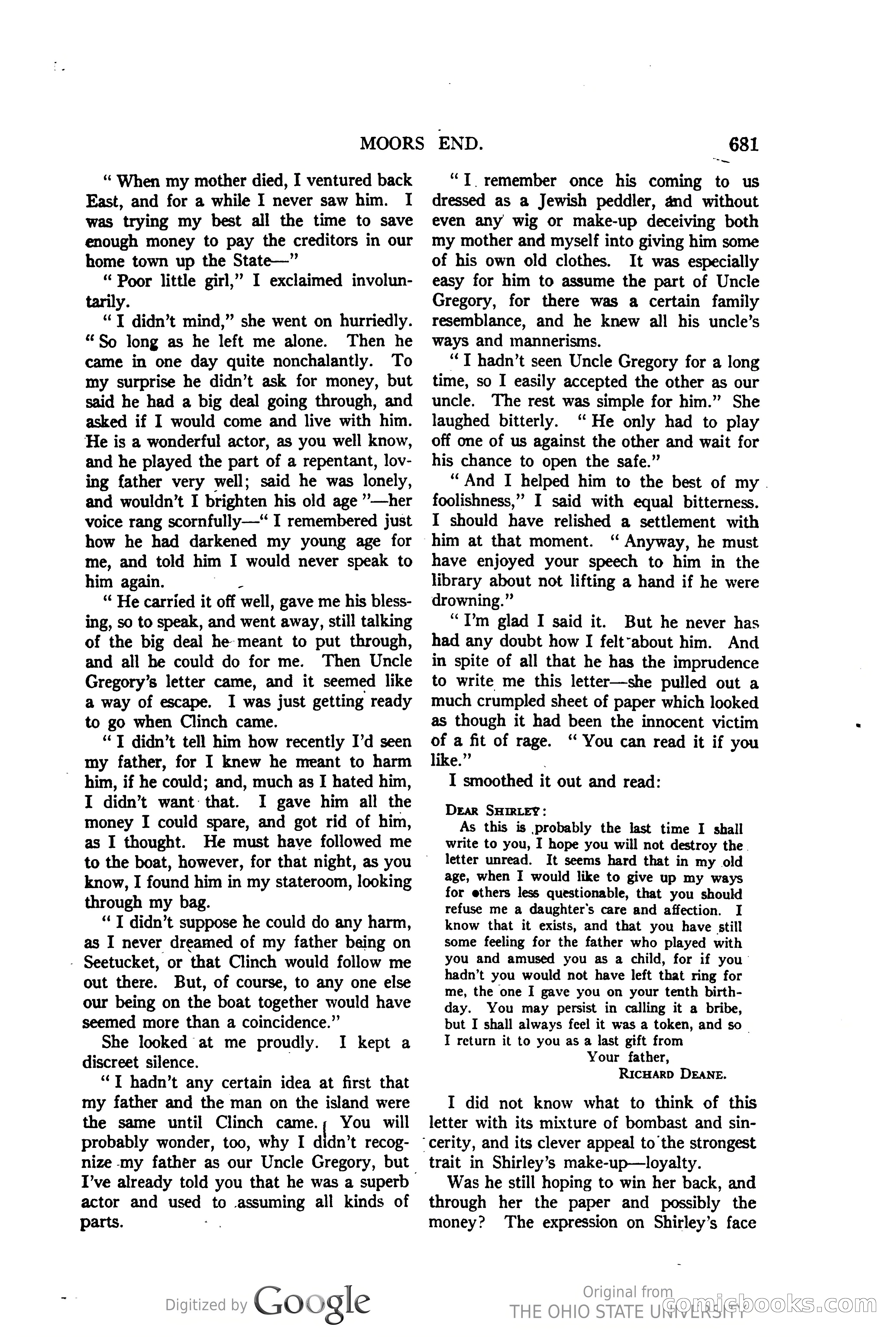
A restored page from Pulp Fiction, 1920. Page through the whole issue in the reader above.
📄 Transcribed text from this page (OCR, searchable)
Machine-transcribed from the original scan — historical spelling and the odd misread are preserved.
MOORS END. 681 “ When my mother died, I ventured back East, and for a while I never saw him. I was trying my best all the time to save enough money to pay the creditors in our home town up the State—”’ “ Poor little girl,” I exclaimed involun- tarily. “I didn’t mind,” she went on hurriedly. ““So long as he left me alone. Then he came in one day quite nonchalantly. To my surprise he didn’t ask for money, but said he had a big deal going through, and asked if I would come and live with him. He is a wonderful actor, as you well know, and he played the part of a repentant, lov- ing father very well; said he was lonely, and wouldn’t I brighten his old age ”—her voice rang scornfully—“ I remembered just how he had darkened my young age for me, and told him I would never speak to him again. - “ He carried it off well, gave me his bless- ing, so to speak, and went away, still talking of the big deal he meant to put through, and all he could do for me. Then Uncle Gregory’s letter came, and it seemed like a way of escape. I was just getting ready to go when Clinch came. “‘T didn’t tell him how recently I’d seen my father, for I knew he meant to harm him, if he could; and, much as I hated him, I didn’t want: that. I gave him all the money I could spare, and got rid of him, as I thought. He must have followed me to the boat, however, for that night, as you © know, I found him in my stateroom, looking through my bag. “‘ IT didn’t suppose he could do any harm, as I never dreamed of my father being on - Seetucket, or that Clinch would follow me out there. But, of course, to any one else our being on the boat together would have seemed more than a coincidence.” She looked at me proudly. I kept a discreet silence. ‘“‘t hadn’t any certain idea at first that my father and the man on the island were the same until Clinch came.; You will probably wonder, too, why I aldn’t recog- nize my father as our Uncle Gregory, but I’ve already told you that he was a superb actor and used to assuming all kinds of parts. _ ‘““T. remember once his coming to us dressed as a Jewish peddler, and without even any wig or make-up deceiving both my mother and myself into giving him some of his own old clothes. It was especially easy for him to assume the part of Uncle Gregory, for there was a certain family resemblance, and he knew all his uncle’s ways and mannerisms. “‘T hadn’t seen Uncle Gregory for a long time, so I easily accepted the other as our uncle. The rest was simple for him.” She laughed bitterly. ‘“‘ He only had to play off one of us against the other and wait for his chance to open the safe.” “And I helped him to the best of my . foolishness,” I said with equal bitterness. I should have relished a settlement with him at that moment. “ Anyway, he must have enjoyed your speech to him in the library about not lifting a hand if he were drowning.” “I’m glad I said it. But he never has had any doubt how I felt-about him. And in spite of all that he has the imprudence to write me this letter—she pulled out a much crumpled sheet of paper which looked as though it had been the innocent victim of a fit of rage. ‘“ You can read it if you like.”’ . I smoothed it out and read: Dear SHIRLEY: As this is probably the last time I shall write to you, I hope you will not destroy the. letter unread. It seems hard that in my old age, when I would like to give up my ways for ethers less questionable, that you should refuse me a daughter's care and affection. I know that it exists, and that you have still some feeling for the father who played with you and amused you as a child, for if you hadn’t you would not have left that ring for me, the one I gave you on your tenth birth- day. You may persist in calling it a bribe, but I shall always feel it was a token, and so I return it to you as a last gift from Your father, RICHARD DEANE. I did not know what to think of this letter with its mixture of bombast and sin- ‘cerity, and its clever appeal to the strongest trait in Shirley’s make-up—loyalty. Was he still hoping to win her back, and through her the paper and possibly the money? The expression on Shirley’s face AHIO sTaTE YiGOueieloook (A)