
Pulp Fiction, 1920 · page 188 of 200
Argosy All-Story Weekly, Vol. 123, No. 4 — page 188: what you’re looking at
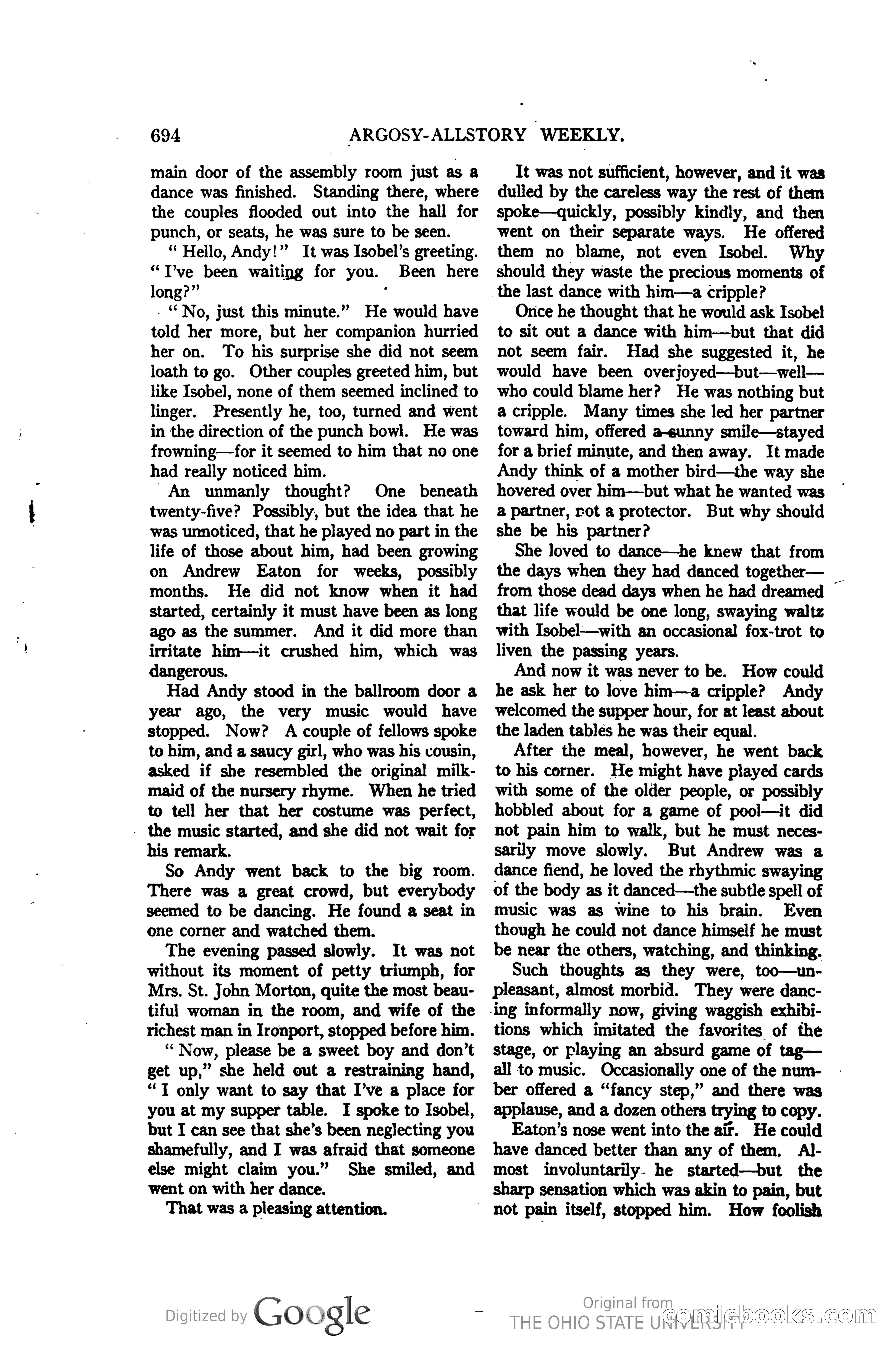
A restored page from Pulp Fiction, 1920. Page through the whole issue in the reader above.
📄 Transcribed text from this page (OCR, searchable)
Machine-transcribed from the original scan — historical spelling and the odd misread are preserved.
694 main door of the assembly room just as a dance was finished. Standing there, where the couples flooded out into the hall for punch, or seats, he was sure to be seen. “ Hello, Andy!”’ It was Isobel’s greeting. “Tye been waiting for you. Been here long?” - “No, just this minute.” He would have told her more, but her companion hurried her on. To his surprise she did not seem loath to go. Other couples greeted him, but like Isobel, none of them seemed inclined to linger. Presently he, too, turned and went in the direction of the punch bowl. He was frowning—for it seemed to him that no one had really noticed him. An unmanly thought? One _ beneath twenty-five? Possibly, but the idea that he was unnoticed, that he played no part in the life of those about him, had been growing on Andrew Eaton for weeks, possibly months. He did not know when it had started, certainly it must have been as long ago as the summer. And it did more than irritate him-—it crushed him, which was dangerous. Had Andy stood in the ballroom door a year ago, the very music would have stopped. Now? A couple of fellows spoke to him, and a saucy girl, who was his cousin, asked if she resembled the original milk- maid of the nursery rhyme. When he tried to tell her that her costume was perfect, - the music started, and she did not wait for his remark. So Andy went back to the big room. There was a great crowd, but everybody seemed to be dancing. He found a seat in one corner and watched them. The evening passed slowly. It was not without its moment of petty triumph, for Mrs. St. John Morton, quite the most beau- tiful woman in the room, and wife of the richest man in Ironport, stopped before him. “‘ Now, please be a sweet boy and don’t get up,” she held out a restraining hand, “TI only want to say that I’ve a place for you at my supper table. I spoke to Isobel, but I can see that she’s been neglecting you shamefully, and I was afraid that someone else might claim you.” She smiled, and went on with her dance. That was a pleasing attention. “an o an ee ‘ | ARGOSY-ALLSTORY WEEKLY. It was not sufficient, however, and it was dulled by the careless way the rest of them spoke—quickly, possibly kindly, and then went on their separate ways. He offered them no blame, not even Isobel. Why should they waste the precious moments of the last dance with him—a cripple? Orice he thought that he would ask Isobel to sit out a dance with him—but that did not seem fair. Had she suggested it, he would have been overjoyed—but—well— who could blame her? He was nothing but a cripple. Many times she led her partner toward him, offered a-cunny smile—stayed for a brief minute, and then away. It made Andy think of a mother bird—the way she hovered over him—but what he wanted was a partner, rot a protector. But why should she be his partner? She loved to dance—he knew that from the days when they had danced together— from those dead days when he had dreamed that life would be one long, swaying waltz with Isobel—with an occasional fox-trot to liven the passing years. And now it was never to be. How could he ask her to love him—a cripple? Andy welcomed the supper hour, for at least about the laden tables he was their equal. After the meal, however, he went back to his corner. He might have played cards with some of the older people, or possibly hobbled about for a game of pool—it did not pain him to walk, but he must neces- sarily move slowly. But Andrew was a dance fiend, he loved the rhythmic swaying of the body as it danced—the subtle spell of music was as wine to his brain. Even though he could not dance himself he must be near the others, watching, and thinking. Such thoughts as they were, too—un- pleasant, almost morbid. They were danc- -Ing informally now, giving waggish exhibi- tions which imitated the favorites of the stage, or playing an absurd game of tag— all to music. Occasionally one of the num- ber offered a “fancy step,” and there was applause, and a dozen others trying to copy. Eaton’s nose went into the air. He could have danced better than any of them. AIl- most involuntarily. he started—but the sharp sensation which was akin to pain, but Rot pain itself, stopped him. How foolish {DOOLK