
Pulp Fiction, 1920 · page 21 of 200
Argosy All-Story Weekly, Vol. 123, No. 4 — page 21: what you’re looking at
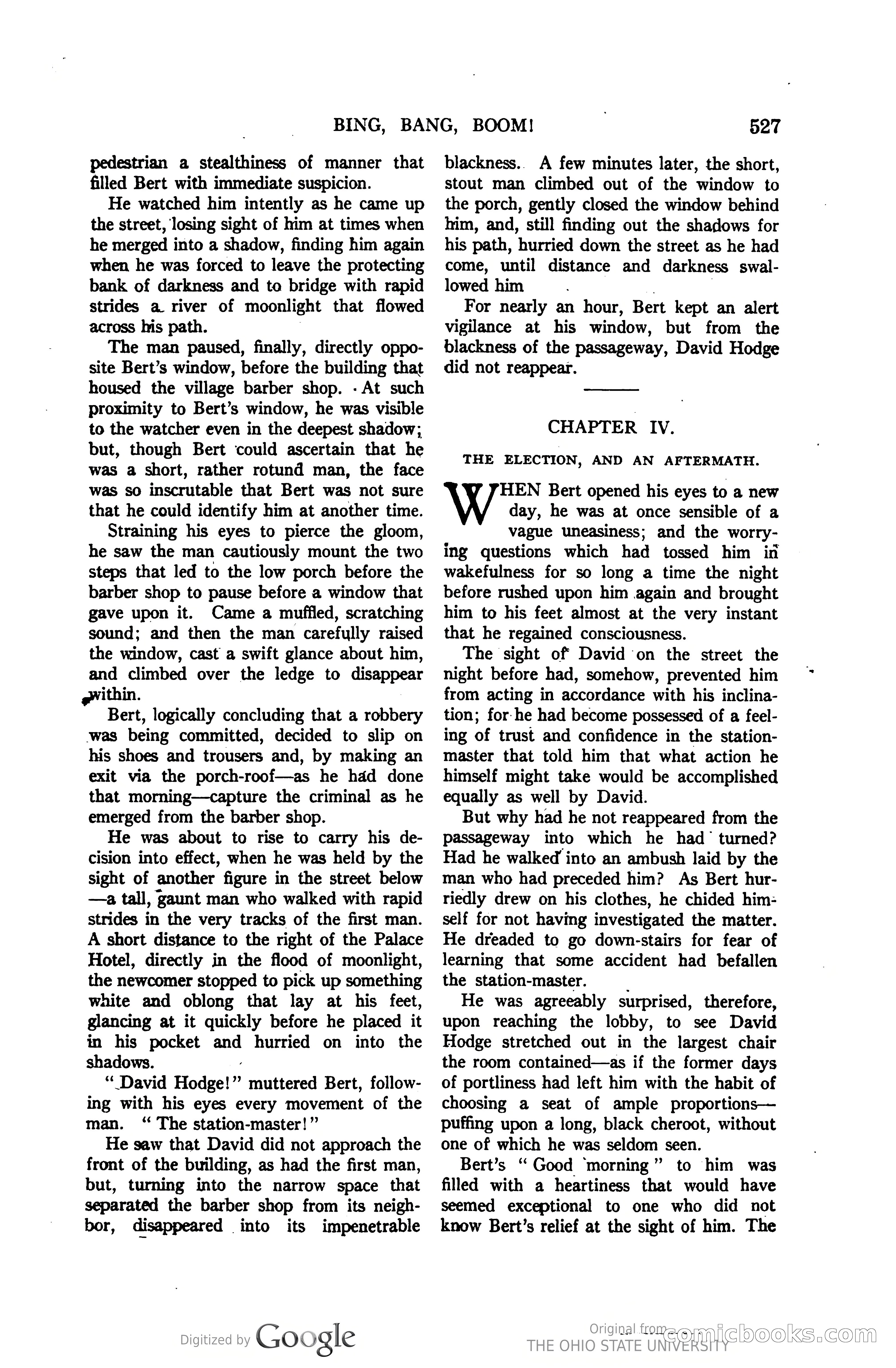
A restored page from Pulp Fiction, 1920. Page through the whole issue in the reader above.
📄 Transcribed text from this page (OCR, searchable)
Machine-transcribed from the original scan — historical spelling and the odd misread are preserved.
BING, BANG, BOOM! pedestrian a stealthiness of manner that filled Bert with immediate suspicion. He watched him intently as he came up the street, losing sight of him at times when he merged into a shadow, finding him again when he was forced to leave the protecting bank of darkness and to bridge with rapid Strides a river of moonlight that flowed across his path. The man paused, finally, directly oppo- site Bert’s window, before the building that housed the village barber shop. - At such proximity to Bert’s window, he was visible to the watcher even in the deepest shadow; but, though Bert could ascertain that he was a short, rather rotund man, the face was so inscrutable that Bert was not sure that he could identify him at another time. Straining his eyes to pierce the gloom, he saw the man cautiously mount the two steps that led to the low porch before the barber shop to pause before a window that gave upon it. Came a muffled, scratching sound; and then the man carefully raised the window, cast a swift glance about him, and climbed over the ledge to dissppear evithin. Bert, logically concluding that a robbery ‘was being committed, decided to slip on his shoes and trousers and, by making an exit via the porch-roof—as he hdd done that morning—capture the criminal as he emerged from the barber shop. He was about to rise to carry his de- cision into effect, when he was held by the sight of another figure in the street below —a tall, gaunt man who walked with rapid strides in the very tracks of the first man. A short distance to the right of the Palace Hotel, directly in the flood of moonlight, the newcomer stopped to pick up something white and oblong that lay at his feet, glancing at it quickly before he placed it in his pocket and hurried on into the shadows. “ David Hodge!” muttered Bert, follow- ing with his eyes every movement of the man. “ The station-master!” He saw that David did not approach the front of the building, as had the first man, but, turning into the narrow space that separated the barber shop from its neigh- bor, disappeared into its impenetrable 527 blackness.. A few minutes later, the short, stout man climbed out of the window to the porch, gently closed the window behind him, and, still finding out the shadows for his path, hurried down the street as he had come, until distance and darkness swal- lowed him For nearly an hour, Bert kept an alert Vigilance at his window, but from the blackness of the passageway, David Hodge did not reappear. CHAPTER IV. THE ELECTION, AND AN AFTERMATH. HEN Bert opened his eyes to a new day, he was at once sensible of a vague uneasiness; and the worry- ing questions which had tossed him in wakefulness for so long a time the night before rushed upon him again and brought him to his feet almost at the very instant that he regained consciousness. The sight of David on the street the night before had, somehow, prevented him from acting in accordance with his inclina- tion; for he had become possessed of a feel- ing of trust and confidence in the station- master that told him that what action he himself might take would be accomplished equally as well by David. But why had he not reappeared from the passageway into which he had turned? Had he walked into an ambush laid by the man who had preceded him? As Bert hur- riedly drew on his clothes, he chided him- self for not having investigated the matter. He dreaded to go down-stairs for fear of learning that some accident had befallen the station-master. He was agreeably surprised, therefore, upon reaching the lobby, to see David Hodge stretched out in the largest chair the room contained—as if the former days of portliness had left him with the habit of choosing a seat of ample proportions— puffing upon a long, black cheroot, without one of which he was seldom seen. Bert’s “ Good ‘morning” to him was filled with a heartiness that would have seemed exceptional to one who did not know Bert’s relief at the sight of him. The IO oATE UR HU CLDOO THE OH S CO