
Pulp Fiction, 1920 · page 56 of 200
Argosy All-Story Weekly, Vol. 123, No. 4 — page 56: what you’re looking at
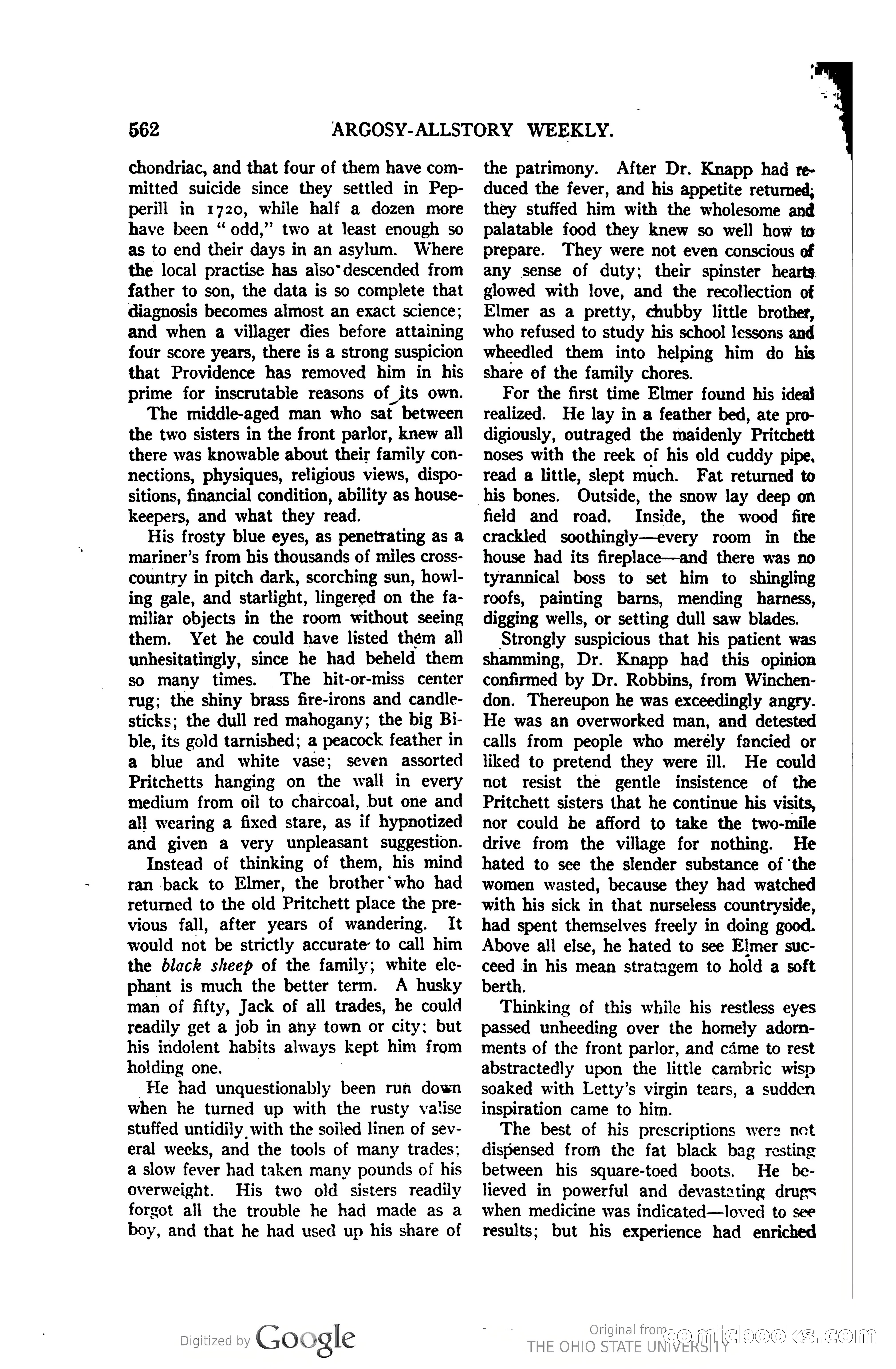
A restored page from Pulp Fiction, 1920. Page through the whole issue in the reader above.
📄 Transcribed text from this page (OCR, searchable)
Machine-transcribed from the original scan — historical spelling and the odd misread are preserved.
562 chondriac, and that four of them have com- mitted suicide since they settled in Pep- perill in 1720, while half a dozen more have been “ odd,” two at least enough so as to end their days in an asylum. Where the local practise has also*descended from father to son, the data is so complete that diagnosis becomes almost an exact science; and when a villager dies before attaining four score years, there is a strong suspicion that Providence has removed him in his prime for inscrutable reasons of_jits own. The middle-aged man who sat between the two sisters in the front parlor, knew all there was knowable about their family con- nections, physiques, religious views, dispo- sitions, financial condition, ability as house- keepers, and what they read. His frosty blue eyes, as penetrating as a mariner’s from his thousands of miles cross- country in pitch dark, scorching sun, howl- ing gale, and starlight, lingered on the fa- miliar objects in the room without seeing them. Yet he could have listed them all unhesitatingly, since he had beheld them so many times. The hit-or-miss center rug; the shiny brass fire-irons and candle- sticks; the dull red mahogany; the big Bi- ble, its gold tarnished; a peacock feather in a blue and white vase; seven assorted Pritchetts hanging on the wall in every medium from oil to charcoal, but one and all wearing a fixed stare, as if hypnotized and given a very unpleasant suggestion. Instead of thinking of them, his mind ran back to Elmer, the brother’ who had returned to the old Pritchett place the pre- vious fall, after years of wandering. It would not be strictly accurate to call him the black sheep of the family; white ele- phant is much the better term. A husky man of fifty, Jack of all trades, he could readily get a job in any town or city; but his indolent habits always kept him from holding one. : He had unquestionably been run down when he turned up with the rusty vatise stuffed untidily with the soiled linen of sev- eral weeks, and the tools of many trades; a slow fever had taken many pounds of his overweight. His two old sisters readily forgot all the trouble he had made as a boy, and that he had used up his share of ARGOSY-ALLSTORY WEEKLY. his bones. the patrimony. After Dr. Knapp had re- duced the fever, and his appetite returned, they stuffed him with the wholesome and palatable food they knew so well how to prepare. They were not even conscious of any sense of duty; their spinster hearts glowed with love, and the recollection of Elmer as a pretty, chubby little brother, who refused to study his school lessons and wheedled them into helping him do his share of the family chores. For the first time Elmer found his ideal realized. He lay in a feather bed, ate pro- digiously, outraged the maidenly Pritchett noses with the reek of his old cuddy pipe, read a little, slept much. Fat returned to Outside, the snow lay deep on field and road. Inside, the wood fire crackled soothingly—every room in the house had its fireplace—and there was no tyrannical boss to set him to shingling roofs, painting barns, mending harness, digging wells, or setting dull saw blades. Strongly suspicious that his patient was shamming, Dr. Knapp had this opinion confirmed by Dr. Robbins, from Winchen- don. Thereupon he was exceedingly angry. He was an overworked man, and detested calls from people who merely fancied or liked to pretend they were ill. He could not resist the gentle insistence of the Pritchett sisters that he continue his visits, nor could he afford to take the two-mile drive from the village for nothing. He hated to see the slender substance of ‘the women wasted, because they had watched with his sick in that nurseless countryside, had spent themselves freely in doing good. Above all else, he hated to see Elmer suc- ceed in his mean stratagem to hold a soft berth. Thinking of this while his restless eyes passed unheeding over the homely adorn- ments of the front parlor, and c‘ime to rest abstractedly upon the little cambric wisp soaked with Letty’s virgin tears, a sudden inspiration came to him. The best of his prescriptions were nct dispensed from the fat black bag resting between his square-toed boots. He be- lieved in powerful and devastating drugs when medicine was indicated—loved to see results; but his experience had enriched Origina | tr O NG o G 6) OO S =) CO