
Pulp Fiction, 1919 · page 116 of 196
Argosy and Railroad Man's Magazine, Vol. 107 No. 3 — page 116: what you’re looking at
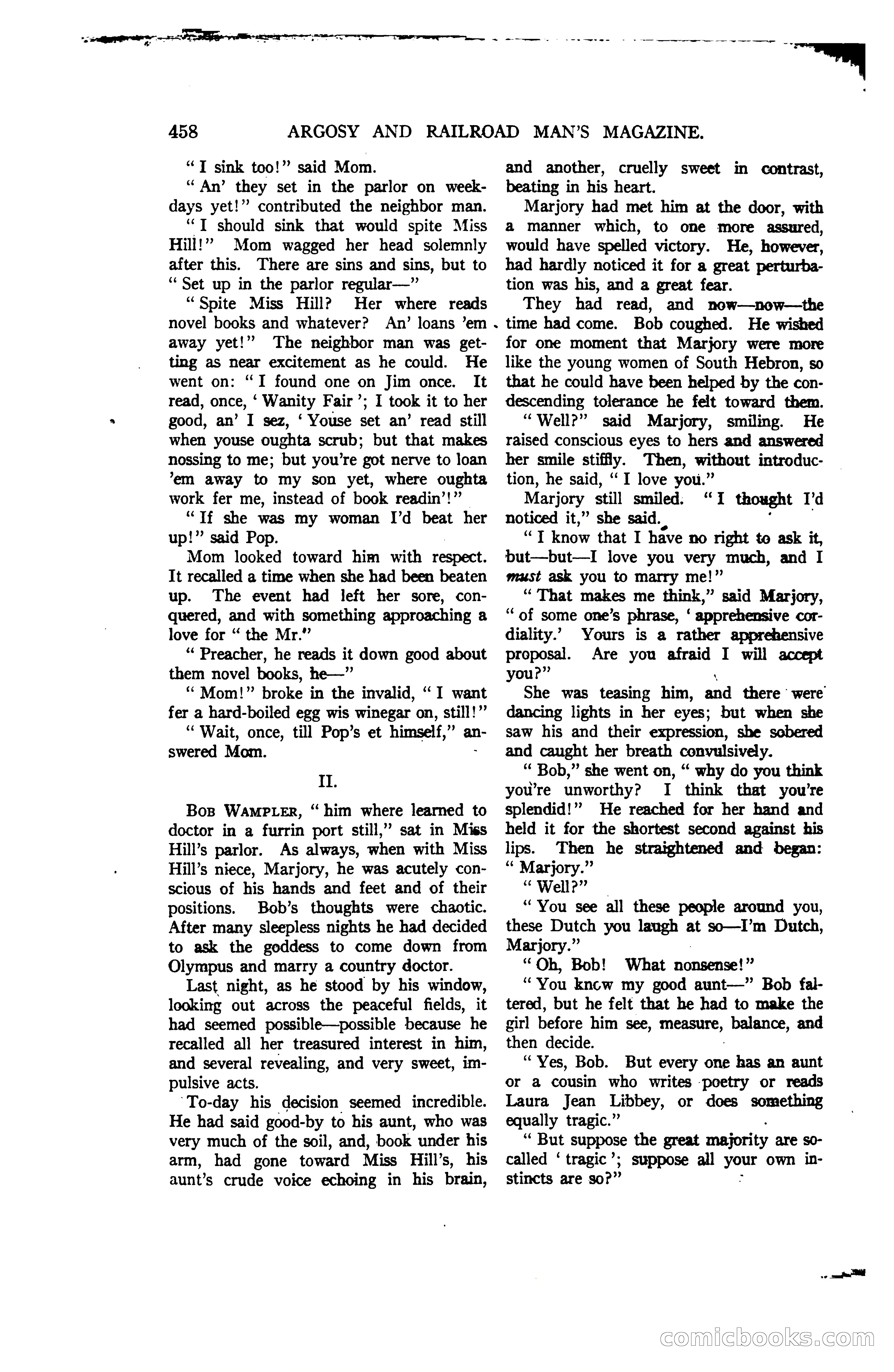
A restored page from Pulp Fiction, 1919. Page through the whole issue in the reader above.
📄 Transcribed text from this page (OCR, searchable)
Machine-transcribed from the original scan — historical spelling and the odd misread are preserved.
458 “T sink too!” said Mom. ‘An’ they set in the parlor on week- days yet!” contributed the neighbor man. ‘‘T should sink that would spite Miss Hill!” Mom wagged her head solemnly after this. There are sins and sins, but to ‘“‘ Set up in the parlor regular—”’ “Spite Miss Hill? Her where reads novel books and whatever? away yet!” The neighbor man was get- ting as near excitement as he could. He went on: “I found one on Jim once. It read, once, ‘ Wanity Fair’; I took it to her good, an’ I sez, ‘ Youse set an’ read still when youse oughta scrub; but that makes hossing to me; but youre got nerve to loan ’em away to my son yet, where oughta work fer me, instead of book readin’!”’ “If she was my woman I’d beat her up!” said Pop. Mom looked toward him with respect. It recalled a time when she had been beaten up. The event had left her sore, con- quered, and with something approaching a love for “ the Mr.” “‘ Preacher, he reads it down good about them novel books, he—”’ “Mom!” broke in the invalid, “I want fer a hard-boiled egg wis winegar on, still!” “Wait, once, till Pop’s et himself,” an- swered Mom. II. Bos WAMPLER, “ him where learned to doctor in a furrin port still,” sat in Miss Hill’s parlor. As always, when with Miss Hill’s niece, Marjory, he was acutely con- scious of his hands and feet and of their positions. Bob’s thoughts were chaotic. After many sleepless nights he had decided to ask the goddess to come down from Olympus and marry a country doctor. Last night, as he stood by his window, looking out across the peaceful fields, it had seemed possible—possible because he recalled all her treasured interest in him, and several revealing, and very sweet, im- pulsive acts. ‘To-day his decision seemed incredible. He had said good-by to his aunt, who was very much of the soil, and, book under his arm, had gone toward Miss Hill’s, his aunt’s crude voice echoing in his brain, An’ loans ’em . ARGOSY AND RAILROAD MAN’S MAGAZINE. and another, cruelly sweet in contrast, beating in his heart. Marjory had met him at the door, with a manner which, to one more assured, would have spelled victory. He, however, had hardly noticed it for a great perturba- tion was his, and a great fear. They had read, and now—now—the time had come. Bob coughed. He wished for one moment that Marjory were more like the young women of South Hebron, so that he could have been helped by the con- descending tolerance he felt toward them. “Well?” said Marjory, smiling. He raised conscious eyes to hers and answered her smile stiffly. Then, without introduc- tion, he said, “‘ I love you.” Marjory still smiled. ‘I thought I'd noticed it,” she said. “T know that I have no right to ask it, but—but—I love you very much, and I must ask you to marry me!” “That makes me think,” said Marjory, “of some one’s phrase, ‘ apprehensive cor- diality.’ Yours is a rather apprehensive proposal. Are you afraid I will accept you?” She was teasing him, nil there were dancing lights in her eyes; but when she saw his and their expression, she sobered and caught her breath convulsively. ‘* Bob,” she went on, “ why do you think you’re unworthy? I think that you're splendid!”» He reached for her hand and held it for the shortest second against his lips. Then he straightened and began: oc Marjory.” “You see all these people around you, these Dutch you laugh at so—I’m Dutch, Marjory.” . “Oh, Bob! What nonsense!” “You kncw my good aunt—” Bob fal- tered, but he felt that he had to make the girl before him see, measOre, balance, and then decide. “Yes, Bob. But every one has an aunt or a cousin who writes poetry or reads Laura Jean Libbey, or does something equally tragic.” “ But suppose the great majority are S0- called ‘ tragic’; suppose all your own in- stincts are 30?” . COMICEDOO S CO inn