
Pulp Fiction, 1919 · page 12 of 196
Argosy and Railroad Man's Magazine, Vol. 107 No. 3 — page 12: what you’re looking at
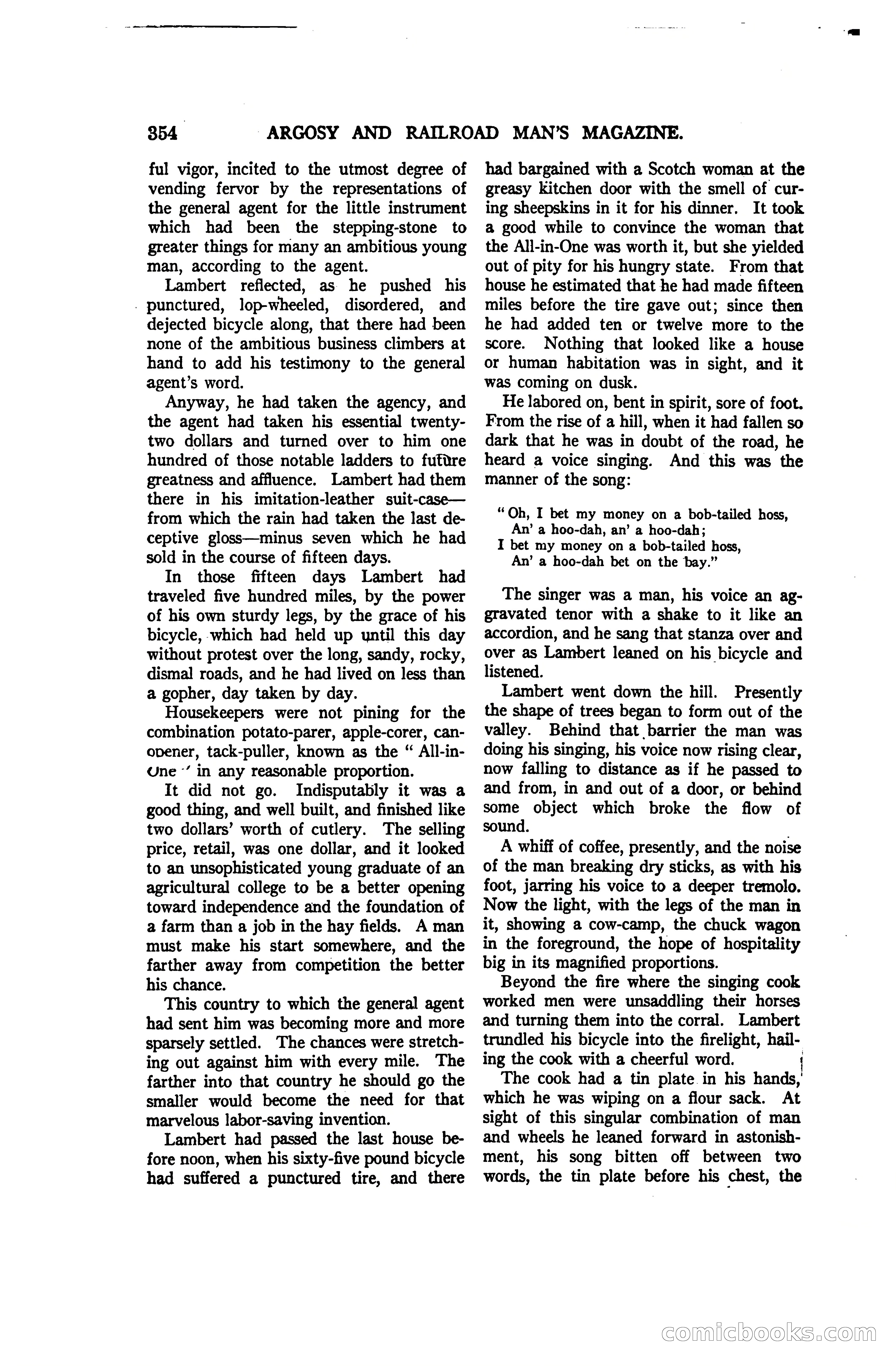
A restored page from Pulp Fiction, 1919. Page through the whole issue in the reader above.
📄 Transcribed text from this page (OCR, searchable)
Machine-transcribed from the original scan — historical spelling and the odd misread are preserved.
354 ful vigor, incited to the utmost degree of vending fervor by the representations of the general agent for the little instrument which had been the stepping-stone to greater things for many an ambitious young man, according to the agent. Lambert reflected, as he pushed his . punctured, lop-wheeled, disordered, and dejected bicycle along, that there had been none of the ambitious business climbers at hand to add his testimony to the general agent’s word. Anyway, he had taken the agency, and the agent had taken his essential twenty- two dollars and turned over to him one hundred of those notable ladders to futire greatness and affluence. Lambert had them there in his imitation-leather suit-case— from which the rain had taken the last de- ceptive gloss—minus seven which he had sold in the course of fifteen days. In those fifteen days Lambert had traveled five hundred miles, by the power of his own sturdy legs, by the grace of his bicycle, -which had held up until this day without protest over the long, sandy, rocky, dismal roads, and he had lived on less than a gopher, day taken by day. Housekeepers were not pining for the combination potato-parer, apple-corer, can- opener, tack-puller, known as the “ All-in- Une *’ in any reasonable proportion. It did not go. Indisputably it was a good thing, and well built, and finished like two dollars’ worth of cutlery. The selling price, retail, was one dollar, and it looked to an unsophisticated young graduate of an agricultural college to be a better opening toward independence and the foundation of a farm than a job in the hay fields. A man must make his start somewhere, and the farther away from competition the better his chance. This country to which the general agent had sent him was becoming more and more sparsely settled. The chances were stretch- ing out against him with every mile. The farther into that country he should go the smaller would become the need for that marvelous labor-saving invention. Lambert had passed the last house be- fore noon, when his sixty-five pound bicycle had suffered a punctured tire, and there -ARGOSY AND RAILROAD MAN’S MAGAZINE. had bargained with a Scotch woman at the greasy Kitchen door with the smell of cur- ing sheepskins in it for his dinner. It took a good while to convince the woman that the All-in-One was worth it, but she yielded out of pity for his hungry state. From that house he estimated that he had made fifteen miles before the tire gave out; since then he had added ten or twelve more to the score. Nothing that looked like a house or human habitation was in sight, and it was coming on dusk. He labored on, bent in spirit, sore of foot. From the rise of a hill, when it had fallen so dark that he was in doubt of the road, he heard a voice singing. And this was the manner of the song: “Oh, I bet my money on a bob-tailed hoss, An’ a hoo-dah, an’ a hoo-dah; I bet my money on a bob-tailed hoss, An’ a hoo-dah bet on the bay.” The singer was a man, his voice an ag- gravated tenor with a shake to it like an accordion, and he sang that stanza over and over as Lambert leaned on his bicycle and listened. Lambert went down the hill. Presently the shape of trees began to form out of the valley. Behind that barrier the man was doing his singing, his voice now rising clear, now falling to distance as if he passed to and from, in and out of a door, or behind some object which broke the flow of sound. A whiff of coffee, presently, and the noise of the man breaking dry sticks, as with his foot, jarring his voice to a deeper tremolo. Now the light, with the legs of the man in it, showing a cow-camp, the chuck wagon in the foreground, the hope of hospitality big in its magnified proportions. Beyond the fire where the singing cook worked men were unsaddling their horses and turning them into the corral. Lambert trundled his bicycle into the firelight, hail- ing the cook with a cheerful word. The cook had a tin plate in his hands, which he was wiping on a flour sack. At sight of this singular combination of man and wheels he leaned forward in astonish- ment, his song bitten off between two words, the tin plate before his chest, the COMICEDOO© ‘eo S (C(O) mM