
Pulp Fiction, 1919 · page 138 of 196
Argosy and Railroad Man's Magazine, Vol. 107 No. 3 — page 138: what you’re looking at
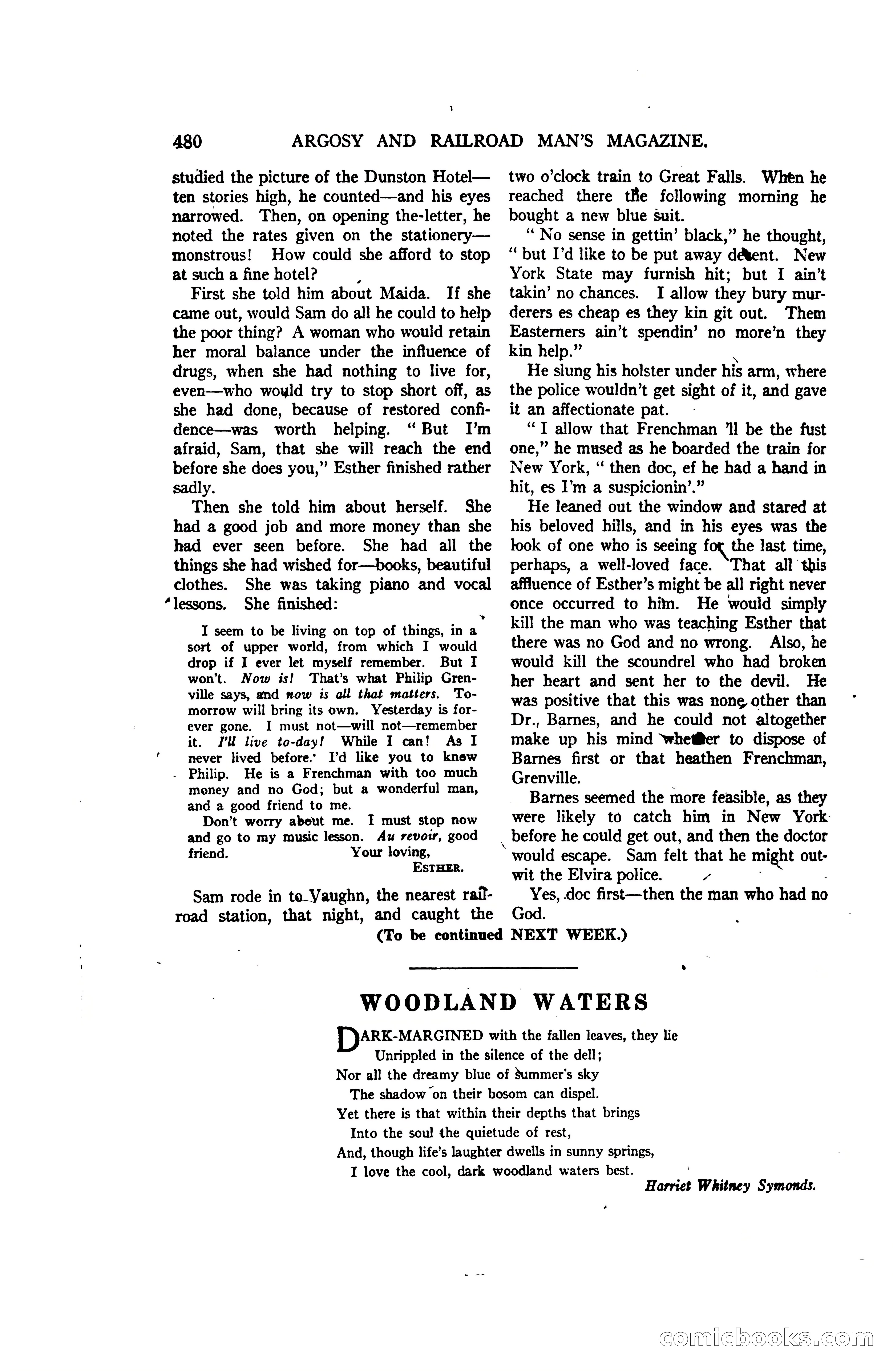
A restored page from Pulp Fiction, 1919. Page through the whole issue in the reader above.
📄 Transcribed text from this page (OCR, searchable)
Machine-transcribed from the original scan — historical spelling and the odd misread are preserved.
480 studied the picture of the Dunston Hotel— ten stories high, he counted—and his eyes narrowed. Then, on opening the-letter, he noted the rates given on the stationery— monstrous! How could she afford to stop at such a fine hotel? ; First she told him about Maida. If she came out, would Sam do all! he could to help the poor thing? A woman who would retain her moral balance under the influence of drugs, when she had nothing to live for, even—who woyld try to stop short off, as she had done, because of restored confi- dence—was worth helping. “ But I’m afraid, Sam, that she will reach the end before she does you,” Esther finished rather sadly. Then she told him about herself. She had a good job and more money than she had ever seen before. She had all the things she had wished for—books, beautiful clothes. She was taking piano and vocal “lessons. She finished: I seem to be living on top of things, in a sort of upper world, from which I would drop if I ever let myself remember. But I won't. Now is! That’s what Philip Gren- ville says, and mow is all that matters. To- morrow will bring its own. Yesterday is for- ever gone. I must not—will not—remember it. J’ live to-day! While I can! As I never lived before.” I’d like you to knew . Philip. He is a Frenchman with too much money and no God; but a wonderful man, and a good friend to me. Don’t worry about me. I must stop now and go to my music lesson. Au revoir, good friend. Your loving, ESTHER. Sam rode in to_Vaughn, the nearest rail- road station, that night, and caught the ARGOSY AND RAILROAD MAN’S MAGAZINE, two o’clock train to Great Falls. When he reached there tHe following morning he bought a new blue suit. “No sense in gettin’ black,” he thought, “but I'd like to be put away déwent. New York State may furnish hit; but I ain’t takin’ no chances. I allow they bury mur- derers es cheap es they kin git out. Them Easterners ain’t spendin’ no more’n they kin help.” . He slung his holster under his arm, where the police wouldn’t get sight of it, and gave it an affectionate pat. “T allow that Frenchman Il be the fust one,” he mused as he boarded the train for New York, “‘ then doc, ef he had a hand in hit, es I’m a suspicionin’.” He leaned out the window and stared at his beloved hills, and in his eyes was the look of one who is seeing for the last time, perhaps, a well-loved face. ‘That all this affluence of Esther’s might be all right never once occurred to him. He would simply kill the man who was teaching Esther that there was no God and no wrong. Also, he would kill the scoundrel who had broken her heart and sent her to the devil. He was positive that this was none other than Dr., Barnes, and he could not altogether make up his mind wheter to dispose of Barnes first or that heathen Frenchman, Grenville. Barnes seemed the more feasible, as they were likely to catch him in New York: _ before he could get out, and then the doctor would escape. Sam felt that he might out- wit the Elvira police. A Yes, doc first—then the man who had no God. (To be continued NEXT WEEK.) WOODLAND WATERS ARK-MARGINED with the fallen leaves, they lie Unrippled in the silence of the dell; Nor all the dreamy blue of Summer's sky The shadow on their bosom can dispel. Yet there is that within their depths that brings Into the soul the quietude of rest, And, though life’s laughter dwells in sunny springs, I love the cool, dark woodland waters best. Harriet Whitney Symonds. é cConniclooolks (C(O) in