
Pulp Fiction, 1919 · page 25 of 196
Argosy and Railroad Man's Magazine, Vol. 107 No. 3 — page 25: what you’re looking at
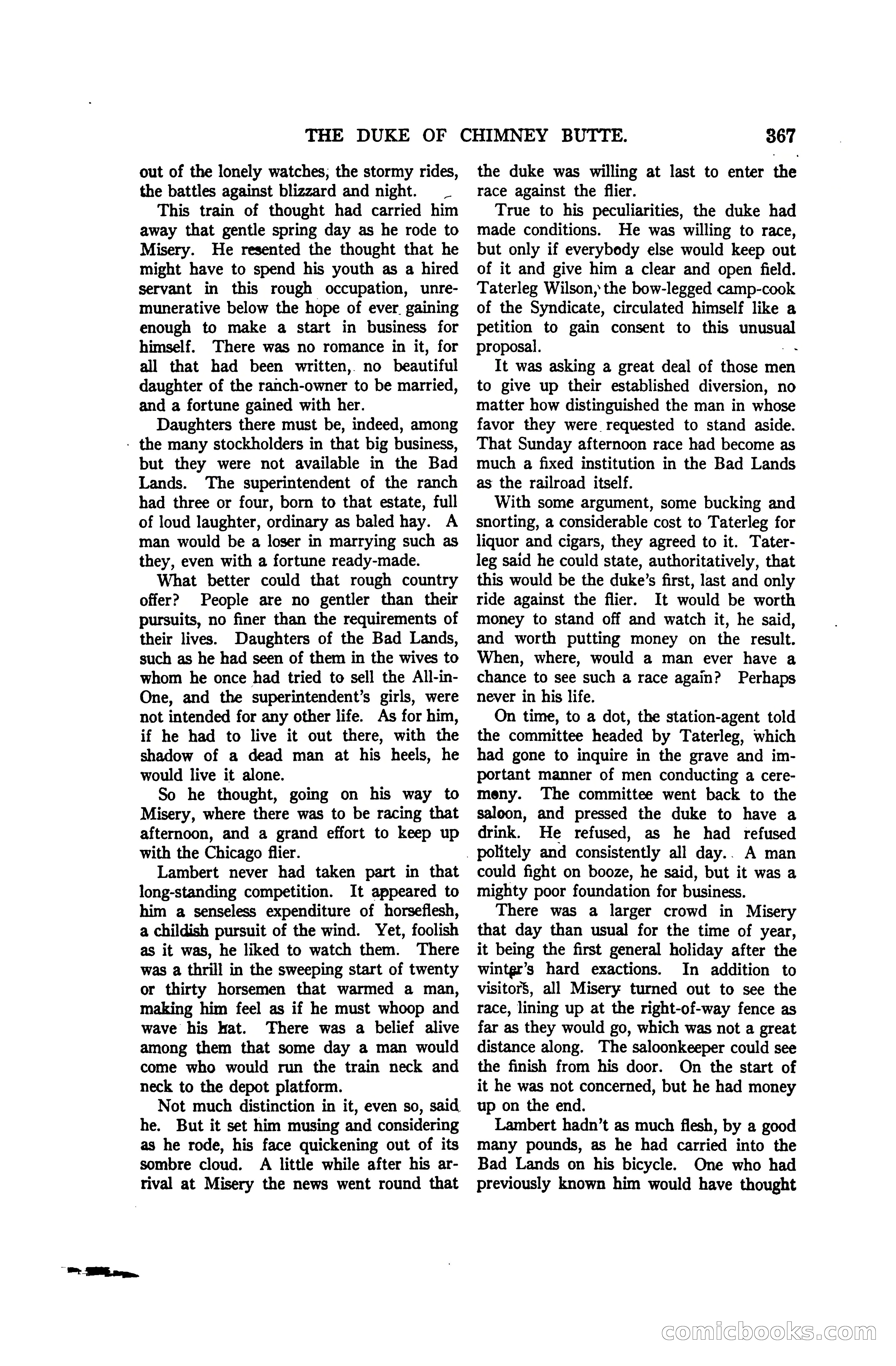
A restored page from Pulp Fiction, 1919. Page through the whole issue in the reader above.
📄 Transcribed text from this page (OCR, searchable)
Machine-transcribed from the original scan — historical spelling and the odd misread are preserved.
THE DUKE OF CHIMNEY BUTTE. out of the lonely watches; the stormy rides, the battles against blizzard and night. _ This train of thought had carried him away that gentle spring day as he rode to Misery. He resented the thought that he might have to spend his youth as a hired servant in this rough occupation, unre- munerative below the hope of ever gaining enough to make a start in business for himself. There was no romance in it, for all that had been written, no beautiful daughter of the ranch-owner to be married, and a fortune gained with her. Daughters there must be, indeed, among - the many stockholders in that big business, but they were not available in the Bad Lands. The superintendent of the ranch had three or four, born to that estate, full of loud laughter, ordinary as baled hay. A man would be a loser in marrying such as they, even with a fortune ready-made. What better could that rough country offer? People are no gentler than their pursuits, no finer than the requirements of their lives. Daughters of the Bad Lands, such as he had seen of them in the wives to whom he once had tried to sell the All-in- One, and the superintendent’s girls, were not intended for any other life. As for him, if he had to live it out there, with the shadow of a dead man at his heels, he would live it alone. So he thought, going on his way to Misery, where there was to be racing that afternoon, and a grand effort to keep up with the Chicago flier. Lambert never had taken part in that long-standing competition. It appeared to him a senseless expenditure of horseflesh, a childish pursuit of the wind. Yet, foolish as it was, he liked to watch them. There was a thrill in the sweeping start of twenty or thirty horsemen that warmed a man, making him feel as if he must whoop and wave his hat. ‘There was a belief alive among them that some day a man would come who would run the train neck and neck to the depot platform. Not much distinction in it, even so, said he. But it set him musing and considering as he rode, his face quickening out of its sombre cloud. A little while after his ar- rival at Misery the news went round that | FE ae. 367 the duke was willing at last to enter the race against the flier. True to his peculiarities, the duke had made conditions. He was willing to race, but only if everybody else would keep out of it and give him a clear and open field. Taterleg Wilson, the bow-legged camp-cook of the Syndicate, circulated himself like a petition to gain consent to this unusual proposal. a It was asking a great deal of those me to give up their established diversion, no matter how distinguished the man in whose favor they were requested to stand aside. That Sunday afternoon race had become as much a fixed institution in the Bad Lands as the railroad itself. With some argument, some bucking and snorting, a considerable cost to Taterleg for liquor and cigars, they agreed to it. Tater- leg said he could state, authoritatively, that this would be the duke’s first, last and only ride against the flier. It would be worth money to stand off and watch it, he said, and worth putting money on the result. When, where, would a man ever have a chance to see such a race again? Perhaps never in his life. On time, to a dot, the station-agent told the committee headed by Taterleg, which had gone to inquire in the grave and im- portant manner of men conducting a cere- meny. ‘The committee went back to the saloon, and pressed the duke to have a drink. He refused, as he had refused _ politely and consistently all day.. A man could fight on booze, he said, but it was a mighty poor foundation for business. There was a larger crowd in Misery that day than usual for the time of year, it being the first general holiday after the wintgr’s hard exactions. In addition to visitors, all Misery turned out to see the race, lining up at the right-of-way fence as far as they would go, which was not a great distance along. The saloonkeeper could see the finish from his door. On the start of it he was not concerned, but he had money up on the end. Lambert hadn’t as much flesh, by a good many pounds, as he had carried into the Bad Lands on his bicycle. One who had previously known him would have thought COMICEDOO© ‘eo S Co mM